

 |
The East-West combination resulted in a disjointed U22 team. |
The second half of 2025 could be considered the darkest period for Indonesian football in many years. The high expectations built on a massive naturalization campaign, from ambitions to reach continental prominence to the dream of the 2026 World Cup, have all collapsed in the most painful ways.
The last six months of the year: when all calculations fail.
The failure in the 2026 World Cup qualifiers was the biggest blow. Indonesia entered the fourth round of qualifiers with a completely different mindset than before: a large squad of players of European origin, coach Patrick Kluivert with his past glory, and strong financial backing from President Erick Thohir.
However, two consecutive defeats against Saudi Arabia and Iraq quickly brought the Indonesian team back down to earth. The harsh reality shows that, even with mass naturalization, Indonesia still lags far behind the top teams in Asia in terms of mental strength, tactical thinking, and squad depth.
The problem isn't just about technical skill. The naturalization strategy is a costly gamble. Maintaining a team with many players of European origin requires a huge budget, from salaries and benefits to logistical expenses.
Without Erick Thohir's personal resources and political acumen, this model would hardly have lasted long. But even with continuous funding, the results were disproportionate, severely eroding fan confidence.
At the youth level, the situation is no better. Indonesia lost to Vietnam in the 2025 Southeast Asian U23 Championship final, and then succumbed to South Korea in the Asian U23 Championship qualifiers. Failing to qualify for the Asian U23 Championship finals is a clear step backward from their previous fourth-place finish in the continent. These results show a worrying gap emerging in Indonesian youth football, as the next generation of players is not reaching the same quality as the generation that won the 2023 SEA Games.
In the last six months of the year, from the national team to the U23 team, Indonesia suffered almost complete failure. The scattered victories were not enough to mask a bleak picture, where major policy decisions consistently yielded results contrary to expectations.
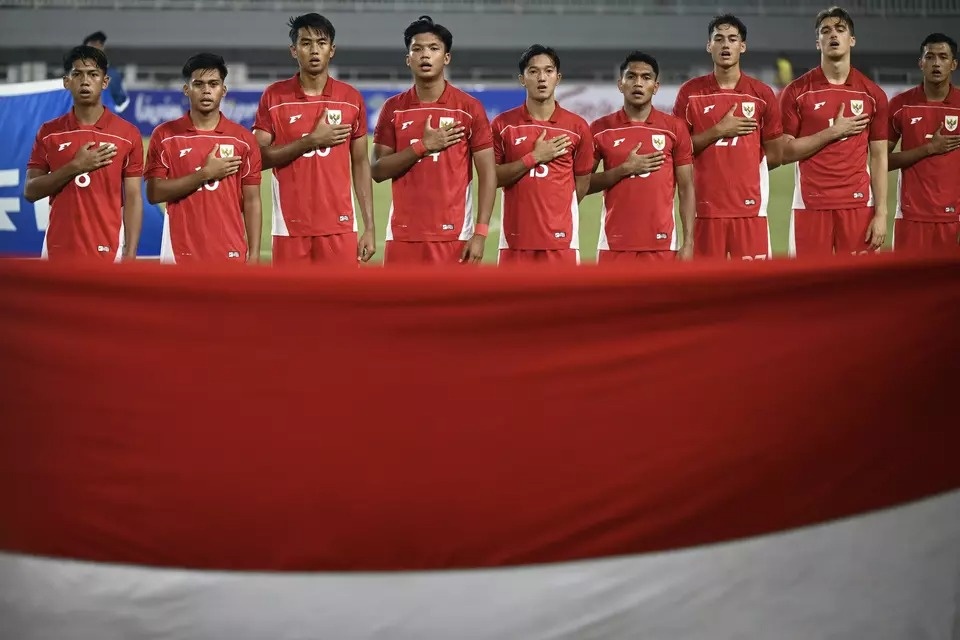 |
Exiting the SEA Games in the group stage was a shock for Indonesian football. |
SEA Games and the undeniable internal conflicts.
The 2025 SEA Games were supposed to be an opportunity for Indonesia to salvage its image after a dark period. Learning from previous failures, the coaching staff decided to add four naturalized players with "European flair" to the U22 squad, hoping to make a difference in the regional competition. But it was here that the internal conflicts of Indonesian football became most apparent.
The first problem lies in the difference in playing philosophy. Pure Indonesian players are accustomed to short passes, a moderate tempo, and an emphasis on individual technique. Meanwhile, players of European descent are strong in physique, speed, tackling ability, and direct play. These two styles do not blend but coexist, making the Indonesian team disjointed.
Coach Indra Sjafri faces a difficult dilemma. With a majority of the players being domestic, he is forced to build his playing style around them. However, the quality of this group of players is not good enough to control the game or create dominance. Indonesia had more possession but lacked ideas, their attacks lacked sharpness, and they were easily predictable by opponents, as seen in the match against the Philippines and the first half against Myanmar.
Only when faced with a hopeless situation did coach Sjafri accept the "all-in" approach, switching to a more pragmatic style of play, making the most of the advantages of the naturalized players. Long balls were used more frequently, and direct attacks became the main option. At that point, the Dutch-born striker, Jens Raven, was brought on in the middle of the second half and immediately scored two goals. But it was all too late. The change came as a reactive measure, not the result of a pre-planned strategy.
The failure at the SEA Games is not just a matter of professional performance, but also reflects a lack of unity in development strategy. Indonesia wants to both nurture domestic players and utilize naturalized players, but lacks a sufficiently clear philosophy to connect these two forces. When conflicts remain unresolved, the team easily falls into a state of "halfway," lacking the identity to create collective strength.
Looking at the bigger picture, the failure of Indonesian football in 2025 is not a temporary accident. It is the consequence of an unbalanced development process, where short-term decisions overshadow long-term problems. Without resolving internal conflicts and redefining its path, Indonesia is very likely to continue its downward spiral, despite massive investments and ambitious dreams.
Source: https://znews.vn/mau-thuan-noi-ngoai-khien-u22-indonesia-that-bai-tai-sea-games-post1611196.html









































































Comment (0)