

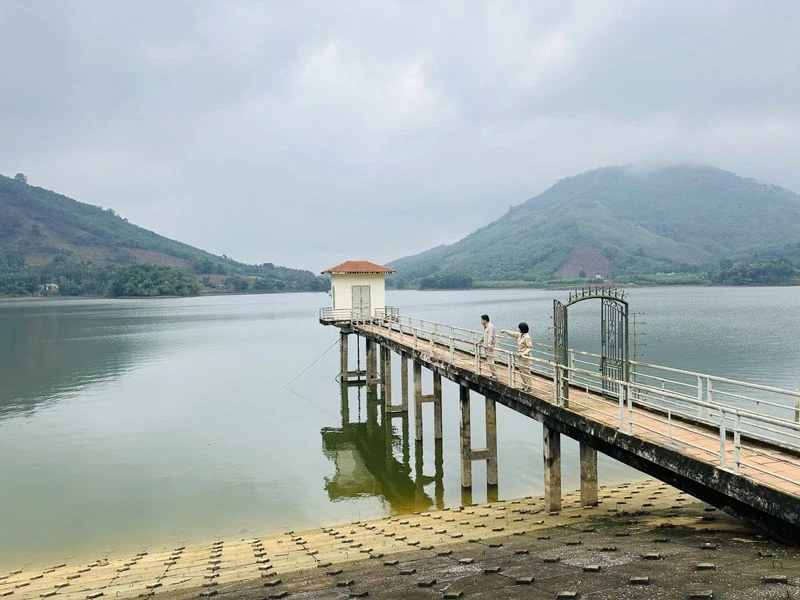
The Cong Khe reservoir, managed by the Ngoc Lac Irrigation Branch, has accumulated enough water according to its design to serve the upcoming spring-summer crop production.
The remaining structures managed by the communes in the area were mostly built before 1984. Many structures such as Hon Vat Lake, Bai Than Lake, Hang Rua Lake (Ngoc Lac commune), Hon Hang Lake, Vung Tho Lake, Bai Da Lake (Minh Son commune), Ban Nang Lake (Thach Lap commune)... have deteriorated, with siltation in the lakebeds, and many areas experiencing severe erosion and overflow damage, failing to serve production as designed.
To ensure the safety of reservoirs and dams, serving both production and the needs of the people, during the recent rainy season, the Ngoc Lac Irrigation Branch implemented flood and storm prevention plans based on the "four on-the-spot" principle for each project. They mobilized on-site reserve materials such as rocks, sandbags, steel gabions, and bamboo stakes for flood and storm prevention. They organized timely inspections, maintenance, and repairs to ensure the safety of reservoirs; and proactively stored water in reservoirs according to design. Engineers and technical workers were assigned to work in shifts at the project sites to address incidents and ensure timely operation to support agricultural production.
Proactively implementing solutions to ensure irrigation water supply for the upcoming spring-summer crop season, with the motto "The State and the People work together," the communes have invested funds, labor, and local materials to renovate and repair dozens of irrigation works; building sturdy internal field canals and main canals of irrigation reservoirs... During the dry months of 2025, the Ngoc Lac Irrigation Branch advised the communes in the area to mobilize the people to contribute labor to dredge internal field irrigation canals and fields, temporarily repair irrigation works that were degraded or damaged during recent storms and floods. They dredged and cleared the flow of canals, repaired minor damage to the works, and built embankments to retain water. In addition, the communes and villages also utilized their internal resources to construct temporary dams and small reservoirs to raise water from river and stream flows to support crop irrigation...
According to Le Dinh Thang, Director of the Ngoc Lac Irrigation Branch: “To overcome the consequences of the recent storms and floods, the branch has proactively inspected, maintained, repaired, and ensured the safety of reservoirs and dams, maximizing their effectiveness in serving production and people's lives. Currently, some irrigation dams such as Bai Du; Bai Nhan dam and canal... have been basically repaired. We have proactively dredged the canals under our management, with a total volume of over 413.4 cubic meters of soil and rock excavated and filled; ensuring smooth water flow from the headworks to the fields. We have developed and implemented irrigation plans for each project, such as managing reservoir and dam water resources in conjunction with water-saving irrigation; and regulating irrigation water from reservoirs in a scientific and rational manner.”
To improve irrigation, in the long term, it is recommended that the State continue to invest in the construction of new reservoirs and dams in mountainous areas according to the plan to increase water storage capacity and water exploitation for production. Building regulating reservoirs in low-lying areas will serve both water storage and drainage purposes, ensuring water security and supporting production. People need to actively plant and protect forests in the area, especially upstream protection forests, to ensure ecological balance, create water sources, and maintain water resources for reservoirs and dams serving production and daily life.
Text and photos: Nguyen Quan
Source: https://baothanhhoa.vn/trien-khai-cac-bien-phap-phuc-vu-nuoc-tuoi-san-xuat-nong-nghiep-271707.htm



















































































Comment (0)