

 |
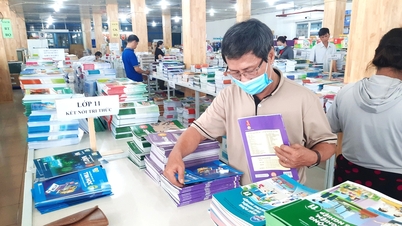
| Currently, the market offers three sets of textbooks based on the 2018 General Education Program. (Photo: Van Trang) |
Following the issuance of Resolution No. 71-NQ/TW by the Politburo , the policy of developing a unified set of textbooks for nationwide use has attracted significant attention from the public, education experts, and textbook developers. How to build upon the achievements of existing textbooks, leverage collective intelligence, and ensure scientific accuracy, feasibility, and social consensus – these are the questions facing the education sector in carrying out this strategically important and long-term task.
Resolution No. 71-NQ/TW on "Continuing the fundamental and comprehensive reform of education and training" clearly identified one of the key tasks: "Developing a unified set of textbooks for nationwide use, ensuring quality, continuity, scientific rigor, and relevance to practical realities."
This is a significant shift after nearly a decade of implementing the policy of socializing textbook compilation in accordance with Resolution 88/2014/QH13. Previously, multiple sets of textbooks coexisted to encourage creativity and diversify learning resources. Now, the requirement for unification demands a new approach – one that both builds upon and innovates, while addressing the shortcomings of the previous period.
On the morning of October 22nd, the National Assembly heard Minister of Education and Training Nguyen Kim Son present proposals on three draft laws: the Law amending and supplementing a number of articles of the Law on Education; the Law on Higher Education (amended); and the Law on Vocational Education (amended). Regarding the Law amending and supplementing a number of articles of the Law on Education, Minister Nguyen Kim Son stated that the draft institutionalizes several important contents of the Party, especially Resolution 71, such as stipulating that lower secondary education is compulsory, universal preschool education for children aged 3-5; stipulating a unified set of textbooks nationwide; and not organizing school councils in public educational institutions...
| "The success of the nationwide standardized textbook series lies in its ability to reflect the spirit of educational innovation of the era, inspire interest in learning, and cultivate character, abilities, and patriotism in Vietnamese students." |
Specifically, the State provides a unified set of textbooks for nationwide use. The Government mandates that textbooks be provided free of charge to students; implements appropriate socialized solutions regarding textbooks, ensuring sustainability and meeting the requirements for improving the quality of education, while ensuring compliance with the Party and State's policies and current practices.
According to experts, having multiple sets of textbooks has created a positive competitive environment, promoting innovation in textbook compilation methods and improving the quality and timeliness of learning materials. However, practical implementation has also revealed numerous difficulties: disparities in quality between sets of textbooks, inadequacies in textbook selection and use at the local level, and increased investment and teacher training costs. Therefore, the policy of unifying textbooks is a reasonable adjustment, based on a summary of practical experience and the need for synchronization of the national education system.
Many experts and educators have proposed various options for creating a unified set of textbooks for nationwide use. Three common approaches are: compiling a completely new set of textbooks, separate from the existing ones; selecting one of the three existing textbook sets as a basis, then upgrading and revising it into a unified set; and selecting the best textbooks for each subject from the existing sets to create a new set.
Each option has its own advantages and disadvantages. Choosing to compile entirely new textbooks could achieve consistency in structure, philosophy, and approach, but it would require significant time, funding, and manpower. Conversely, inheriting from existing textbooks would save resources while leveraging the achievements and experience of thousands of authors and educators who participated in the compilation. However, selecting and integrating different textbooks also places high demands on objectivity, transparency, and scientific rigor in the evaluation process.
Importantly, the quality and consistency of textbooks must remain the top priority, placed above all else. The goal is not just to have a "universal" set of textbooks, but a "standard" set in terms of content, structure, pedagogical methods, and educational value.
According to Associate Professor Dr. Le Huy Hoang, Deputy Director of the Education Department, Central Propaganda and Mass Mobilization Committee, regardless of the chosen option, the compilation process must ensure objectivity, transparency, and scientific rigor, especially when inheriting from existing textbooks; the quality and consistency of the textbooks must be the top priority, placed above all else; the reform principles of Resolution No. 71-NQ/TW must be fully reflected in the ideology, structure, content, pedagogical methods, and learning materials of the entire textbook series.
A unified set of textbooks should not be understood simply as a replacement or negation of existing textbooks. On the contrary, inheriting and developing the positive, innovative, and practical values from previous periods is the foundation for building a more complete set of textbooks.
According to many experienced educators, the current textbooks all possess commendable strengths, from their competency-based approach and interdisciplinary integration to their lively, modern, and student-friendly presentation. Selective inheritance of existing knowledge not only saves resources but also demonstrates respect for the collective intelligence and efforts of authors and teachers nationwide.
Furthermore, the digital learning resource system of current textbooks is also a valuable resource for building a unified textbook series that is open, multimedia-oriented, and supports teaching and learning in the digital age. From paper books to e-books, from images and videos to interactive lectures, everything can be integrated to form a comprehensive learning resource ecosystem serving learners nationwide.
| "A unified set of textbooks should not be understood simply as a replacement or negation of existing textbooks. On the contrary, inheriting and developing the good, innovative, and practical values from the previous period is the foundation for building a more complete set of textbooks." |
To achieve social consensus, the process of developing a unified set of textbooks must ensure scientific rigor, objectivity, and transparency at every stage: from defining the educational philosophy and goals; building the curriculum structure; organizing the author group; to the evaluation, testing, and publication process.
According to experts, a unified national council for textbook compilation and evaluation should be established, comprising scientists, educators, psychologists, sociologists, local representatives, and experienced teachers. Mobilizing the intellect of multiple stakeholders will help ensure that the textbooks are both scientifically sound and relevant to regional realities and the needs of learners.
The evaluation process also needs to be open, transparent, have an independent review mechanism, and widely solicit opinions from teachers, students, and parents before official publication. Only when society trusts that the textbooks were developed with a scientific, impartial, and transparent spirit can consensus be strengthened.
A unified set of textbooks for the 21st century is not just printed books. It is also a digital knowledge platform, connected to devices, online learning platforms, and modern teaching support tools. Therefore, compiling a unified set of textbooks needs to be placed within the context of the digital transformation of education, to ensure continuity while paving the way for the future.
All educational reforms can only be sustainable when there is social consensus. Developing a unified set of textbooks is a crucial issue, profoundly impacting tens of millions of students, teachers, parents, and society as a whole. Therefore, the implementation process requires clear and transparent communication, listening to feedback, and making appropriate adjustments.
The success of the nationwide standardized textbook series lies in its ability to reflect the spirit of educational innovation of the era, inspire interest in learning, and cultivate character, abilities, and patriotism in Vietnamese students.
From the guiding principles of Resolution 71-NQ/TW to concrete actions, the development of a unified set of textbooks is not merely a technical or academic task, but a profound political, cultural, and social undertaking. A unified set of textbooks will help ensure national knowledge standards, create fairness in access to learning materials across regions, and serve as an effective tool for spreading innovative, creative, and internationally integrated ideas in Vietnamese education.
Most importantly, in every stage from design and compilation to use, the spirit of "quality, consistency, scientific rigor, and humanism" must always be prioritized. This is the solid foundation for Vietnam to build a unified, modern, advanced set of textbooks that reflect national identity and best serve the generations of students today and tomorrow.
Source: https://baoquocte.vn/mot-bo-sach-giao-khoa-thong-nhat-toan-quoc-buoc-chuyen-lon-tu-chu-truong-den-hanh-dong-331875.html
![[Photo] Prime Minister Pham Minh Chinh receives Lao Minister of Education and Sports Thongsalith Mangnormek](/_next/image?url=https%3A%2F%2Fvphoto.vietnam.vn%2Fthumb%2F1200x675%2Fvietnam%2Fresource%2FIMAGE%2F2025%2F12%2F16%2F1765876834721_dsc-7519-jpg.webp&w=3840&q=75)

![[Live] 2025 Community Action Awards Gala](/_next/image?url=https%3A%2F%2Fvphoto.vietnam.vn%2Fthumb%2F1200x675%2Fvietnam%2Fresource%2FIMAGE%2F2025%2F12%2F16%2F1765899631650_ndo_tr_z7334013144784-9f9fe10a6d63584c85aff40f2957c250-jpg.webp&w=3840&q=75)
![[Photo] Prime Minister Pham Minh Chinh receives the Governor of Tochigi Province (Japan)](/_next/image?url=https%3A%2F%2Fvphoto.vietnam.vn%2Fthumb%2F1200x675%2Fvietnam%2Fresource%2FIMAGE%2F2025%2F12%2F16%2F1765892133176_dsc-8082-6425-jpg.webp&w=3840&q=75)
![[Image] Leaked images ahead of the 2025 Community Action Awards gala.](/_next/image?url=https%3A%2F%2Fvphoto.vietnam.vn%2Fthumb%2F1200x675%2Fvietnam%2Fresource%2FIMAGE%2F2025%2F12%2F16%2F1765882828720_ndo_br_thiet-ke-chua-co-ten-45-png.webp&w=3840&q=75)








































































Comment (0)