

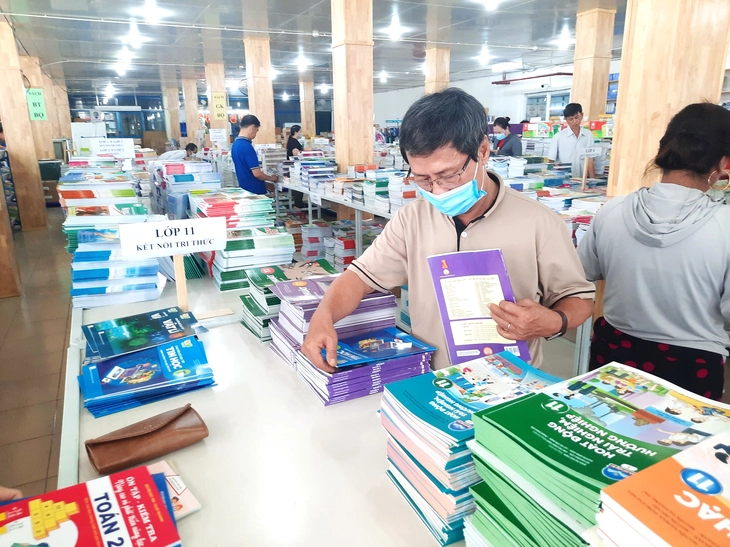
Parents buy textbooks at Ho Chi Minh City School Books and Equipment Joint Stock Company - Photo: NHU HUNG
However, precisely because of the strong determination and tight deadline, the technical, legal, and pedagogical challenges become immense. If rushed or driven by administrative inertia, the system could face costly adjustments and a shock to students and teachers.
Criteria for textbooks need to be established.
Despite their shortcomings, the three current sets of textbooks each have their own strengths. Some excel in thematic structure, others in their thought-provoking question systems, and some are highly regarded for their organization of learning activities or their teacher-friendliness.
However, with the rapid development of technology and the need for innovative methods, the future unified textbook series must take into account the element of an "integrated learning environment"—where printed books, digital learning materials, interactive exercises, learning data, and AI support operate together as an ecosystem. Therefore, a unified understanding of the objectives is needed to avoid going down the wrong path at the outset.
The key point is not to "choose one set to use universally," but rather to choose a way to distill the essence of all three sets onto a new pedagogical standard.
If done correctly, we will have a superior, unified set of textbooks; if done hastily, we will create a double waste: a waste of academic and pedagogical excellence, and a waste of the money and effort that society has invested.
The general sentiment is that established positive values cannot be allowed to become "abandoned public assets" simply because of a mechanical change in the management structure or selection mechanism.
From that perspective, the correct question is not about what format a set of textbooks should take, but rather what criteria should be used to prepare them. The most convincing step is to develop a new version of the National Textbook Evaluation Criteria with four pillars: accuracy and scientific integrity; pedagogical quality and the ability to develop higher-order thinking; inclusiveness - unbiased and appropriate for all regions; and the inclusion of digital learning materials, interactive exercises, digital assessment standards, and the ability to integrate technology into the teaching and learning process.
Of those four pillars, pedagogical quality must be the "primary pillar". The unified set of textbooks should be selected based on the logic of "student learning outcomes," not the logic of "publisher input."
The key criterion is not "which set is more familiar" or "which set is more popular," but rather "which book helps teachers teach more effectively, students learn more deeply, reduces rote learning, and increases real competence." Setting standards in this way will help the selection process avoid falling into "technical negotiation" without a sufficiently strong pedagogical standard to guide it.
Inheritance and development
Along with the new criteria, the textbook evaluation council needs to be restructured in an interdisciplinary direction. In the age of artificial intelligence (AI), a set of textbooks cannot be evaluated solely by subject experts and teachers in the traditional way.
The council needs more experts in AI and educational technology, competency assessment experts, digital learning material designers, data experts, experts in equality and inclusion, representatives from disadvantaged areas, and practicing teachers. This diversity will both increase the credibility of the decision and help identify the true value of each set of textbooks for selective adoption and revision.
The biggest challenge remains the requirement to replace textbooks simultaneously across all 12 grades. Given that the entire country is currently using three different sets of textbooks, a model of replacing them at the beginning of each grade level will struggle to completely resolve the discrepancies in content and teaching methods in a short period of time.
A more feasible solution is to create a "unified textbook version 2026" for all 12 grades, selectively inheriting the truly good parts of the current textbooks but all of them must be re-evaluated according to the new criteria.
To reduce "transition shock," transitional materials by subject and grade level are needed to bridge the gap between the three current textbooks and the unified textbook; at the same time, flexible teacher training is required, combining online and in-person instruction with a repository of illustrative lesson plans, sample learning materials, and assessment tools.
Preparing a unified set of textbooks should not be simply understood as choosing a single set from the three existing sets for nationwide use, but rather as a process of selection and integration based on a new pedagogical standard, suitable for an integrated learning environment and the age of AI.
By doing so, we will have a unified, feasible, and superior set of textbooks, while avoiding the waste of social resources and expertise, and preventing the risk of turning a sound policy into a mere mechanical decision.
Ensuring digital capabilities
The AI-related section of the new criteria should be understood in terms of genuine modernization: not just adding a few trendy elements, but ensuring digital competence, data-driven thinking, the ability to learn with AI tools, along with principles of safety, transparency, and academic ethics.
If AI is considered a new cognitive infrastructure for learners, standardized textbooks need to provide sufficiently clear suggestions on methods, task types, and assessment approaches so that teachers can implement them uniformly, without turning AI into a fad or a mere "labeling for advancement."
Source: https://tuoitre.vn/lam-mot-bo-sach-giao-khoa-cho-ca-nuoc-can-quy-trinh-tinh-tuyen-tich-hop-20251214231830191.htm


![[Photo] Two flights successfully landed and took off at Long Thanh Airport.](/_next/image?url=https%3A%2F%2Fvphoto.vietnam.vn%2Fthumb%2F1200x675%2Fvietnam%2Fresource%2FIMAGE%2F2025%2F12%2F15%2F1765808718882_ndo_br_img-8897-resize-5807-jpg.webp&w=3840&q=75)















































































Comment (0)