

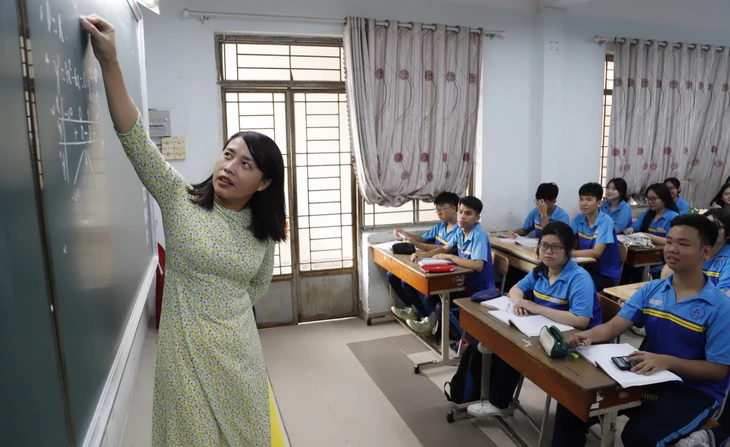
A math lesson for 12th grade students in class 12A5 at Ngo Quyen High School, Phu My Ward, Ho Chi Minh City - Photo: Nhu Hung
In addition, the National Assembly also passed a resolution on a number of special and outstanding mechanisms and policies to achieve breakthroughs in education and training development; and a resolution on the investment policy for the National Target Program on modernization and improvement of the quality of education and training for the period 2026-2035. These laws and resolutions will take effect from January 1, 2026.
Free textbooks for students.
One of the notable new points of the Law amending and supplementing a number of articles of the Law on Education is that from 2026 onwards, junior high school diplomas will no longer be issued, and there will be a unified set of textbooks nationwide.
Accordingly, the new law stipulates that diplomas of the national education system are documents in paper or digital form issued to students upon graduation from high school; students who complete educational programs, training programs and meet the output standards of the corresponding level in vocational education and higher education.
According to this law, diplomas of the national education system include high school diplomas, vocational high school diplomas, intermediate diplomas, college diplomas, bachelor's degrees, master's degrees, doctoral degrees, and diplomas from specialized training programs in certain specific fields and disciplines.
Thus, compared to current regulations, the newly amended law has abolished the issuance of junior high school graduation certificates. Instead, students who have completed the primary education program and the junior high school education program, and meet the requirements stipulated by the Minister of Education and Training , will have their academic records certified by the school principal as having completed the program.
Regarding regulations on textbooks, the law clearly states that " The Government shall regulate the provision of free textbooks for students." The Minister of Education and Training shall decide on a set of general education textbooks to be used uniformly nationwide.
The National Textbook Review Council is established by the Minister of Education and Training for each subject and educational activity to review textbooks. The Council and its members are responsible for the content and quality of the review.
The Minister of Education and Training approves textbooks for use in general education institutions after they have been appraised and classified by the National Council for Textbook Appraisal; and prescribes standards and procedures for compiling and editing general education textbooks.
Textbooks implementing the general education program concretize the requirements of the general education program regarding educational goals, content, and the required qualities and competencies of students; they provide guidance on teaching methods and ways to test and evaluate the quality of education; the content and format of textbooks do not contain prejudices based on ethnicity, religion, occupation, gender, age, and social status; textbooks are presented in printed books, Braille books, and e-books.
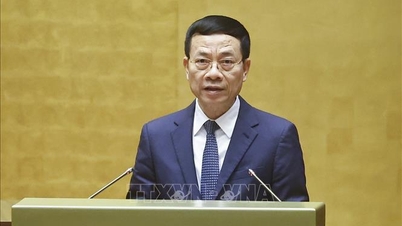
Earlier, presenting the report explaining and responding to feedback, Minister of Education and Training Nguyen Kim Son stated that many delegates agreed with the regulation that the Ministry of Education and Training should decide on a single set of textbooks for unified use nationwide, to be applied from the 2026-2027 school year. The State will provide the common set of textbooks free of charge, to be completed by 2030.
According to Mr. Son, the resolution on some specific and outstanding mechanisms and policies to achieve breakthroughs in education and training has stipulated more specifically the timeframe for implementing a unified set of textbooks for nationwide use, starting from the academic year.
2026-2027. Simultaneously, the State will provide a free set of textbooks for common use, to be completed by 2030, to ensure clarity and transparency in implementing the directives in Resolution 71 of the Politburo.
The government has taken note of the feedback and will study it to specify in regulations, legal guidelines, resolutions, and other documents under its authority the criteria for selecting textbooks, defining the scope of free textbooks, and managing accompanying books to ensure efficient use of the budget.
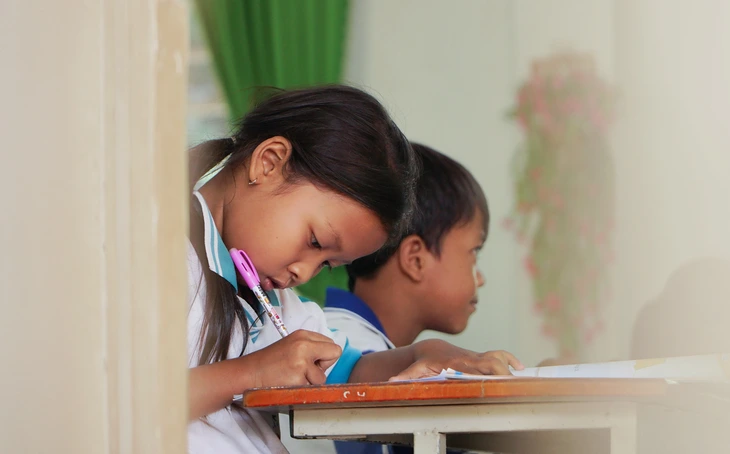
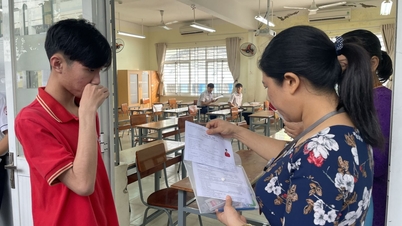
Students at Tan Dong Primary School, Tam Pho hamlet branch (Tan Dong commune, Tay Ninh province) during class - Photo: THU BUI
The Ministry of Health manages the training of resident and specialist doctors.
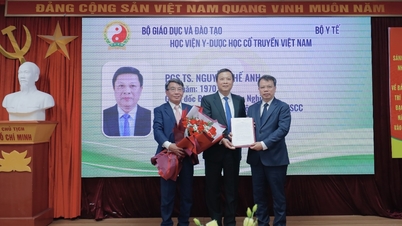
In the recently passed amended Law on Higher Education, a notable point emphasized is the group of topics related to postgraduate training leading to residency degrees, specialist doctor degrees (Level I and II) of the Ministry of Health, and the articulation between residency and specialist doctor degrees with doctoral and master's degrees.
Regarding this matter, the Government acknowledges and explains that the team of specialist doctors and resident doctors are highly competent individuals who have made significant contributions to the cause of caring for and protecting the health of the people, and deserve to be honored and receive appropriate treatment.
However, the recognition of equivalence between residency and specialist doctor degrees and master's or doctoral degrees currently lacks scientific basis and international precedent. Practice in various countries shows that educational systems clearly distinguish between degree-based training (master's, doctoral) and specialized practical training.
Master's and doctoral degrees belong to the academic training system with their own programs, learning outcomes, and regulations; while residency programs and specialist training programs (Level I and Level II) are recognized as intensive practical training specific to the medical field but do not belong to the postgraduate degree system.
In addition, the medical field continues to train master's and doctoral students and appoint academic titles such as associate professor and professor in accordance with current regulations.
Therefore, the Government has directed the Ministry of Education and Training and the Ministry of Health to research and discuss from a professional perspective and reach a consensus on the regulation that postgraduate advanced training programs in the health sector leading to residency and specialist doctor degrees will be guided, organized, and managed by the Ministry of Health. This regulation aims to strengthen the responsibility of the Ministry of Health in managing postgraduate advanced training in the health sector.
In addition, the regional university model remains unchanged, while the Government directs a review and streamlining of the model; promoting decentralization and reducing intermediate steps to ensure efficient operation and avoid creating new management levels.
Regarding university autonomy coupled with accountability, the Government stated that it has incorporated feedback on university autonomy and fully institutionalized its policies, ensuring full and comprehensive autonomy for higher education institutions regardless of their level of financial autonomy. The perspective has shifted from "autonomy means self-reliance" to a mechanism where the State and higher education institutions jointly care for the development of higher education.
Adding a vocational high school model.
The amended Vocational Education Law includes general provisions; regulations on the organization and management of vocational education institutions; training activities; lecturers, teachers, vocational instructors and learners; quality assurance and accreditation; cooperation with businesses; finance and assets; cooperation and investment in vocational education.
Notably, the new law perfects the national education system towards openness, flexibility, and interconnectedness, creating lifelong learning opportunities for all citizens through the addition of vocational high school models and the expansion of the target group participating in vocational education activities.
Vocational high schools are defined as being at the same educational level as regular high schools, integrating core knowledge from the high school curriculum with vocational skills to help students complete their general education.
Teachers will receive a minimum 70% increase in allowances.
The National Assembly also passed a resolution on a number of special and outstanding mechanisms and policies to create breakthroughs in the development of education and training, effective from January 1, 2026. Notably, the resolution stipulated special and outstanding policies on remuneration for human resources in the education sector.
Accordingly, the preferential allowance for vocational training will be implemented according to a roadmap stipulated by the Government for public preschool and general education institutions, with a minimum rate of 70% for teachers, a minimum rate of 30% for staff, and 100% for teachers working in areas with particularly difficult socio-economic conditions, ethnic minority areas, border areas, and islands.
Source: https://tuoitre.vn/quoc-hoi-thong-qua-ba-luat-moi-tao-buoc-ngoat-cho-giao-duc-tu-nam-2026-20251211093100855.htm
![[Photo] Closing Ceremony of the 10th Session of the 15th National Assembly](/_next/image?url=https%3A%2F%2Fvphoto.vietnam.vn%2Fthumb%2F1200x675%2Fvietnam%2Fresource%2FIMAGE%2F2025%2F12%2F11%2F1765448959967_image-1437-jpg.webp&w=3840&q=75)






























![[OFFICIAL] MISA GROUP ANNOUNCES ITS PIONEERING BRAND POSITIONING IN BUILDING AGENTIC AI FOR BUSINESSES, HOUSEHOLDS, AND THE GOVERNMENT](https://vphoto.vietnam.vn/thumb/402x226/vietnam/resource/IMAGE/2025/12/11/1765444754256_agentic-ai_postfb-scaled.png)



































Comment (0)