

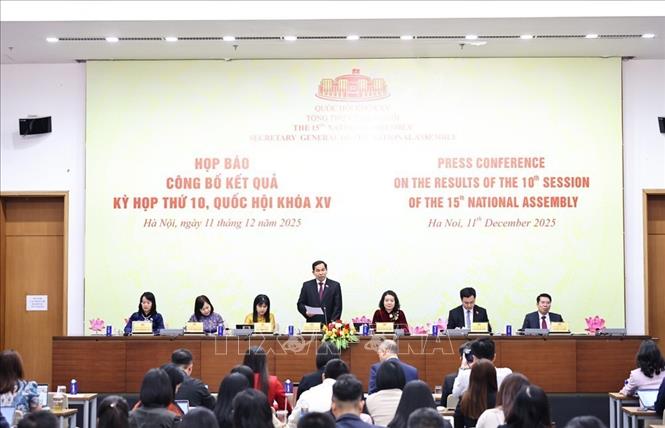
Removing institutional bottlenecks
Speaking at the press conference, Deputy Head of the National Assembly Office Nguyen Van Hien emphasized that, in order to contribute to perfecting the institutional framework and removing "bottlenecks within bottlenecks," the Politburo has issued Resolution 66-NQ/TW on reforming the work of lawmaking and enforcement to meet the requirements of national development in the new era.
In implementing the objectives set out in Resolution 66-NQ/TW, the National Assembly completed approximately 150 laws during the past term. With this number of laws, the goal of removing institutional bottlenecks has been basically achieved, and the country has rapidly moved towards a state where "institutions are the breakthrough of breakthroughs," serving the country's development in the coming period.
Reviewing some of the shortcomings in the National Assembly's activities during the past term, the Deputy Head of the National Assembly Office frankly stated that in legislative work, there were delays and deviations from the planned schedule in submitting draft laws. Regarding content, the process of analyzing and evaluating policies and preparing for draft laws still had shortcomings.
"However, analyzing and evaluating policies, and assessing their socio -economic impacts, is always a very difficult task, especially formulating policies and forecasts based on scientific, qualitative, and quantitative data to find solutions," Mr. Nguyen Van Hien shared.
Another difficulty and limitation is mobilizing the participation of experts, scientists, and those affected by the policy in the consultation process, along with selecting issues for monitoring in supreme oversight, thematic oversight, and oversight by the National Assembly and Committees...
Creating new momentum for growth and strengthening the foundation of macroeconomic stability.
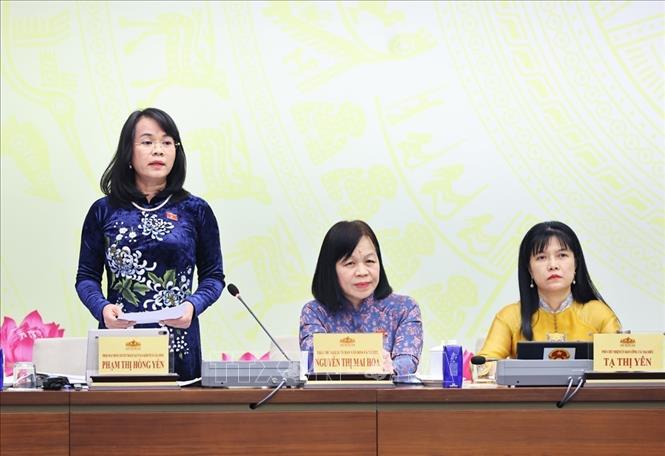
Responding to a reporter's question about the double-digit growth target, Ms. Pham Thi Hong Yen, a full-time National Assembly representative on the National Assembly's Economic and Financial Committee, said that this target reflects the aspiration for breakthroughs and the strong determination of the entire political system in the new development phase of the country.
To contribute to addressing these challenges, Ms. Pham Thi Hong Yen stated that the top priority is to continue promoting growth while maintaining macroeconomic stability, controlling inflation, ensuring major economic balances, and keeping public debt and budget deficits within prescribed limits. Given the limited remaining fiscal and monetary policy space, the coordination of these two policies needs to be extremely close, flexible, and harmonious...
Furthermore, it is necessary to create substantive breakthroughs in institutions and establish a favorable, safe, and healthy investment and business environment; focusing on thoroughly removing bottlenecks in laws on land, investment, planning, construction, environment, agriculture, and administrative procedures... At the 10th session, several laws were passed to address and remove these bottlenecks. The Government needs to accelerate the issuance of guiding documents and organize the effective, synchronized, and high-quality implementation of laws and resolutions passed by the National Assembly; decentralize power and authority in conjunction with resource allocation, enhance implementation capacity, and create proactive space for localities, especially in key economic regions.
"Transparent, stable, and consistent institutions are prerequisites for effectively mobilizing and allocating resources for growth; the effectiveness and success of policy decisions should be measured by tangible results in implementation," said Ms. Pham Thi Hong Yen.
Furthermore, it is necessary to focus on enhancing strategic autonomy and establishing a new growth model, with science, technology, innovation, and digital transformation as the main driving forces. This is the decisive factor for rapid and sustainable growth. Along with promoting industrialization and modernization, and developing key foundational industries, it is necessary to implement favorable policies and mechanisms to develop new economic models, new business models, new fields, and new technologies such as semiconductors, renewable energy, artificial intelligence, biotechnology, digital economy, and circular economy.
Simultaneously, focus on strongly developing the private sector, unlocking human resources, diversifying medium and long-term mobilization tools; effectively attracting domestic and international capital, efficiently operating the International Financial Center in Ho Chi Minh City and Da Nang, and establishing a specialized court law at the Center to ensure its rapid operation; and effectively exploiting new-generation free trade zones in several localities. Establish mechanisms to encourage businesses to invest in research and development, product innovation, and the application of high technology; integrate the goal of greening production, developing a carbon market, and improving environmental standards, helping Vietnam expand its export markets and better adapt to global trade trends.
Simultaneously, promoting the development of modern, high-quality human resources is the long-term foundation that determines the quality of growth; training needs to be closely linked with market needs; emphasis should be placed on digital skills, automation technology, and innovation management; and the private sector, FDI enterprises, and research and training institutions should be mobilized to participate in human resource development for key industries, especially energy processing, manufacturing, and high-tech services.
The National Assembly's Economic and Financial Committee believes that to achieve the 10% growth target, Vietnam needs a comprehensive approach: stability for growth, reform for breakthroughs, and innovation for sustainable development. When institutions are functioning smoothly, resources are unleashed, and people are placed at the center of development, Vietnam's economy can fully realize its aspiration of 10% growth, not only through speed but also through quality, resilience, and the stature of an economy entering a new era.
Enhancing national governance capacity
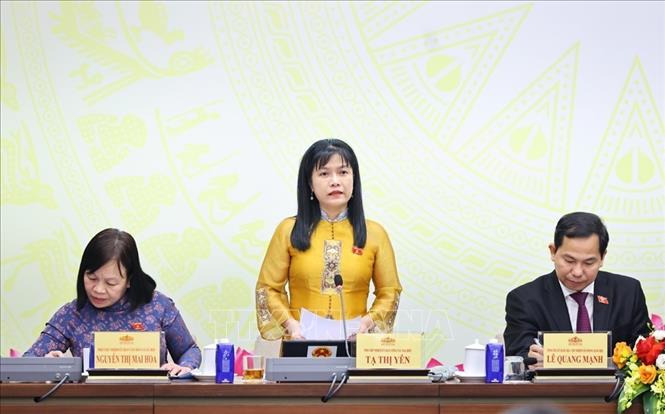
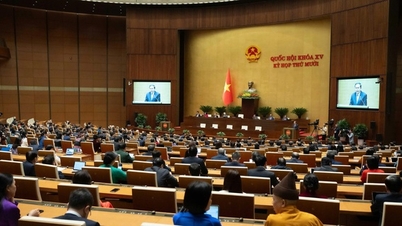
At its 10th session, the National Assembly considered many issues, including personnel matters within its jurisdiction.
Regarding the significance of personnel work at the Session, in an exchange with the press, Deputy Chair of the Committee on Delegate Affairs Ta Thi Yen affirmed that this personnel restructuring is of paramount importance, not only for the immediate future but also for the next term.
According to Ms. Ta Thi Yen, the restructuring of personnel contributes to ensuring the continuous, unified, effective, and efficient leadership of the state apparatus; ensuring smooth direction and management, and preventing any gaps in any important areas. The positions elected and approved by the National Assembly all meet key criteria within the apparatus.
Regarding the quality of personnel, the procedures at the Session were conducted rigorously, systematically, and in accordance with the Party's regulations and state laws, clearly demonstrating the principles of democratic centralism, objectivity, openness, and transparency. This strengthens the people's trust in personnel work and the supreme oversight of the National Assembly.
Furthermore, the restructuring of personnel also meets the requirements of the tasks in the coming period, especially as the country enters a period of strengthening and perfecting institutions, in the context of implementing a two-tiered local government system and preparing for the 16th National Assembly term. The timely restructuring of leadership positions also helps the apparatus have sufficient capacity and resources to effectively implement the major policies set forth by the Party and the State.
"It can be said that personnel work at the 10th Session is not only an organizational requirement but also an important solution to enhance national governance capacity, ensure the stable operation of the apparatus, and align with the principle of serving the people and the goals of national development," said Ms. Ta Thi Yen.
Regarding the question about the Press Law, Deputy Chair of the National Assembly's Committee on Culture and Society, Nguyen Thi Mai Hoa, stated that the Press Law stipulates that leading multi-media press agencies encompass various types of media and affiliated press agencies, have specific financial mechanisms, and are established in accordance with the strategy for developing and managing the press system. According to the authority, the regulation of the development strategy and management of the press system, related to press planning, falls under the jurisdiction of the Government.
"This is why the revised Press Law does not include provisions on this matter for local authorities," Ms. Nguyen Thi Mai Hoa emphasized.
The government has tasked the Ministry of Culture, Sports and Tourism with summarizing the current plan for the development and management of the press. This will be a crucial step as it will provide practical insights into the achievements and challenges encountered, and from there, solutions can be developed to build leading multi-media press agencies at both the central and local levels.
Source: https://baotintuc.vn/thoi-su/ky-hop-thu-10-quoc-hoi-khoa-x5-cung-co-niem-tin-cua-nhan-dan-vao-cong-tac-can-bo-va-su-giam-sat-toi-cao-cua-quoc-hoi-20251211183017224.htm



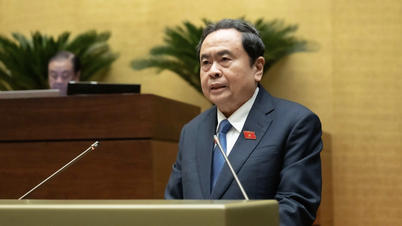
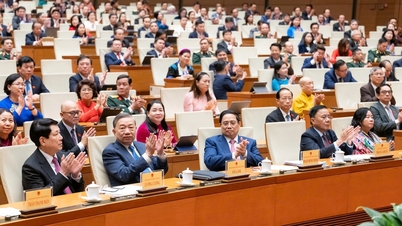
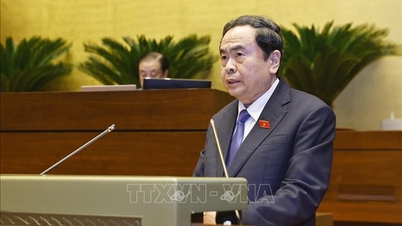
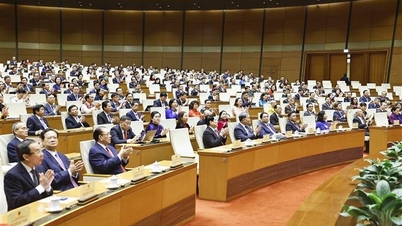
![[Photo] Closing Ceremony of the 10th Session of the 15th National Assembly](/_next/image?url=https%3A%2F%2Fvphoto.vietnam.vn%2Fthumb%2F1200x675%2Fvietnam%2Fresource%2FIMAGE%2F2025%2F12%2F11%2F1765448959967_image-1437-jpg.webp&w=3840&q=75)




































![[OFFICIAL] MISA GROUP ANNOUNCES ITS PIONEERING BRAND POSITIONING IN BUILDING AGENTIC AI FOR BUSINESSES, HOUSEHOLDS, AND THE GOVERNMENT](https://vphoto.vietnam.vn/thumb/402x226/vietnam/resource/IMAGE/2025/12/11/1765444754256_agentic-ai_postfb-scaled.png)






































Comment (0)