

The highlight of the Project is the regulation to implement compulsory English language teaching starting from grade 1, instead of grade 3 as currently. According to the roadmap, in the period 2025-2030, the goal is for 100% of general education institutions nationwide to implement English teaching from grade 1.
The necessity of this policy can be affirmed in the global context, where English is the official or second language in 54 countries and 27 territories; and is also the primary language of international scientific publications. Domestically, the need for early English exposure is rapidly increasing. By 2024, 62 out of 63 localities had implemented programs to introduce English to preschool children; approximately 30% of preschool children (over 1.2 million) were enrolled in English introduction programs – a 300% increase compared to 2020.
The policy of promoting the improvement of foreign language proficiency in general, and English proficiency in particular, for students, contributing to the development of science and technology and strengthening international integration, has been given attention and direction by the Central Committee of the Communist Party, the Politburo , the Government, and the Prime Minister.
The English program for grades 1 and 2, issued under Circular No. 32/2018/TT-BGDĐT, is implemented as an elective subject, helping students become familiar with English based on the needs and aspirations of parents and students, and the capacity of primary education institutions.
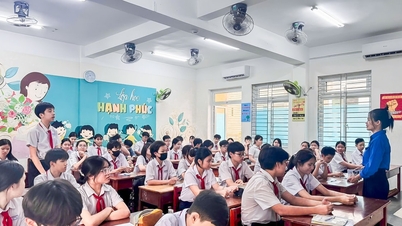
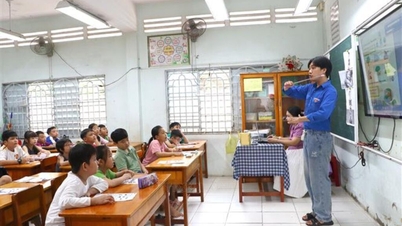
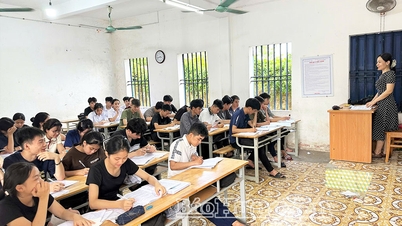
At the primary school level, following the directives of the Ministry of Education and Training, localities have actively implemented comprehensive solutions to improve the quality of foreign language teaching and learning. 100% of schools have organized compulsory Foreign Language 1 teaching in grades 3, 4, and 5, with English being the majority... These results create a solid foundation for expanding the program to grade 1 in the future.
Of course, there are many difficulties and challenges, especially regarding human resources. According to data from localities, in the 2024-2025 school year, the whole country will still lack approximately 3,000 English teachers (accounting for up to 10% of the total number of teachers). Primary schools in remote areas with many scattered school locations also pose difficulties in assigning teachers to teach.
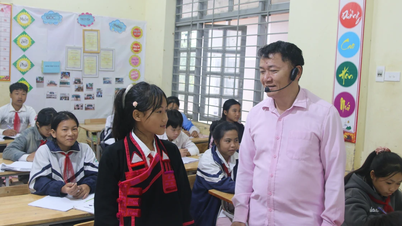
The qualifications of teachers are uneven, with some in disadvantaged areas not meeting the required training standards. Attracting qualified teachers remains difficult due to inconsistent and unattractive policies. Implementing compulsory English instruction from grade 1 would create nearly 10,000 additional English teacher positions in primary schools. This presents a significant challenge.
Regarding solutions, the Plan outlines eight comprehensive groups, ranging from communication to raise awareness and build and improve institutions; the necessary conditions for implementation in terms of human resources, infrastructure, programs, and learning materials; innovation in teaching methods, examination methods, and assessment; promoting the development of an English-speaking environment; applying advanced technology and artificial intelligence; and strengthening international cooperation. The tasks and solutions presented reflect a strategic vision and require coordinated efforts across multiple sectors and fields, as well as the joint participation of the entire political system and society.
However, the decisive factor still lies in the people, the determination of each school, especially the role of the leader; the dedication, innovative thinking, and perseverance of each teacher in the journey of sowing the seeds of a new language for future generations. When English is taught not just as a foreign language, but as a way to open doors to knowledge and connect with the world, this is truly a shift in vision, helping Vietnam integrate and develop sustainably.
Source: https://giaoducthoidai.vn/nen-tang-hoi-nhap-post754764.html





































































































Comment (0)