

This requires a comprehensive strategy, from teacher recruitment and training to competency assessment and effective utilization of the teaching staff.
The most important condition
The English lesson taught by Ms. Tran Hong Hanh from Phan Dinh Phung High School (Ba Dinh District, Hanoi ) at Tan Lap High School (O Dien Commune) has attracted the attention of students and colleagues thanks to her many useful teaching skills and experience.
This is an activity within the "Schools working together for development, teachers sharing responsibility" movement implemented by the Hanoi Department of Education and Training, aiming to share teaching and management experiences between schools in the inner and outer city, contributing to improving the quality of education , including English.
Simultaneously, the Hanoi Department of Education and Training has organized training courses to upgrade the qualifications of English teachers both domestically and internationally. In 2024, 1,900 teachers participated in the international IELTS standard upgrade training course. In addition to 400 official class hours, participants also received professional support from a group of teachers who had previously participated in the training courses.
The Hanoi Department of Education and Training has also provided English language and teaching methodology training for approximately 500 teachers of Mathematics, Science , Physics, Chemistry, and Informatics according to the Cambridge dual-degree program. After the training, these teachers are fully capable of teaching these subjects in English according to the Cambridge dual-degree standard – a model that is being effectively implemented in many high schools in Hanoi.
Mr. Tran The Cuong, Director of the Hanoi Department of Education and Training, said that the department has established core clubs, including a very effective English Club. Teachers who meet the foreign language standards have received training abroad and participated in professional activities, helping teachers in disadvantaged areas improve their foreign language skills and meet current teaching needs.
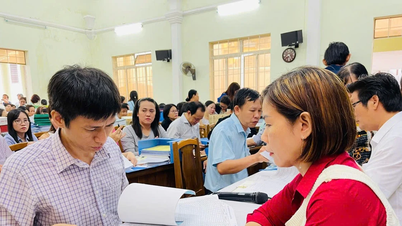
Recently, the Ho Chi Minh City Department of Education and Training surveyed the English proficiency of approximately 47,000 public school teachers from primary to high school. The survey aimed to collect real-world data, build a comprehensive view of foreign language proficiency in the education sector, and thereby guide appropriate development strategies.
Training and assessing English proficiency among teachers is essential to build a database for the future development of public education. In the context of globalization, English is a crucial tool; therefore, improving the quality of teaching is a fundamental requirement for the younger generation to become proficient in this foreign language.

Anticipating teaching trends
In implementing Resolution 71 of the Politburo on breakthroughs in education and training development, the Ministry of Education and Training is developing a draft plan titled "Gradually Making English the Second Language in Schools," with the overall goal of widely and regularly using English in communication, learning, research, and work; while simultaneously enhancing the competitiveness of human resources in the new era.
The project aims for English to become the second language in the education system by 2045, widely used in teaching, management, and educational activities. The implementation roadmap is divided into three phases (2025-2030, 2030-2040, 2040-2045) with a set of seven evaluation criteria for each educational level.
Key tasks include: Raising social awareness; improving mechanisms and policies; developing the teaching staff; building curricula and learning materials; innovating examinations, tests, and assessments; applying technology and artificial intelligence; strengthening international cooperation and social participation; and promoting emulation and rewards.
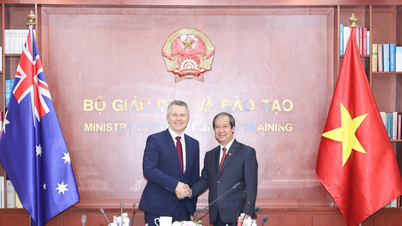
According to the Permanent Deputy Minister of Education and Training, Pham Ngoc Thuong, the project is expected to be implemented throughout the entire education system, encompassing nearly 50,000 institutions, approximately 30 million students, and 1 million staff and teachers. This includes the need to recruit approximately 12,000 additional English teachers for preschools and nearly 10,000 for primary schools, while also training at least 200,000 teachers to teach in English by 2030.
The resources for implementation include the State budget and the participation and contributions of businesses, organizations, and individuals. The Ministry of Education and Training affirms that the success of the project requires social consensus and persistent implementation over 20 years, aiming to enhance national competitiveness and deep international integration.
Ms. Tran Thi Huyen, Acting Director of the Can Tho Department of Education and Training, stated that making English a second language is a major policy with high consensus, but its implementation will face difficulties due to the uneven distribution of teachers across regions, especially at the preschool level, where there are insufficient resources to provide one teacher per school. Furthermore, consideration must be given to providing preferential allowances for teachers in disadvantaged areas.
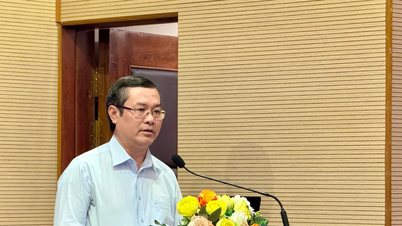
Mr. Nguyen Van Hieu, Director of the Ho Chi Minh City Department of Education and Training, stated that no subject receives as much attention as English. Previously, the State had many policies to invest in foreign languages, but these were not implemented as comprehensively and decisively as in the spirit of Resolution 71. While Ho Chi Minh City has many advantages, it also faces difficulties in implementing the project, particularly regarding the teaching staff.
Therefore, the Ho Chi Minh City Department of Education and Training proposes that teacher training colleges research and provide training for teachers currently teaching Mathematics and Science to become proficient in English. Students studying these majors will receive the same benefits as students in the gifted student program. Teachers who meet the foreign language proficiency requirements will be recognized as outstanding graduates of the gifted student program.
Evaluating the meticulously prepared draft plan, Professor Huynh Van Son, Rector of Ho Chi Minh City University of Education, commented that the implementation roadmap is appropriate, taking into account regional specificities and various scenarios. The training and professional development are entirely feasible because current human resources and technology can meet the needs if properly organized and utilized.
To gradually make English a second language, improving the quality of teaching is a significant challenge. The Hanoi Department of Education and Training has determined that the most important condition is to improve the quality of the teaching staff, because if you want excellent students, the teachers must be excellent.
Source: https://giaoducthoidai.vn/tieng-anh-thanh-ngon-ngu-thu-hai-cuoc-cach-mang-tu-doi-ngu-post753950.html
![[Photo] Prime Minister Pham Minh Chinh holds a phone call with the CEO of Russia's Rosatom Corporation.](/_next/image?url=https%3A%2F%2Fvphoto.vietnam.vn%2Fthumb%2F1200x675%2Fvietnam%2Fresource%2FIMAGE%2F2025%2F12%2F11%2F1765464552365_dsc-5295-jpg.webp&w=3840&q=75)
![[Photo] Closing Ceremony of the 10th Session of the 15th National Assembly](/_next/image?url=https%3A%2F%2Fvphoto.vietnam.vn%2Fthumb%2F1200x675%2Fvietnam%2Fresource%2FIMAGE%2F2025%2F12%2F11%2F1765448959967_image-1437-jpg.webp&w=3840&q=75)











































![[OFFICIAL] MISA GROUP ANNOUNCES ITS PIONEERING BRAND POSITIONING IN BUILDING AGENTIC AI FOR BUSINESSES, HOUSEHOLDS, AND THE GOVERNMENT](https://vphoto.vietnam.vn/thumb/402x226/vietnam/resource/IMAGE/2025/12/11/1765444754256_agentic-ai_postfb-scaled.png)












































Comment (0)