


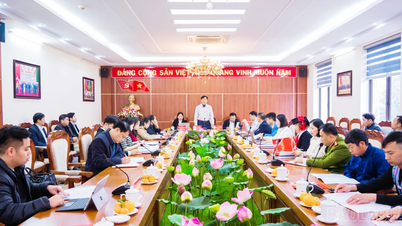
The conference was held in a hybrid format, combining in-person and online participation, connecting to various locations including units under and directly affiliated with the Ministry; the Vietnam Education Trade Union; Departments of Education and Training; and universities, academies, colleges, and vocational schools nationwide.
Through the conference, delegates gained a firm grasp and clear understanding of the viewpoints, objectives, tasks, and main solutions of Resolution No. 71-NQ/TW, as well as the specific contents and solutions for implementing the Ministry of Education and Training's Action Plan to implement Resolution No. 71-NQ/TW.
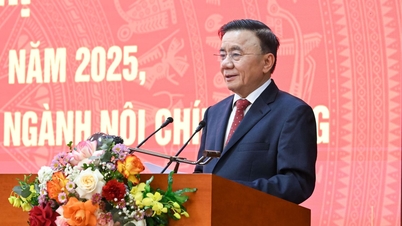
Speaking at the conference, Minister of Education and Training Nguyen Kim Son shared that the process of drafting Resolution No. 71-NQ/TW reflects the vision of the Politburo and the Secretariat in developing education and training in conjunction with national development. The Minister reiterated the very important issues raised by General Secretary To Lam, linked to the three words "human": "human" - developing people in the new era; "human resources" - preparing human resources for the new era; and "talent" - as competition among nations worldwide intensifies, talent must be the decisive factor.
Regarding the differences between Resolution No. 71-NQ/TW and Resolution No. 29-NQ/TW, dated November 4, 2013, of the 11th Central Committee of the Communist Party of Vietnam, "On fundamental and comprehensive reform of education and training to meet the requirements of industrialization and modernization in the context of a socialist-oriented market economy and international integration," the Minister stated that the most important spirit of Resolution No. 29-NQ/TW is the shift from an education system focused on equipping students with knowledge to one that comprehensively develops their abilities and qualities. Resolution No. 29-NQ/TW also focuses on all aspects of education and training, both sectoral and national issues requiring focused development in education and training; however, the core focus lies in professional, managerial, and internal issues within the field of education and training.
According to the Minister, Resolution No. 29-NQ/TW still retains its full strategic orientation values; however, it needs to be strengthened in terms of action, practicality, and feasibility. With Resolution No. 71-NQ/TW, the core guiding principle in its development is: action, practicality, and feasibility; in the guiding ideology for education and training, the three "keywords" are: modernity, quality, and equity; and in the implementation perspective, there are three "keywords": decisiveness, speed, and effectiveness.
Regarding the implementation of Resolution No. 71-NQ/TW, Minister Nguyen Kim Son stated that it will initiate a new revolution in education. The resolution's content, "Education and training are the top national priority, determining the future of the nation," reflects an unprecedented vision, guiding principles, and a significant commitment and positioning for education and training. Therefore, every teacher and education administrator needs to adopt an attitude, understanding, and actions commensurate with this responsibility, so as not to betray the trust and commitment of the Party and the people.
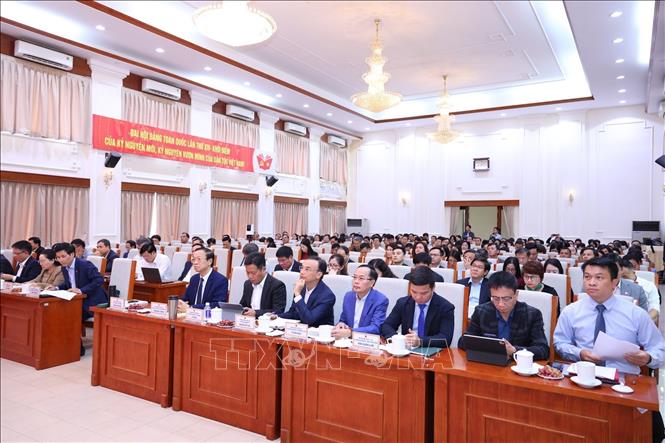
The Minister noted that the priority and the need for consistent and immediate action is to fully and profoundly renew thinking and awareness; to confront the truth, the shortcomings and weaknesses, and the persistent "ailments" in order to make better adjustments.
The Minister also emphasized the importance of fully understanding and implementing the guiding principles in Resolution No. 71-NQ/TW on the comprehensive and thorough leadership role of Party organizations, especially Party organizations in educational institutions, particularly higher education and vocational education institutions.
Resolution No. 71-NQ/TW requires educational institutions, especially higher education and vocational education, to develop more rapidly and strongly, with a higher level of orientation; public schools must fulfill their public mission, specifically at this time focusing on training human resources that the country has a high demand for; alongside this is the awareness and thinking about the role, leading nature, and guidance of the state in the entire education system; maximizing the mobilization of social resources, but with the state playing the leading role.
Referring to the institutionalization of important contents in the Resolution, the Minister said that, if everything goes according to plan, from January 1, 2026, all four laws in the field of education and training will come into effect (the Law on Teachers, the Law amending and supplementing a number of articles of the Law on Education, the amended Law on Higher Education, and the amended Law on Vocational Education), along with a series of new decrees and circulars.
With this new institutional framework for operating the education system, the Minister urged teachers and education administrators at all levels to seriously study the laws to avoid errors, delays, omissions, and mistakes during implementation; this is an important and urgent task that needs to be implemented vigorously.
Regarding the restructuring of educational institutions within the national education system to strengthen them and to ensure more focused, targeted, and effective investment, the Minister noted that implementation should be based on the Ministry's directives and practical realities, not mechanically. For example, in the case of the new vocational high school model, this model does not replace the continuing education and vocational education model; continuing education and vocational education institutions should not be immediately converted into vocational high schools.
For public higher education and vocational training institutions, the Ministry of Education and Training is developing a plan to implement the arrangement where the Party Committee Secretary also serves as the head of the institution, ensuring that when the new laws come into effect, the new system will operate smoothly and without any gaps.
When the new law comes into effect, the School Board's activities will end; the Chairpersons and Vice-Chairpersons of the School Board will also conclude their roles. The Principals or Directors, who are elected for a term by the School Board, will, in principle, also have completed their duties. However, to ensure a smooth transition period, the Principals and Directors will continue to manage the school's operations until a new decision is made…
At the conference, Deputy Minister of Education and Training Pham Ngoc Thuong emphasized the important contents of Resolution No. 71-NQ/TW, from the guiding principles, objectives, tasks, and solutions…
Representatives from the Departments of Education and Training and higher education institutions also shared the contents they have implemented to proactively deploy Resolution No. 71-NQ/TW, while affirming their determination to put the Resolution into practice effectively.
Source: https://baotintuc.vn/giao-duc/nganh-giao-duc-can-nhin-thang-vao-bat-cap-yeu-kem-de-dieu-chinh-tot-hon-20251024213409304.htm




































































Comment (0)