For the indigenous Bana, Jrai, and Ede peoples, the ghè (a type of jar) represents a diverse and rich world intimately connected to each individual from birth and adulthood until death (Atâu).
More than just everyday household items, jars are also a deeply ingrained cultural element in the community life of the ethnic groups in the Central Highlands, reflected in rituals, ceremonies, and festivals. The more jars a family owns, the more it demonstrates their wealth and social status; the more unique, rare, and valuable the jars, the higher their wealth and social standing.
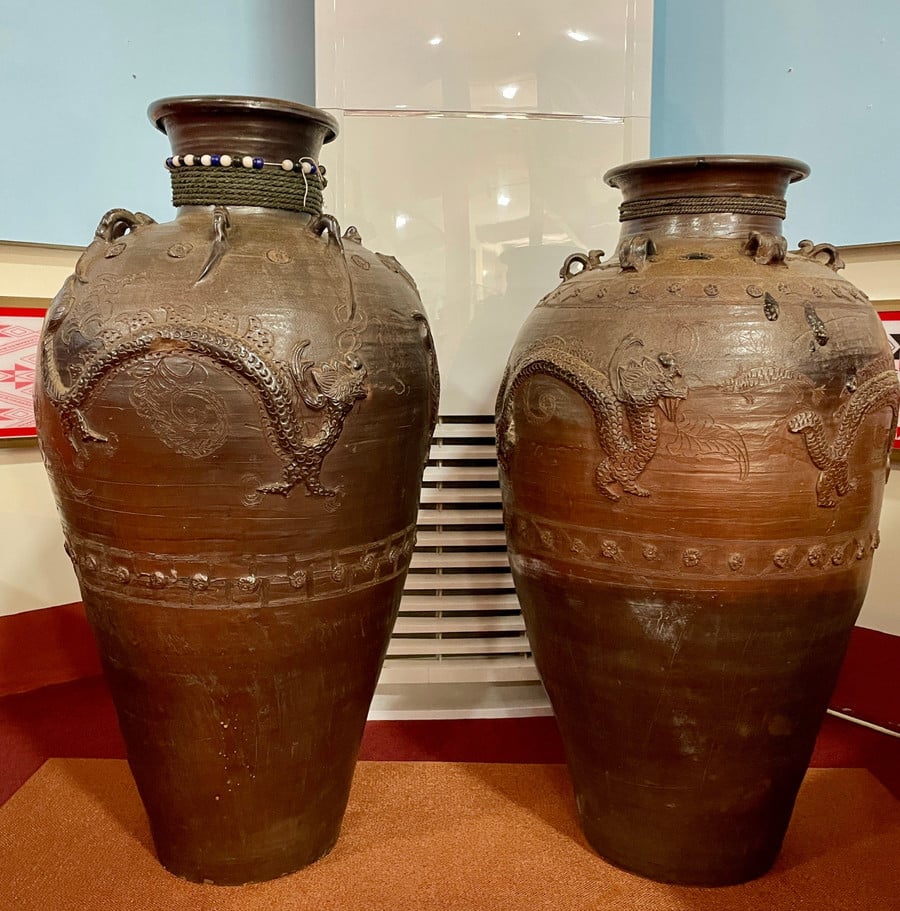
This pair of jars, a husband and wife set together, was collected by collector Ngo Ngoc Tam from Lam Dong province. Photo: Phuong Duyen
Collector Ngo Ngoc Tam (Thong Nhat ward) said he was very pleased to have collected a pair of "husband and wife jars" from a family in Lam Dong province a few years ago. They are called "husband and wife jars" because they come in pairs with similar designs and patterns.
However, traces of the matriarchal system are evident in the size: the wife's jar is taller than the husband's, affirming the decisive role of women in the community. According to custom, these two jars are used in wedding ceremonies, where the bride and groom drink wine together from the two jars, as a metaphor for a perfect match and a wish for happiness.
Recalling the past, collector Ngo Ngoc Tam smiled and said that the pair of jars were made around the 14th-15th centuries, belonging to the Go Sanh pottery line (an ancient type of pottery produced in a village on the Con River in Phu Quang hamlet, Nhon Hoa commune, An Nhon town, former Binh Dinh province, now Gia Lai province). The owner insisted on selling the pair of jars as a pair rather than individually, because selling them separately would be like shattering a cherished happiness.
Another unique Go Sanh pottery artifact that he owns is the "mother carrying child" jar. It's a brown glazed "mother" jar with a smaller "child" jar attached near the top of the mouth. The "child" jar is only about 10 cm tall, connected to the "mother" jar, and has identical patterns and designs. Typically, a "mother" jar carries between one and four children. This type of jar is considered a symbol of maternal love and is highly valued by the people of the Central Highlands.
A closer look at these jars reveals that every detail, beyond just aesthetics, carries its own meaning. Many are surprised to see jars decorated with majestic dragon motifs and intricate patterns, yet with handles stylized into small animals like squirrels and mice.
Dr. Vo Van Hung (from Pleiku ward), also a renowned collector in the Gia Lai plateau, explains: Squirrels and rats are animals that destroy crops; in particular, rats once caused terrible plague epidemics in many places.
Therefore, the images of these animals appearing on the jars are to serve in rituals praying for a bountiful harvest and peace for the entire community.
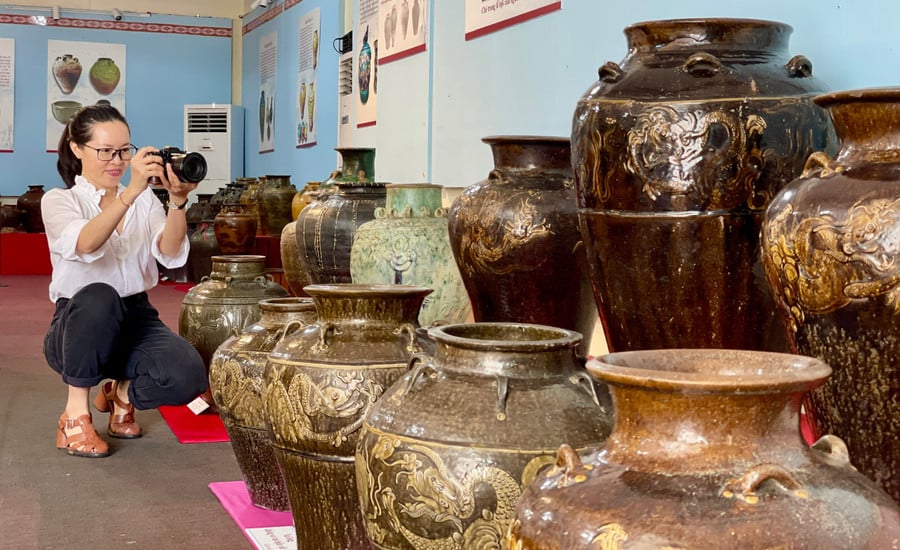
The jars of the Central Highlands hold many interesting stories. Photo: Phuong Duyen
Meanwhile, collector Nguyen The Phiệt (Dien Hong ward) offered a different explanation based on observations he made during his field trips: On occasions when the village men returned from hunting wild animals, they would gather around the campfire and enjoy a type of wine served in earthenware jars with handles decorated with images of animals such as mice, squirrels, frogs, or chameleons...
When they drink wine from this jar, they will gain more agility and stamina for their next hunting trip. Mr. Phiệt said that the differences in these interpretations depend on the beliefs and customs of each region and community.
According to Mr. Phiệt, since ancient times, the people of the Central Highlands have classified jars according to their purpose. Sacred jars used for worshipping deities often feature embossed images of dragons, cranes, animals, plants, and leaves on their bodies, or tiger motifs on their handles.

Vietnam encourages US businesses to expand investment in high technology.On the morning of June 26th, at the Government Headquarters, Deputy Prime Minister Ho Quoc Dung received Mr. Jeff Place, Supply Chain Director of Coherent Group (USA). During the meeting, the Deputy Prime Minister affirmed that Vietnam encourages US businesses to expand investment, especially in high-tech, innovation, and semiconductor industries. The Jrai, Bahnar, and Xê Đăng people believe that if they offer such special jars to Yàng (the supreme deity), Yàng will bless the community with bountiful harvests and favorable weather.
Interestingly, jars are even categorized by gender. For example, valuable jars used for fermenting wine are called "male jars"; while jars used for storing food and pickled items are called "female jars," simpler in color, without handles like "male jars," and usually placed in a corner of the kitchen.
Over the centuries, these precious jars have become increasingly rare due to damage over time or the custom of sharing possessions with the deceased among the people of the Central Highlands. Therefore, the efforts of collectors in the province to collect them are a good way to preserve the memories and culture of the community.
Source: https://baogialai.com.vn/nghe-ghe-ke-chuyen-nhan-sinh-post566563.html







![[Image] National conference summarizing one year of operation of the overall organizational model of the political system, the three-tiered government model.](https://vphoto.vietnam.vn/thumb/1200x675/vietnam/resource/IMAGE/2026/07/01/1782882811691_ndo_br_1-jpg.webp)










![[Video] Weather forecast for tonight and tomorrow, July 2nd, 2026: Tropical depression likely to strengthen into a storm; many areas will continue to experience thunderstorms.](https://vphoto.vietnam.vn/thumb/402x226/vietnam/resource/IMAGE/2026/07/01/1782911026600_thumb-dem-png.webp)