

Reuters reported yesterday (December 2) that hundreds of fighters from Iraq have entered Syria to support the local government. These fighters are believed to be close to Iran and came to Syria to fulfill Tehran's commitment to Damascus amidst a strong resurgence of opposition forces, who have seized control of several areas.
"Five factions, seven groups"
Currently, there are four main military forces clashing in Syria. First, there is the government army and several paramilitary groups close to Syrian President Bashar al-Assad, while the government also enjoys strong support from Hezbollah in Lebanon.
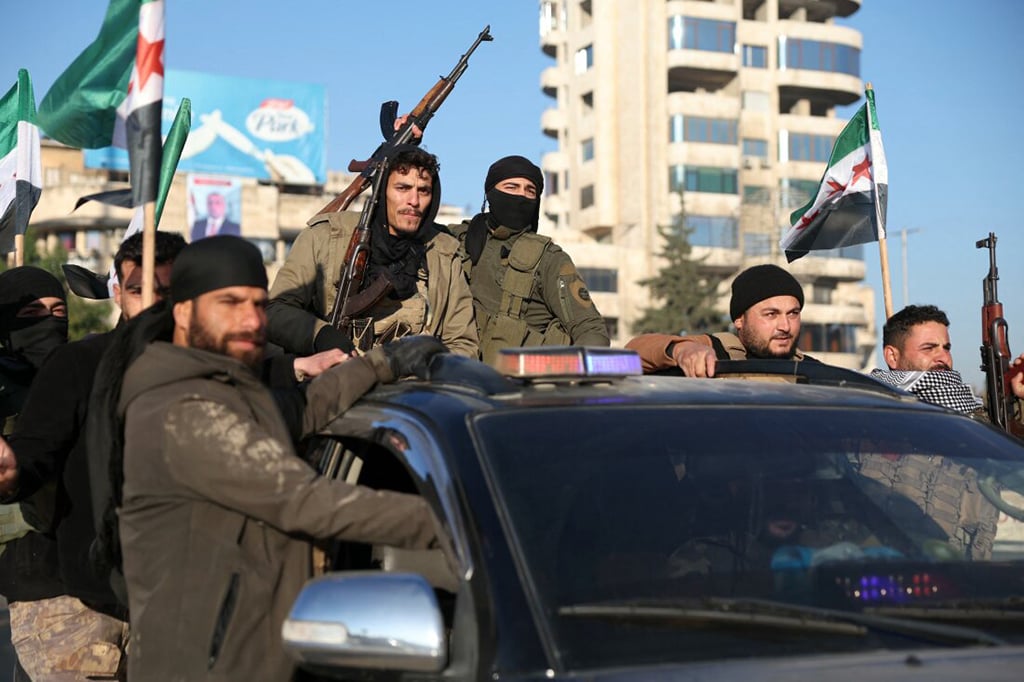
Gunmen from an opposition military force in Aleppo on November 30.
Secondly, there is the Kurdish-led Syrian Democratic Front, backed by the United States. Thirdly, there is the Hayat Tahrir al-Sham (HTS, formerly the Nusra Front), a former al-Qaeda affiliate currently listed as a terrorist organization by several countries, including the US, Russia, and Türkiye. Fourthly, there is the Turkish-backed Syrian National Army (SNA) along with several pro-Turkish groups.
In fact, conflict began to erupt in Syria in 2011 when numerous rebel forces sought to overthrow President al-Assad. Throughout the civil war, various factions emerged, as did the rise of the self-proclaimed Islamic State (IS). The rise of IS is the reason for the US military presence in Syria, even though Washington also wanted to overthrow al-Assad's regime.
By around 2015, thanks to military support from Iran and Russia, President al-Assad not only held his ground but also regained control of much of the territory. However, the Damascus government still faced a major challenge as Turkey did not abandon its intention to overthrow al-Assad. The situation only truly calmed down in 2019 after Iran, Russia, and Türkiye reached an agreement on the Syrian issue. Reached at a time when the US was about to withdraw its troops, the agreement stipulated that Syria would proceed to general elections. Since then, al-Assad has remained in power, and the civil war has been considered temporarily halted, although opposition military forces still occupy certain areas.
However, on November 27th, HTS unexpectedly attacked areas controlled by government forces and quickly captured Aleppo, Syria's second-largest city. Of course, other armed groups also mobilized, such as the SNA, which expanded its control and attacked Kurdish forces.
Reports surface that Moscow has replaced the general in charge of Russian forces in Syria.
According to Reuters, citing Russian military bloggers, Sergei Kisel, the general in charge of Russian forces in Syria, has been dismissed after rebels overtook Aleppo. The dismissal of Kisel (53 years old) was revealed on the Telegram channel Rybar – which is believed to be close to the Russian Ministry of Defense – and the military website Voenny Osvedomitel. “Clearly, he was expected to demonstrate his potential in Syria, but something went wrong,” according to Voenny Osvedomitel.
Tri Do
The balance has shifted.
According to an analysis by Eurasia Group (USA) – a leading global political risk research and consulting firm – sent to Thanh Nien newspaper , HTS saw a shift in the regional balance of power as Russia expended significant resources in its conflict with Ukraine, while Iran and its allies suffered heavy losses from Israeli military operations. Therefore, HTS seized the opportunity to act amidst the limited resources available to Moscow and Tehran for Damascus, and the difficulty Hezbollah faced in providing sufficient support to al-Assad.
The HTS military intervention could benefit Türkiye by putting pressure on President al-Assad, as well as Russia and Iran, given that many provisions of the 2019 agreement have not been implemented. This development could also help Turkey increase its control while weakening Kurdish forces. For years, Ankara has had to contend with Kurdish forces fighting to establish their own state, which includes parts of Turkish territory.
In an interview with Thanh Nien newspaper, a US military intelligence expert assessed that current developments will weaken al-Assad's regime, while Iran's influence in Syria will gradually surpass Russia's, as Moscow will find it difficult to provide strong support to Damascus in the current context. Furthermore, the power struggle between Iran and Turkey in the region will become more intense, and Tehran is likely to influence its allies to attack the SNA. On the other hand, Iran is also seeking to increase pressure on Turkey to resolve the situation, while blaming Israel and the US for causing instability in order to "shift the focus" away from the current conflicts involving Tel Aviv.
Nevertheless, the expert predicts that the escalating conflict will soon stabilize in December. The only issue is that the area controlled by President al-Assad's government will shrink.
The US, France, Germany, and the UK urge de-escalation in Syria.
The US, France, Germany, and the UK called for “de-escalation,” protecting civilians and infrastructure in Syria to prevent further displacement and disruption of humanitarian access.
“The current escalation only highlights the urgent need for a Syrian-led political solution to the conflict, consistent with UN Security Council Resolution 2254,” according to a joint statement by the four countries released by the US State Department on December 1. UN Resolution 2254 calls for a ceasefire and support for the peace process in Syria. On the same day, the UN Humanitarian Coordinator in Syria, Adam Abdelmoula, also called for an end to hostilities in Syria.
Tri Do
Source: https://thanhnien.vn/the-cuoc-tu-chao-lua-hon-don-syria-185241202233925093.htm
![[Photo] National Assembly Chairman Tran Thanh Man working with the Standing Committee of the National Assembly's Delegation Affairs Committee.](https://vphoto.vietnam.vn/thumb/1200x675/vietnam/resource/IMAGE/2026/05/20/1779294340023_ndo_br_1-1691-jpg.webp)
![[Photo] General Secretary and President To Lam works with the Party Committee of the Ministry of Health on the work of Vietnamese traditional medicine.](https://vphoto.vietnam.vn/thumb/1200x675/vietnam/resource/IMAGE/2026/05/20/1779294323718_a1-bnd-2978-3319-jpg.webp)
![[Image] "Journey of Hope" promotes the organ and tissue donation movement in Vietnam.](https://vphoto.vietnam.vn/thumb/1200x675/vietnam/resource/IMAGE/2026/05/20/1779294400833_1-8910-jpg.webp)

























































Comment (0)