

Governor Nguyen Thi Hong believes that early intervention with support measures such as special loans at 0% interest is necessary to prevent banks from experiencing mass withdrawals of funds.
The draft Law on Credit Institutions (amended), submitted to the National Assembly this time, adds a provision allowing the State Bank of Vietnam to intervene early in credit institutions.
Accordingly, banks are eligible for early intervention when they experience mass withdrawals leading to insolvency, or when they fail to maintain their solvency and capital adequacy ratios for 3 and 6 consecutive months, respectively, and have accumulated losses exceeding 20% of their charter capital and reserves. One of the measures applied to this group is special lending, without collateral, at a 0% annual interest rate from the State Bank of Vietnam, the Deposit Insurance Corporation, and other banks.
During a discussion on June 10th, Mr. Pham Van Hoa ( Dong Thap province ) suggested clarifying the extent to which mass withdrawals require intervention from the State Bank of Vietnam. This is to ensure transparency, timeliness, and avoid risks similar to the mass withdrawal incident at Saigon Commercial Bank (SCB) last October.
In her subsequent explanation, State Bank Governor Nguyen Thi Hong stated that while current law allows for early intervention, the one-year timeframe and lack of accompanying support measures make implementation difficult in practice. For example, in the case of SCB, other credit institutions wanted to provide support, but the law doesn't specify it, so "they didn't dare because it involves the risks associated with the loans."
"In a normal bank, there might still be incidents of mass withdrawals for some reason, and early intervention would be implemented. However, in the case of a bank under special supervision, it's already a very difficult phase, and not implementing support solutions would make it difficult to ensure the safety of the banking system," she explained.
Therefore, early intervention measures were implemented to prevent the risk of mass withdrawals from banks.
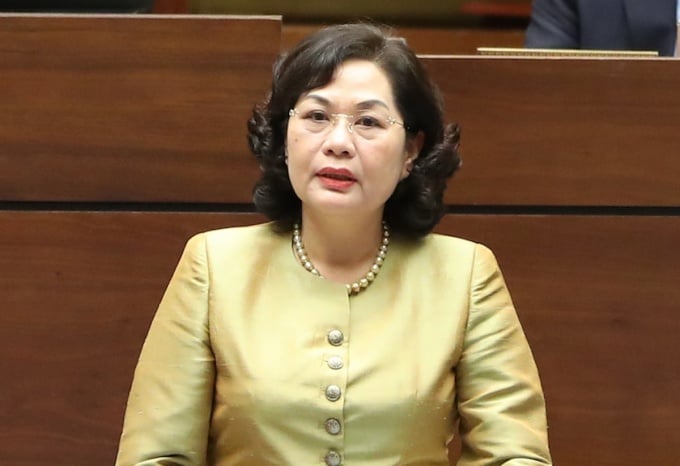
Ms. Nguyen Thi Hong, Governor of the State Bank of Vietnam, explains before the National Assembly on June 10th. Photo: Hoang Phong
The State Bank of Vietnam's leadership also cited international experience, emphasizing that it's not necessary to wait for credit institutions to face liquidity difficulties before taking action. For example, US banks, with total assets exceeding $200 billion, low non-performing loans (NPLs) of less than 1%, and risk provisions 4-6 times the value of NPLs, still experienced mass withdrawals. Within just a few days, these banks lost up to $100 billion, forcing them to receive support from the central bank and tens of billions of dollars in loans from other banks.
Accordingly, in this revision, the early intervention measures are designed based on the practical difficulties in restructuring weak banks, the mass withdrawal event at SCB, and drawing on the experience from the recent bank failures in the US.
"The regulations on early intervention are designed to mobilize support resources, increase the responsibility of banks for system safety, and reduce the financial costs of handling incidents for credit institutions," Ms. Hong said.
According to Governor Nguyen Thi Hong, banks inevitably face difficult periods during their operations. During inspections and supervision, the regulatory body will warn of risks so that banks can make timely adjustments. In cases of worsening conditions, where there is a risk of insolvency, the level of management and intervention will be stronger.
Expressing her earlier viewpoint, Ms. Pham Thi Thanh Mai, Deputy Head of the Hanoi City Delegation, suggested that there should be additional regulations regarding the timeframe for early intervention and corresponding plans if a bank cannot recover after being placed under special supervision.
"Banks are implementing early intervention measures, reporting quarterly on the progress of corrective actions, to ensure the urgency and effectiveness of early intervention," Ms. Mai said.
Regarding special loans for banks at risk of mass withdrawals , delegates proposed that these banks be required to freeze their loans until they recover the debts from their customers, at which point the loans will be repaid. This aims to ensure fairness for banks that operate efficiently.
Mr. Pham Van Hoa also suggested that special loans should require collateral, specifically collateral provided by the customer to the banks. "There's no reason why customers should only be granted credit if they have collateral, and why banks shouldn't have to mortgage assets for special loans," he stated.
The Economic Committee also raised the issue of allowing illiquid banks to obtain special loans requiring collateral when reviewing the draft law.
The reviewing agency requested clarification on the basis for proposing measures to designate banks for special loans, and an assessment of the impact of these loans on the designated credit institutions. In the case of designating several banks for special loans, the Economic Committee believes that the basis for selection and allocation of loan funds needs to be clarified.
Source link

![[Image] Vietnam's colorful journey of innovation](/_next/image?url=https%3A%2F%2Fvphoto.vietnam.vn%2Fthumb%2F1200x675%2Fvietnam%2Fresource%2FIMAGE%2F2025%2F12%2F14%2F1765703036409_image-1.jpeg&w=3840&q=75)






































































![[Image] Vietnam's colorful journey of innovation](https://vphoto.vietnam.vn/thumb/402x226/vietnam/resource/IMAGE/2025/12/14/1765703036409_image-1.jpeg)





























Comment (0)