

 |
From January 1, 2026, students nationwide will be provided with free textbooks. Photo: Phuong Lam . |
On the morning of December 10, the National Assembly officially approved the draft to amend and supplement a number of articles of the Law on Education .
Notably, starting January 1, 2026, students will receive free textbooks. Simultaneously, a single set of textbooks for general education will be used nationwide.
Many new points regarding textbooks.
Compared to the 2019 Education Law, the new Education Law passed by the National Assembly has many new points related to textbooks and local educational materials.
Specifically, the new law stipulates that textbooks must concretize the requirements of the general education curriculum regarding objectives, content, qualities, and competencies of students; and at the same time, guide teaching methods, testing, and quality assessment.
The content and presentation must not be biased based on ethnicity, religion, occupation, gender, age, or social status. Furthermore, textbooks will be published in various formats, including printed books, Braille books, and e-books.
The National Council for Textbook Appraisal is established for each subject and educational activity and is responsible for the content and quality of the appraisal. The Minister of Education and Training will approve textbooks after the National Council for Appraisal assesses that they meet the requirements; at the same time, it will issue standards and procedures for compilation and editing.
Previously, when using various sets of textbooks, the provincial People's Committee decided on the selection of textbooks to be used consistently in general education institutions within the province, in accordance with the regulations of the Ministry of Education and Training.
According to the new law, for local educational materials , the specialized agency of the Provincial People's Committee is responsible for organizing their compilation, ensuring they are appropriate to the socio-cultural characteristics of the locality.
The document appraisal council is established by the Chairman of the Provincial People's Committee and is responsible for the appraisal results.
After being evaluated and approved by the Council, the document will be approved by the Chairman of the Provincial People's Committee for use in general education institutions. At the same time, the Ministry of Education and Training will regulate the standards and procedures for compiling, editing, and evaluating this type of document to ensure unified management.
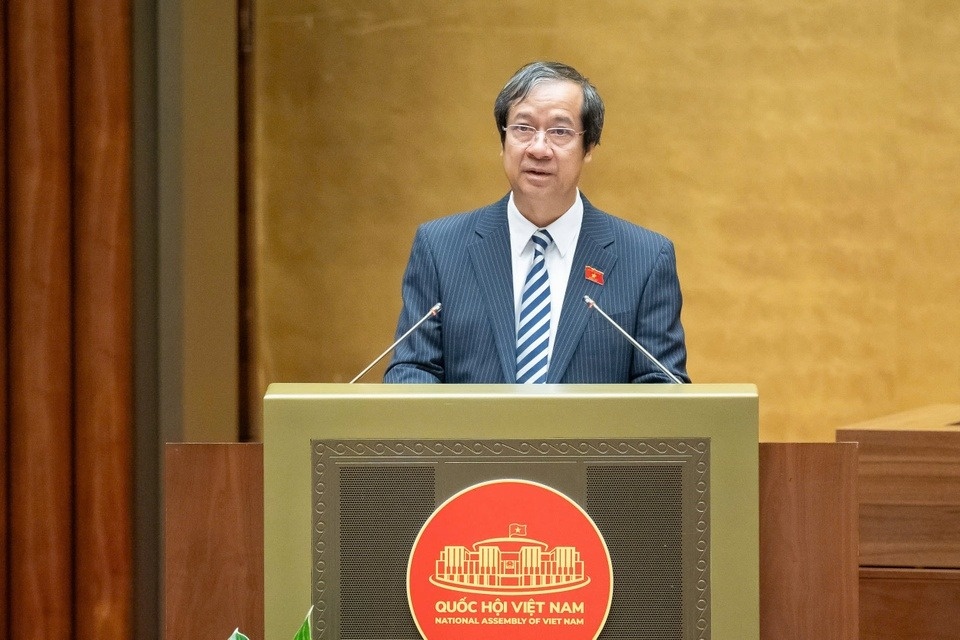 |
Minister of Education and Training Nguyen Kim Son presented three draft laws on education to the National Assembly on the morning of October 22. Photo: Quochoi.vn . |
Maintain tuition-free status.
The new law has also clarified the concept of tuition fees, the structure of educational service costs, and the mechanism for collecting and managing fees according to a roadmap that ensures accurate and complete calculation and enhances transparency.
According to the new regulations, tuition fees are the amount of money that students pay to cover part or all of the costs of educational and training services. Tuition fees are determined according to the cost guarantee roadmap issued by the Government; vocational training institutions and universities are subject to the Law on Vocational Education and the Law on Higher Education.
The cost of educational services includes salaries, direct teaching expenses, administrative costs, depreciation of fixed assets, and other expenses related to program implementation. The enrollment service fee is also determined according to the principle of accurate and complete calculation.
The new law stipulates that preschool children, primary school students and students of general education programs in public institutions are exempt from tuition fees. Students at private institutions will receive State support in paying tuition fees at a level decided by the Provincial People's Council, based on the tuition fee framework issued by the Government and not exceeding the fees charged by private institutions.
The management mechanism for tuition fees and other educational service fees is clearly decentralized. The government sets the general management framework. Provincial People's Councils decide on specific tuition fees in their localities to serve as a basis for tuition fee exemptions and subsidies.
Meanwhile, provincial People's Committees regulate the mechanism for collecting and using enrollment service fees, and also decide on the list and fee levels for services supporting educational activities under their local authority.
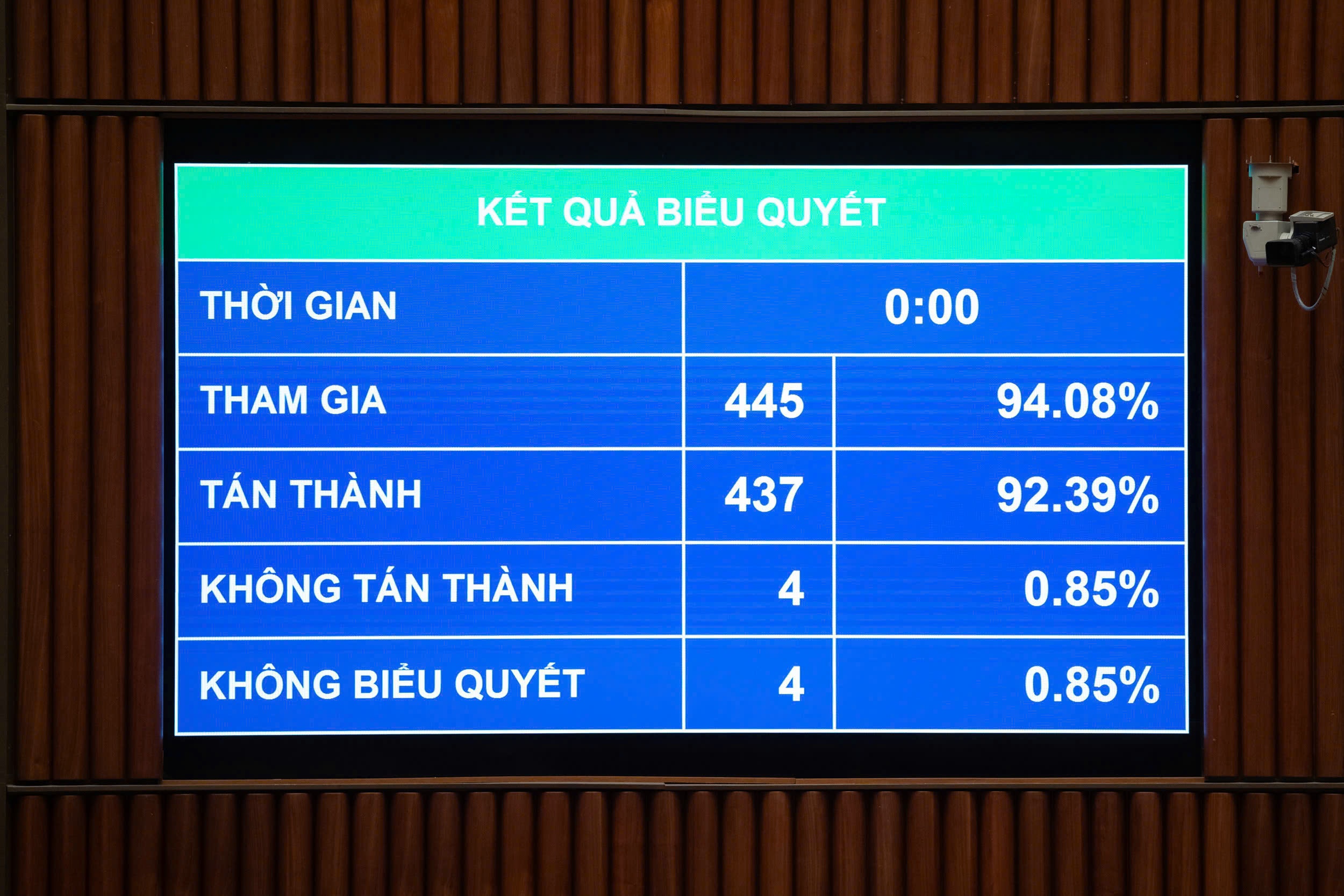 |
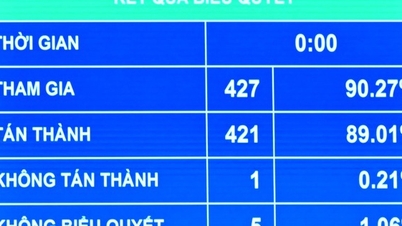
Voting to pass the Law amending and supplementing a number of articles of the Law on Education on the morning of December 10. Photo: Quochoi.vn . |
Vocational and university education institutions are also required to independently determine the list and level of service fees, except in cases where the State sets prices, but these must be publicly disclosed by course, level, and academic year.
Private and independent educational institutions are free to determine tuition fees and service charges to ensure they cover costs and generate surplus, while also being required to fully disclose tuition fees and service charges in accordance with the school's establishment documents and legal regulations.
Change the diploma issuing authority.
In addition to regulations related to textbooks, the new education law also amends and supplements regulations related to the confirmation of completion of primary, lower secondary, and upper secondary education programs and the issuance of high school diplomas.
Specifically, students who have completed the primary and lower secondary education programs and meet the requirements stipulated by the Ministry of Education and Training will have their academic records certified by the school principal as having completed the primary and lower secondary education programs.
Previously, the 2019 Education Law stated that students who completed the lower secondary education program and met the requirements would be awarded a graduation certificate by the head of the specialized education agency under the People's Committee at the district level.
Similar to high school level. Previously, high school graduates would be awarded a diploma by the head of the specialized education agency under the provincial People's Committee. Currently, with the new law passed by the National Assembly, students who have completed the high school education program and meet the prescribed requirements will be allowed to take the exam. If they meet the requirements, they will be awarded a high school diploma by the school principal.
In case students do not take the exam or do not pass the exam, the school principal will issue a certificate of completion of the general education program.
The certificate of completion of general education program is used to register for the high school graduation exam when the learner has a need or to study vocational education and is used in specific cases according to the provisions of law.
In addition to the above-mentioned contents, the new education law passed by the National Assembly has also amended and supplemented many provisions compared to the old education law, including content related to diplomas and certificates; school boards; licensing of educational activities, student admissions, etc.
Source: https://znews.vn/thong-nhat-1-bo-sach-giao-khoa-mien-phi-cho-tat-ca-hoc-sinh-post1609968.html


![[Photo] The captivating scenery of the fragrant maple forest in Quang Tri](/_next/image?url=https%3A%2F%2Fvphoto.vietnam.vn%2Fthumb%2F1200x675%2Fvietnam%2Fresource%2FIMAGE%2F2025%2F12%2F10%2F1765353233198_lan09046-jpg.webp&w=3840&q=75)
![[Photo] Explore the US Navy's USS Robert Smalls warship](/_next/image?url=https%3A%2F%2Fvphoto.vietnam.vn%2Fthumb%2F1200x675%2Fvietnam%2Fresource%2FIMAGE%2F2025%2F12%2F10%2F1765341533272_11212121-8303-jpg.webp&w=3840&q=75)

















![[Video] The craft of making Dong Ho folk paintings has been inscribed by UNESCO on the List of Crafts in Need of Urgent Safeguarding.](https://vphoto.vietnam.vn/thumb/402x226/vietnam/resource/IMAGE/2025/12/10/1765350246533_tranh-dong-ho-734-jpg.webp)





















































Comment (0)