

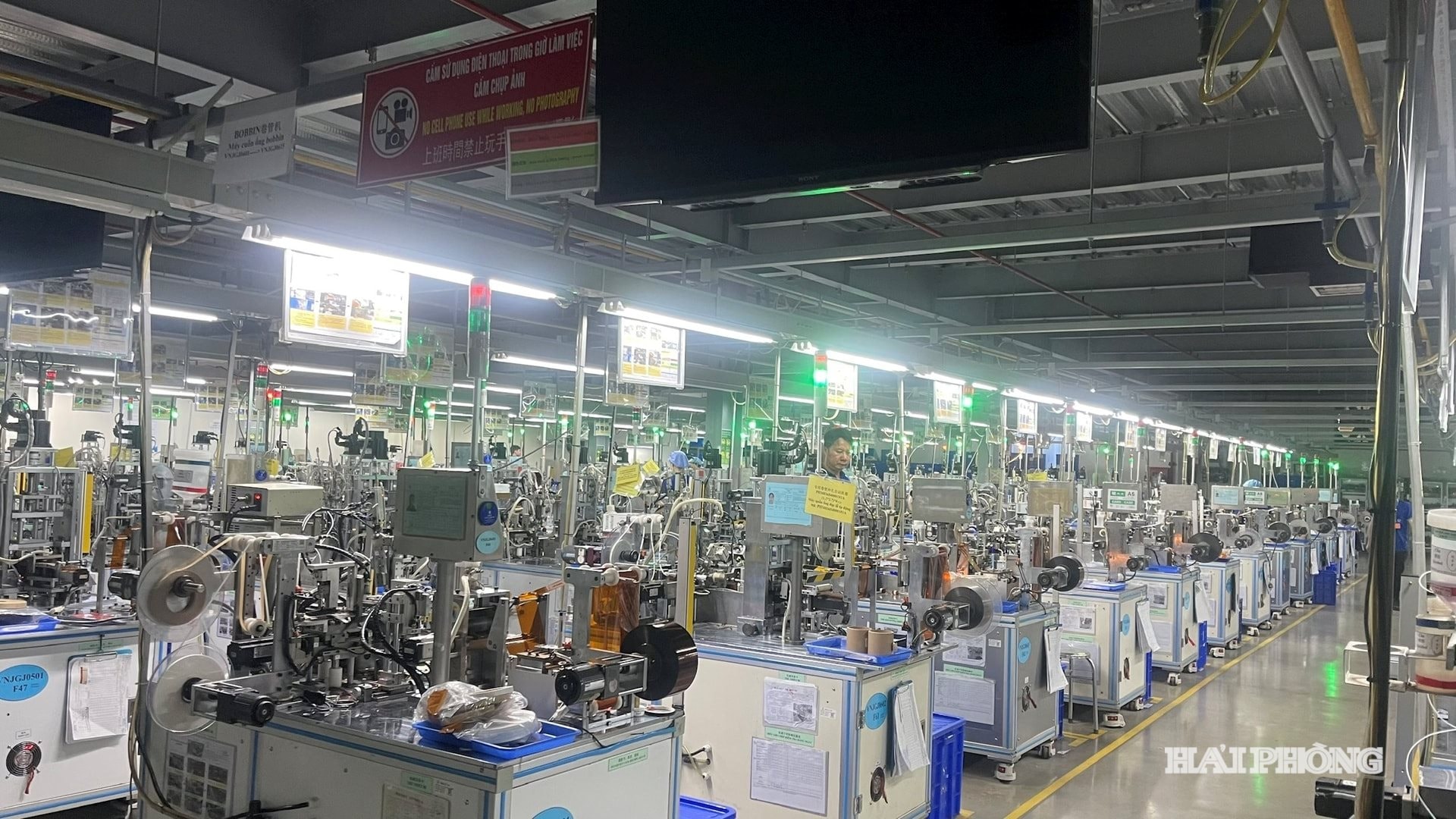
Transition to clean energy
Implementing Plan No. 205/KH-UBND of the City People's Committee on enhancing electricity saving in the period of 2023 - 2025, businesses in the area simultaneously deployed many solutions to reduce energy consumption, prioritize the use of high-efficiency equipment and integrate renewable energy sources into production.
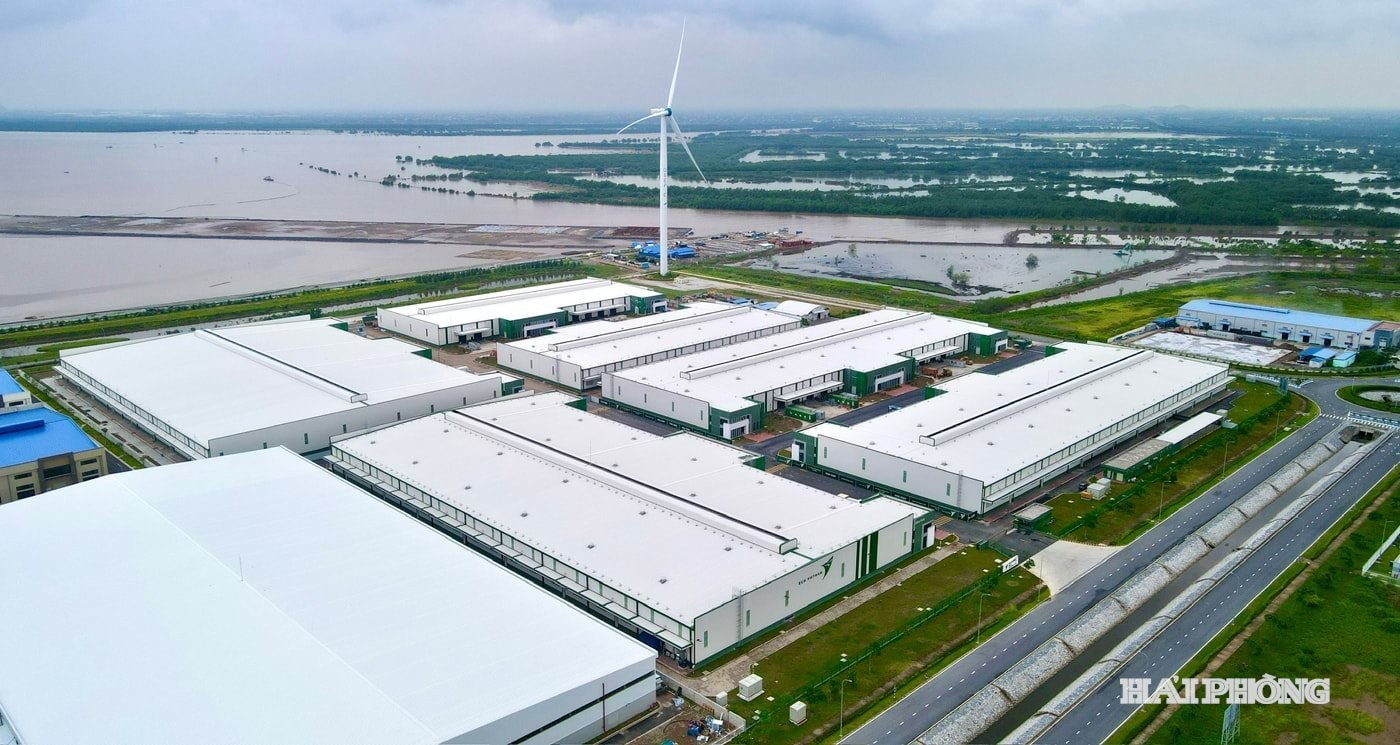
DEEP C Industrial Zone Complex (East Hai Phong area) is one of the pioneers in developing an ecological model in Vietnam. Currently, 4 industrial zones of DEEP C Industrial Zones are replacing old lights with Signify's smart LED lights, with the ability to automatically adjust the appropriate brightness at night, helping to optimize energy use and increase lamp life. This green conversion is estimated to bring about savings of up to 45% of energy consumption (compared to old halogen lights), while reducing more than 60 tons of CO2 annually.
In addition, the solar power system at DEEP C Hai Phong includes many panels installed on factory roofs and vacant land to produce electricity. Currently, DEEP C has installed more than 20MWp of solar panels, contributing to reducing annual CO₂ emissions.
According to incomplete statistics, after 5 years of persistently implementing the ecological industrial park model, each year, the unit saves 5.7 million kWh of electricity. This power source is fed into the industrial park's internal grid, helping to diversify the supply source. According to the representative of DEEP C, this is not only an economic problem but also a strategy to enhance environmental value and competitiveness.
In the West Hai Phong area, Poyun Vietnam Electronics Co., Ltd. (Tran Hung Dao Ward) invested in a rooftop solar power system with 3,468 panels, capacity of 1.9 MW. After just over 8 months of operation, the enterprise has saved about 5 billion VND in electricity costs, equivalent to an output of 2 million kWh of electricity. This system currently meets about 80% of the factory's electricity consumption needs, showing clear efficiency and the ability to replicate in the electronics, mechanical and assembly manufacturing industries.
Also in the industrial production sector, Ford Vietnam Co., Ltd. (Viet Hoa Ward) conducted an energy audit, replacing lighting and air conditioning systems with energy-saving devices, and increasing ventilation and natural lighting in the factory. The company aims to save at least 2% of electricity consumption each year and is researching and deploying a rooftop solar power system to self-supply electricity for production activities.
The above models show that implementing energy-saving solutions is completely feasible, bringing economic and environmental efficiency, and at the same time being consistent with the city's green and sustainable development orientation.
Spread the electricity saving movement
In recent years, the electricity saving movement in the business community in Hai Phong has become a oriented program, promoted by both state policies and the goal of reducing production costs. The City People's Committee issued a Plan to implement electricity saving for the period 2023-2025 to concretize the Government 's Directive.
Accordingly, the City People's Committee requires production facilities with high consumption to implement clear saving targets; at the same time, encourage the installation of renewable energy sources, use of high-efficiency energy-labeled equipment and participate in the load adjustment program when necessary. This plan is not only an administrative document but also creates a legal framework, a premise for businesses to incorporate electricity saving into their production and cost management strategies.
In fact, this policy encourages the shift of investment to technological solutions. At the enterprise level, projects to install rooftop solar power, replace all lighting with smart LED or apply real-time electricity consumption monitoring systems are becoming popular because of the direct economic benefits: reducing energy bills, shortening payback periods and reducing emissions.
For example, at Poyun Viet Electronics Co., Ltd., after just over 8 months of operating a 1.9 MW rooftop solar power system, the company recorded savings of about 5 billion VND, equivalent to more than 2 million kWh of electricity generation. This result has contributed to convincing many businesses in the same industry to consider the "self-production and self-consumption" option to reduce dependence on grid electricity.
In addition to economic outcomes, policy and technology must also be driven by the awareness and vision of business leaders and technology partners. At recent conferences, representatives of lighting technology and energy management corporations repeatedly emphasized the role of smart lighting and data in optimizing consumption.
Mr. Phung Hoai Duong, General Director of Signify Vietnam, affirmed that the transition to sustainable production combined with smart energy-saving solutions is the foundation to improve the competitiveness of Vietnamese enterprises... This assessment shows that technology and data management are key to expanding the effectiveness of energy saving.
However, the transition process still faces significant barriers. According to representatives of some businesses, initial investments in solar power systems, smart LED devices or control systems often require large capital and the economic benefits, although obvious, take time to recover.
Many small and medium-sized enterprises are still concerned about the costs, procedures and capacity to operate new technologies. Furthermore, in terms of management, the measurement, monitoring and reporting of energy savings are not synchronized between enterprises and between enterprises and management agencies, leading to difficulties in evaluating, comparing and replicating successful models.
These constraints require local authorities, the Electricity industry and financial partners to work together to develop support mechanisms or tax incentive policies, or technical assistance and operational training programs.
CONFIDANTSource: https://baohaiphong.vn/tiet-kiem-nang-luong-gop-phan-giam-chi-phi-trong-san-xuat-526931.html

![[Photo] General Secretary To Lam and National Assembly Chairman Tran Thanh Man attend the 80th Anniversary of the Traditional Day of the Vietnamese Inspection Sector](https://vphoto.vietnam.vn/thumb/1200x675/vietnam/resource/IMAGE/2025/11/17/1763356362984_a2-bnd-7940-3561-jpg.webp)













































































Comment (0)