

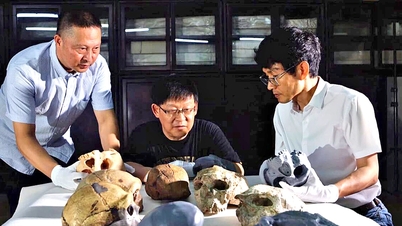
Researchers excavating near Lake Turkana in northern Kenya have found fossilized hand and foot bones belonging to an extinct relative of humans, dating back 1.52 million years.
Research results show that this species was capable of grasping and manipulating objects such as stone tools, and moved entirely on two legs.
New research published in the journal Nature shows that fossils discovered in an area called Koobi Fora, located east of Lake Turkana, represent the first hand and foot bones believed to belong to the species Paranthropus boisei.
This incomplete skeleton includes most of the hand, three foot bones, most of the teeth, part of the forearm bone, and fragments of the skull.
Given the fragmented nature of previously found fossils, this new discovery represents a breakthrough in the study of Paranthropus boisei. This species is a member of the evolutionary lineage of humans, essentially a relative of Homo sapiens, which evolved much later.
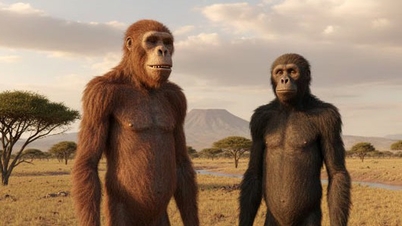
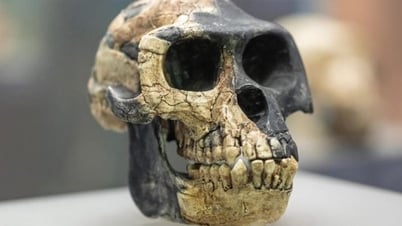
Paranthropus boisei had a robust physique with strong jaws and massive teeth. Its skull was adapted for forcefully chewing tough plants, featuring a crest on top to anchor the large jaw muscles, while flared cheekbones created its characteristic disc-shaped face.
Previously, due to the lack of fossilized hands and feet, research into the tool-making and tool-using abilities of this species was limited.
Paleoanthropologist Carrie Mongle of Stony Brook University in New York, the lead author of the study, commented: "Sixty-five years after the discovery of this species, this is the first time we can confidently link Paranthropus boisei to specific hand and foot bones."
"Before this discovery, scientists were limited to the skull and teeth of this species, and there was very little data on the rest of the skeleton," said paleoanthropologist and co-author Louise Leakey, director of the Koobi Fora Research Project.
According to Leakey, the hand bones show that the species could perform precise grasping movements similar to modern humans, suggesting that Paranthropus boisei was capable of making and using stone tools. The fossils also provide information about locomotion, indicating that the species had adapted to walking upright on two legs.
Ms. Leakey asserted: "From a few metatarsal bones, we can see that it was entirely bipedal, without flat feet like chimpanzees, and Paranthropus boisei's feet must have had lateral arches, similar to our own feet, which helped it move forward when walking."
Species belonging to the evolutionary branch of humans are collectively known as hominins. Paranthropus boisei was one of four early human species that lived in East Africa approximately 1-2 million years ago.
Stone and bone tools from that period have been discovered, although it remains unclear whether Paranthropus was able to manufacture and use them.
Source: https://www.vietnamplus.vn/tim-thay-hoa-thach-mot-ho-hang-da-tuyet-chung-cua-loai-nguoi-post1071174.vnp
![[Photo] Two flights successfully landed and took off at Long Thanh Airport.](/_next/image?url=https%3A%2F%2Fvphoto.vietnam.vn%2Fthumb%2F1200x675%2Fvietnam%2Fresource%2FIMAGE%2F2025%2F12%2F15%2F1765808718882_ndo_br_img-8897-resize-5807-jpg.webp&w=3840&q=75)






























































































Comment (0)