

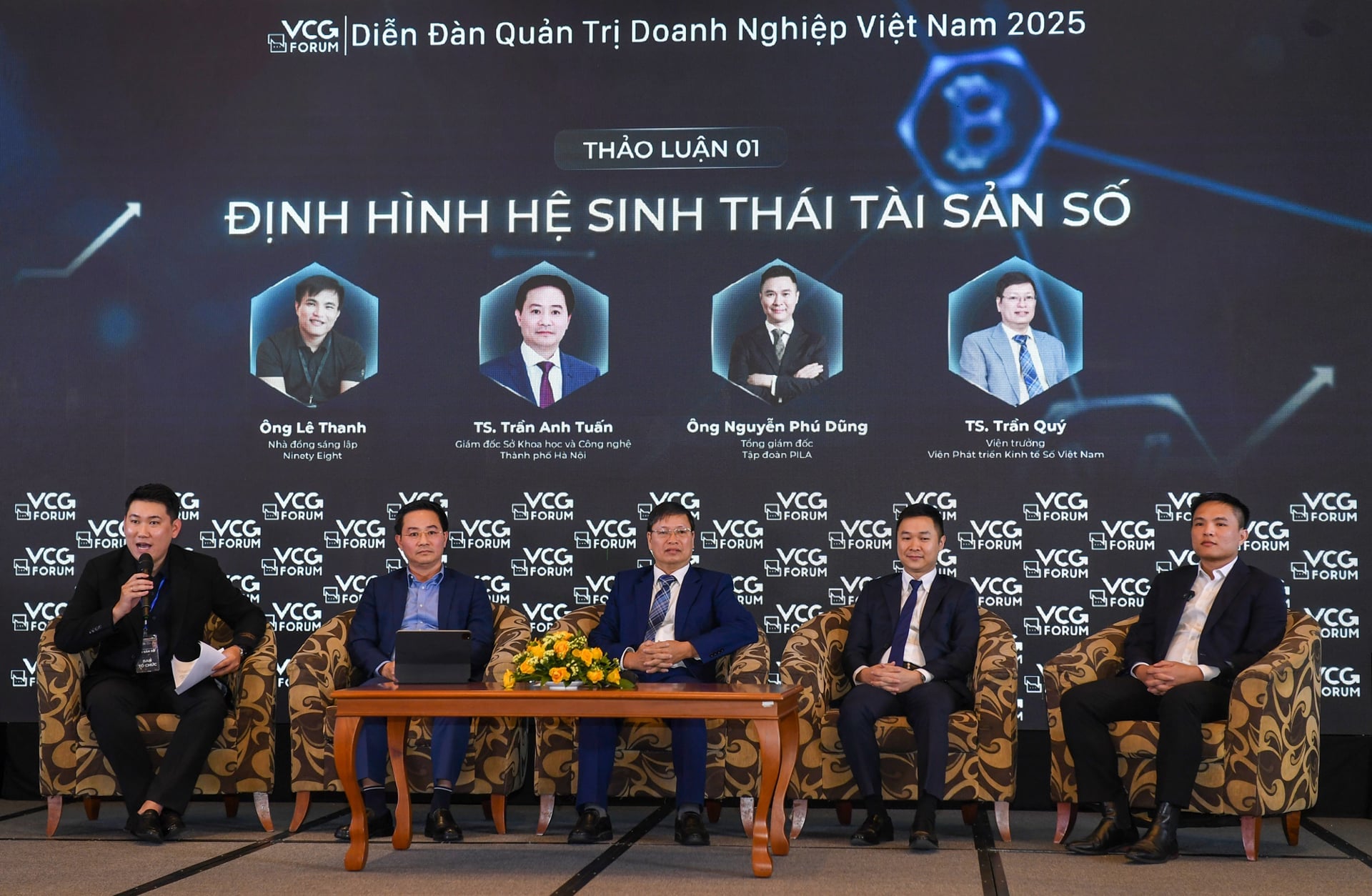
Speaking at the Vietnam Corporate Governance Forum 2025 (VCG Forum 2025) with the theme "Unlocking the Potential of Digital Assets," Mr. Nguyen Duc Thuan, Chairman of the Vietnam Association of Corporate Governance (VACD), stated that Vietnam is entering an era of strong growth and realizing this aspiration requires new growth drivers. One of these is the market for digital assets and crypto assets.
 |
According to assessments by international investment organizations, the Vietnamese digital asset market is highly promising due to its highest adoption rate of digital assets in Southeast Asia and fourth globally. According to Chainalysis' Crypto Adoption Index 2025 report, with approximately 21% of the population using or holding digital assets, the total transaction value in one year exceeds $220 billion. Furthermore, the factors of a young, tech-savvy population that readily accepts digital products, and the openness of government policies, also contribute to the market's attractiveness.
According to a survey by the Vietnam Association of Corporate Directors (VACD), businesses' thinking about digital assets has matured significantly. Vietnamese businesses no longer view digital assets as a speculative product, but rather as a tool to transparentize cash flow and digitize ownership of real assets.
Mr. Nguyen Phu Dung, co-founder of PILA Group and a member of the Solaris Impact fund investment board under Pacific Bridge Capital, pointed out the reality that Vietnam's capital turnover rate is only one-third that of Singapore. The main reason is that capital in Vietnam is tied up in collateral assets, mainly real estate. However, with the new legal framework on digital assets, and as digital trust is built, this capital bottleneck will be resolved. Accordingly, raising capital through digital asset channels will become easier.
"When collateral is no longer needed, capital will flow more freely without being tied up too much in physical assets. Of course, to achieve this, the parties must build trust in digital assets," Mr. Dung commented.
Globally , digital assets are divided into two groups: pure digital assets and digitally encrypted assets (RWA). Experts believe that Vietnam's strength lies in RWA assets, through the encryption of real-world assets.
"If Vietnam doesn't leverage this strength, it will be very difficult to catch up with the world. The legal framework supports Vietnam in pursuing this advantage, especially in the fields of real estate, wind power, logistics, and intangible assets such as tourism exploitation rights or digital content intellectual property. All these characteristics can be fully transformed into digital assets to attract investment," Mr. Dung recommended.
With the opening of Resolution No. 05/2025/NQ-CP, Vietnam may have five digital asset exchanges established by 2026. Dr. Tran Quy, Director of the Vietnam Institute for Digital Economic Development, believes that five exchanges is not a small number, but attracting investors and becoming a channel for capital mobilization depends on many factors, including trust, technology, and management systems.
In fact, blockchain technology offers many benefits to the economy, not just as a digital asset. Le Thanh, co-founder of Ninety Eight – one of the blockchain technology development companies established in 2017 – says that blockchain has many applications, and even within the digital asset sector, there are different markets and user groups with varying needs. Therefore, exchanges are not the only application, nor can it be definitively said to be the biggest business opportunity.
"In my opinion, we need to look at Blockchain from a broader perspective. It's a large ecosystem picture, encompassing exchanges, infrastructure layers, digital asset components, and applications developed on that platform," Mr. Thanh stated.
According to experts, although Vietnam has no precedent for operating a digital asset exchange, in terms of technology and the quality of its human resources, Vietnam is in no way inferior to other countries in the world. Currently, top blockchain companies worldwide such as Binance, Coinbase, Ethereum... all have significant contributions from Vietnamese people.
According to a representative from Ninety Eight, the legal framework needs further improvement for the market to function smoothly.
"Although we say we have laws, the regulations are still very basic, lacking specific guidelines, like having only a green light to proceed but no clear path. Furthermore, we also face risks related to infrastructure and security, as well as challenges in investment thinking. However, alongside the challenges are very clear opportunities. The reason we must develop this sector is because it offers a more transparent financial transaction model, higher liquidity thanks to global connectivity, faster transaction speeds, and significantly lower costs compared to traditional markets," said Nguyen The Vinh, co-founder of Ninety Eight.
Source: https://baodautu.vn/toc-do-quay-vong-von-cua-viet-nam-chi-bang-13-singapore-tai-san-so-la-chia-khoa-d456173.html



![[Image] Vietnam's colorful journey of innovation](/_next/image?url=https%3A%2F%2Fvphoto.vietnam.vn%2Fthumb%2F1200x675%2Fvietnam%2Fresource%2FIMAGE%2F2025%2F12%2F14%2F1765703036409_image-1.jpeg&w=3840&q=75)


























































![[Image] Vietnam's colorful journey of innovation](https://vphoto.vietnam.vn/thumb/402x226/vietnam/resource/IMAGE/2025/12/14/1765703036409_image-1.jpeg)


























Comment (0)