

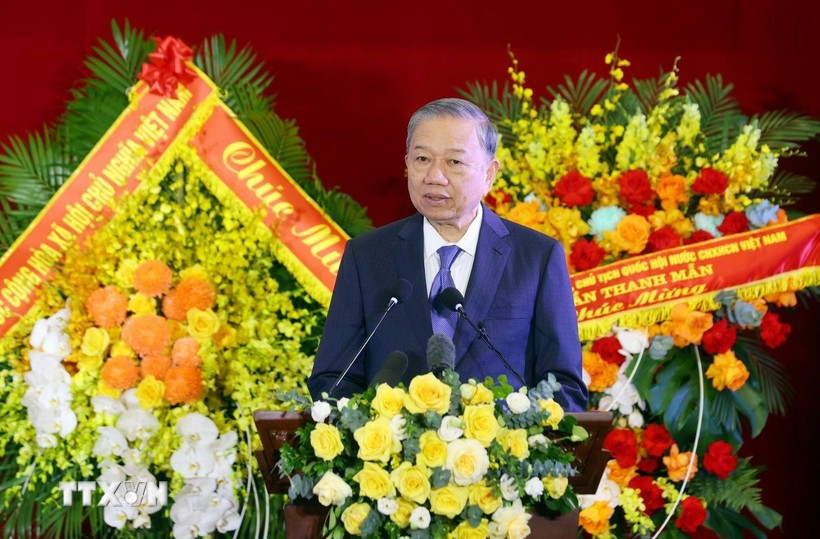
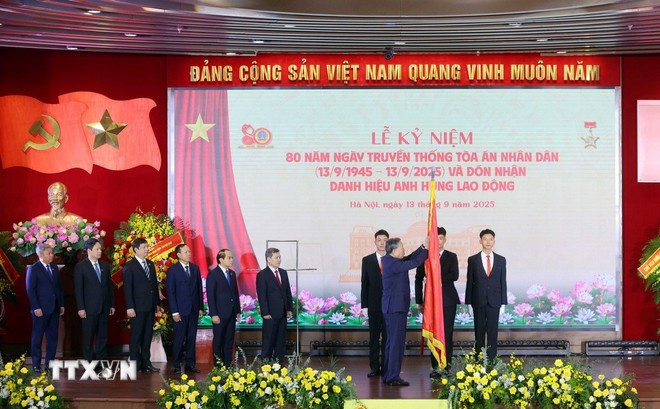
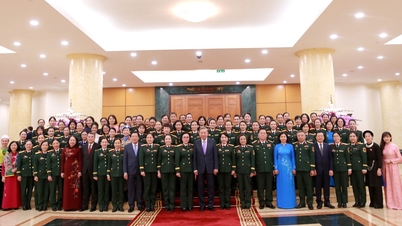
On the morning of September 13th, in Hanoi , General Secretary To Lam attended the ceremony commemorating the 80th anniversary of the Traditional Day of the People's Courts (September 13, 1945 - September 13, 2025).
Attending the ceremony were members of the Politburo and Secretaries of the Central Committee of the Party: Phan Dinh Trac, Head of the Central Internal Affairs Commission; Nguyen Duy Ngoc, Chairman of the Central Inspection Commission; Do Van Chien, Chairman of the Central Committee of the Vietnam Fatherland Front; members of the Politburo: Standing Deputy Prime Minister Nguyen Hoa Binh ; Minister of Public Security, General Luong Tam Quang; and Bui Thi Minh Hoai, Secretary of the Hanoi City Party Committee. Also present were Secretaries of the Central Committee of the Party: General Trinh Van Quyet, Head of the General Political Department of the Vietnam People's Army; Le Hoai Trung, Acting Minister of Foreign Affairs; Le Minh Tri, Chief Justice of the Supreme People's Court; members of the Central Committee of the Party: Vice President Vo Thi Anh Xuan; Vice Chairman of the National Assembly Nguyen Duc Hai; leaders of central and Hanoi city departments, ministries, agencies, and organizations; leaders and former leaders of the Supreme People's Court, along with all civil servants, officials, and employees of the People's Court. Officers and soldiers of military courts nationwide.
A solid political and legal "fortress," contributing to strengthening the people's trust.
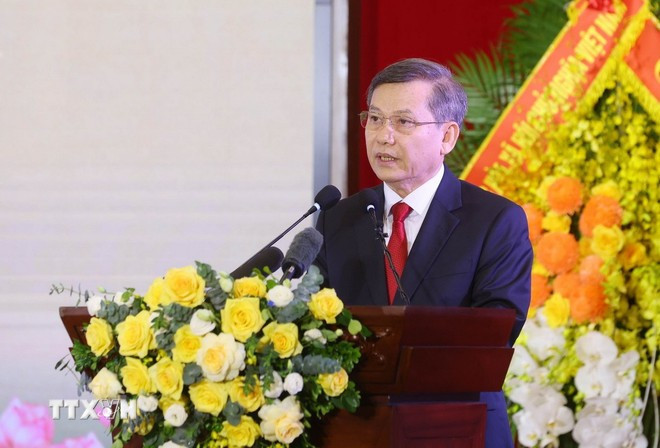
Delivering a speech at the commemoration ceremony, Chief Justice of the Supreme People's Court Le Minh Tri emphasized that 80 years ago, on September 13, 1945, President Ho Chi Minh signed Decree No. 33C, establishing military courts.
This is a significant historical event, marking the establishment of the courts, and since then, September 13th has become the traditional day of the People's Court system.
On January 24, 1946, the President of the Provisional Government of the Democratic Republic of Vietnam issued Decree No. 13 on the organization of courts and judicial ranks.
Accordingly, a system of ordinary courts (later renamed People's Courts) was established, including: primary courts at the district level, second-level courts at the provincial level, and three Supreme Courts in the North, Central, and South regions.
In particular, as the country enters a new stage of development, alongside its judicial activities, the Court has the task of identifying and recommending to competent authorities the amendment or repeal of documents that violate the Constitution and laws; developing case law; training personnel, judges, and providing professional training in the judicial field.
Looking back over the past 80 years, through the various stages of the country's development, regardless of the circumstances, from the arduous and fierce years of resistance to the years of peace, reform, and national development, generations of court officials and employees have always been dedicated to serving the people, loyal to the Party and the State; striving diligently; overcoming all difficulties and challenges; united in purpose, striving to build the People's Courts into a worthy symbol of justice and fairness, protecting what is right, fighting against what is wrong, protecting the Party, protecting the interests of the State, the legitimate rights and interests of organizations and individuals, serving the Fatherland, and serving the people.
Over the past 80 years, the judicial sector has been awarded many prestigious honors by the Party and the State, including the Gold Star Order and the Ho Chi Minh Order twice.
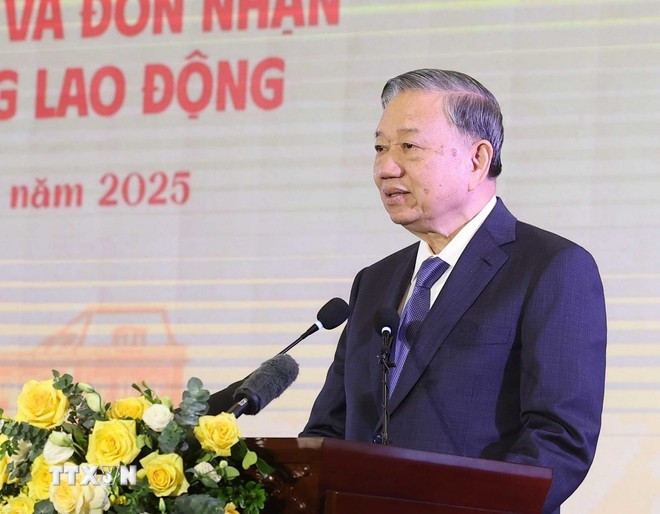
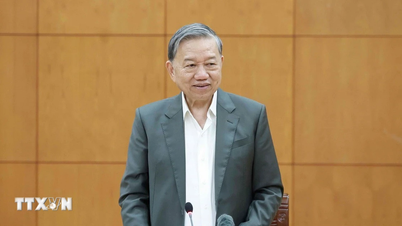
Speaking at the commemoration ceremony, General Secretary To Lam emphasized that speaking of the courts is speaking of the sacred meaning of justice and fairness; speaking of integrity and impartiality; speaking of the people's trust and support.
This is both a source of pride and a great responsibility for the People's Court system towards the nation. Established immediately after the success of the August Revolution and the founding of the Democratic Republic of Vietnam – alongside the nation through two protracted wars – and maturing during the country's renovation process, the People's Court system has made many important contributions to the struggle for independence, national reunification, and the building and protection of the socialist Vietnamese Fatherland.
Along with the country's development, the important role and position of the judiciary are increasingly affirmed; the functions and tasks of the courts are becoming clearer; the organizational model of the judiciary is becoming more perfect; the team of judges and judicial staff is growing stronger; the material facilities, equipment, and working conditions are improving; and the work of the judiciary is making more progress.
The General Secretary affirmed that the Party and State of Vietnam have always acknowledged and highly appreciated the contributions of the People's Courts throughout various periods, from protecting the achievements of the revolution, consolidating the people's government, maintaining political security, ensuring social order and safety, preventing and combating crime, corruption, waste, and negative phenomena; to protecting justice and fairness, protecting human rights, civil rights, and the legitimate rights and interests of the State, organizations, and individuals.
To fulfill its responsibilities effectively, the General Secretary requested that the People's Courts sector always thoroughly understand and effectively implement the Party's guidelines and policies on comprehensively promoting the reform process, and simultaneously carrying out strategic tasks and breakthrough policies to develop the country in the new era, the era of national progress.
Effectively carry out advisory work, coordinate strategic advice with the Party and the State, and implement policies and guidelines on building a socialist rule of law state; on judicial reform and innovation in building and perfecting the legal system; and comprehensively improve the institutions for national development.
Maintaining and strengthening the Party's leadership over the judicial organs in general, and the People's Courts in particular, is an unchangeable principle that ensures the People's Courts sector continues to develop steadily, steadfastly pursuing the goal of national independence linked with socialism, and placing national interests and the interests of the people above all else in all activities.
The People's Court must be a solid political and legal "fortress," contributing to strengthening the people's trust in the Party, the State, and the cause of national renewal, construction, and development along the socialist path.
The General Secretary requested a focus on improving the quality and effectiveness of judicial proceedings at all levels – this is the central task of the judicial sector, and also the central task of judicial reform.
In judicial proceedings, the measure of success must be the protection of justice, fairness, human rights, civil rights, the interests of the State, and the legitimate rights and interests of organizations and individuals.
The principles of adjudication stipulated in the Constitution and laws must be strictly implemented, especially ensuring independent adversarial proceedings; ensuring the principle of adversarial proceedings; conducting trials openly and transparently, except as otherwise provided by law; ensuring that all citizens are equal before the law; and guaranteeing the right to defense of suspects and defendants, and the right to protect the legitimate interests of parties involved.
Regardless of the nature or severity of any case, serious wrongful convictions or miscarriages of justice that harm the rights and interests of the State, or the legitimate interests of organizations and individuals, must not be allowed to occur.
The judicial branch must constantly strive to ensure that all judgments are "fair and reasonable"—strict in law but also rich in humanity, simultaneously protecting the rule of law and maintaining social stability and harmony, nurturing faith and aspirations for a better life among the people. The court should not only be an institution for adjudication, but also a symbol of justice and the people's trust, a solid foundation upon which people can entrust their hopes for fairness and righteousness.
A symbol of justice, fairness, faith, and righteousness.
The General Secretary emphasized the need to strengthen participation in building and perfecting legal institutions, ensuring the consistent application of law in the activities of prosecuting agencies.
The judicial sector is promoting modernization and expanding international cooperation in its work; strengthening digital transformation, applying science and technology, aiming to build e-courts - digital courts, to better serve the people.
The judicial sector needs to continue to do well in foreign affairs and international cooperation in accordance with the Party and State's policies to enhance the international standing and prestige of the Vietnamese courts; to research, select, and learn from the experiences of countries with modern judicial systems, in order to continuously improve the operational capacity of domestic courts, especially in adjudicating and resolving cases with foreign elements and international characteristics, and to actively participate in international justice.
The General Secretary noted that the most important issue is to pay special attention to building the judicial sector, especially building a team of officials and judges of the People's Courts that meets the requirements and tasks in the new situation; it is necessary to focus on building a clean, strong, professional, and modern Party and judicial sector, promoting the spirit of unity and responsibility; strengthening discipline, order, and integrity within the sector; and ensuring the smooth, efficient, effective, and efficient operation of the three-level People's Court model after restructuring and streamlining.
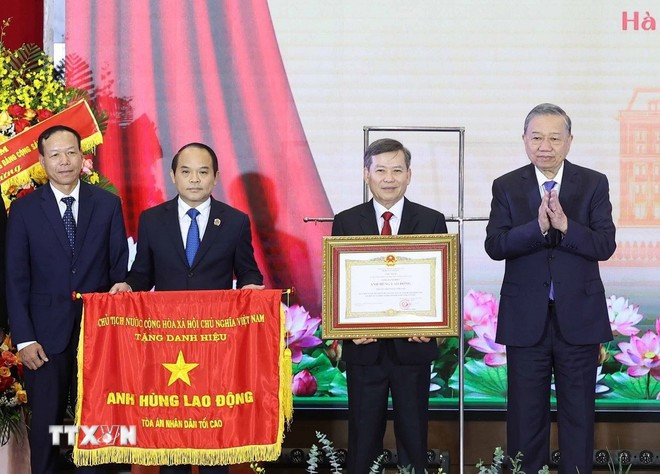
The judicial sector must pay special attention to building a team of officials, especially judges, who possess strong political convictions, impeccable ethics, integrity, deep expertise, the courage to defend what is right, and the determination to fight against what is wrong.
Every court official, especially the team of judges, needs to clearly understand their role and responsibility as those entrusted with the crucial task of upholding justice and fairness; and as those who "act in the name of the Socialist Republic of Vietnam" to adjudicate and pronounce judgments.
Each ruling not only demonstrates the ability to apply the law but also reflects political acumen, professional ethics, and profound social responsibility. Therefore, judges and court officials are required to be truly fair, honest, courageous, knowledgeable in law, well-versed in practical matters, and compassionate.
Every judicial officer must constantly study, cultivate ethics and professional competence, as President Ho Chi Minh taught judicial officers, "Serve the public, uphold the law, be impartial and selfless," and "be close to the people, understand the people, help the people, and learn from the people," meeting the increasingly high demands of the job in the new era.
The General Secretary affirmed that the Party and the State will continue to allocate resources to strengthen the infrastructure, equipment, and office buildings for courts at all levels, so that they can live up to their position as the center of the judicial system and a symbol of justice.
The General Secretary expressed confidence that the People's Court system will continue to make remarkable progress in the coming time, truly becoming a symbol of justice, fairness, trust, and righteousness in our society, making an important contribution to building the socialist rule of law state of Vietnam, of the people, by the people, and for the people; and together with the entire Party, the entire people, and the entire army, successfully achieving the goal of a prosperous people, a strong nation, democracy, fairness, and civilization.
At the ceremony, on behalf of the Party and State leaders, General Secretary To Lam presented the title of Hero of Labor to the Supreme People's Court.
On behalf of the Party and State leaders, Vice President Vo Thi Anh Xuan presented the First-Class Labor Order to the People's Court of Hanoi and the People's Court of Ho Chi Minh City.
According to Hong Diep-Xuan Tung (VNA/Vietnam+)
Source: https://baogialai.com.vn/tong-bi-thu-nganh-toa-an-phai-phan-dau-de-moi-phan-quyet-deu-thau-tinh-dat-ly-post566510.html

![[Photo] Prime Minister Pham Minh Chinh receives the Governor of Tochigi Province (Japan)](/_next/image?url=https%3A%2F%2Fvphoto.vietnam.vn%2Fthumb%2F1200x675%2Fvietnam%2Fresource%2FIMAGE%2F2025%2F12%2F16%2F1765892133176_dsc-8082-6425-jpg.webp&w=3840&q=75)
![[Live] 2025 Community Action Awards Gala](/_next/image?url=https%3A%2F%2Fvphoto.vietnam.vn%2Fthumb%2F1200x675%2Fvietnam%2Fresource%2FIMAGE%2F2025%2F12%2F16%2F1765899631650_ndo_tr_z7334013144784-9f9fe10a6d63584c85aff40f2957c250-jpg.webp&w=3840&q=75)
![[Image] Leaked images ahead of the 2025 Community Action Awards gala.](/_next/image?url=https%3A%2F%2Fvphoto.vietnam.vn%2Fthumb%2F1200x675%2Fvietnam%2Fresource%2FIMAGE%2F2025%2F12%2F16%2F1765882828720_ndo_br_thiet-ke-chua-co-ten-45-png.webp&w=3840&q=75)
![[Photo] Prime Minister Pham Minh Chinh receives Lao Minister of Education and Sports Thongsalith Mangnormek](/_next/image?url=https%3A%2F%2Fvphoto.vietnam.vn%2Fthumb%2F1200x675%2Fvietnam%2Fresource%2FIMAGE%2F2025%2F12%2F16%2F1765876834721_dsc-7519-jpg.webp&w=3840&q=75)













































![[Video] Independence and self-reliance linked with international integration through 40 years of reform](https://vphoto.vietnam.vn/thumb/402x226/vietnam/resource/IMAGE/2025/12/16/1765899635777_1-1-8054-png.webp)























Comment (0)