

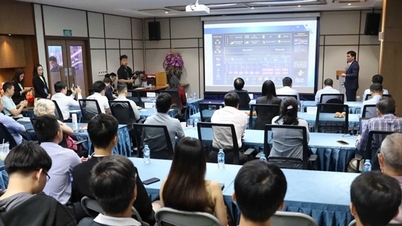
In November 2023, hundreds of technical experts from many of China's largest state-owned and private companies, including the Industrial and Commercial Bank of China (ICBC), China Telecom, Meituan, and Baidu, gathered in Beijing for a developer certification training session on Huawei's Harmony Operating System (OS).
The telecommunications giant has been quietly building an independent Chinese operating system, exempt from US sanctions, for four years since being placed on the sanctions list.
Independent ecosystem
Unlike HarmonyOS 4, which still uses the open-source Android project (AOSP) as its foundation, HarmonyOS NEXT is built entirely on the proprietary Harmony core developed by Huawei.
This means that Huawei's new operating system will lack the AOSP library, will not be compatible with Android, and will not directly run existing Android applications (APKs).
HarmonyOS NEXT is expected to help China break free from its dependence on foreign technology companies.
Huawei's ambitious move opens up promising opportunities for developers and programmers in China. As native applications become the sole language of HarmonyOS NEXT, the demand for programmers proficient in this architecture will increase significantly.
This prompted over 400 software companies from various sectors in China to participate and develop specialized HarmonyOS NEXT applications.
This is no easy goal, as the entirely new application ecosystem has yet to generate significant traction, especially among global developers – a key factor determining the long-term growth potential of the operating system.
However, HarmonyOS NEXT is a significant milestone in Huawei's journey towards software independence, paving the way for a potential alternative in the mobile market. Unlike standard HarmonyOS, the new operating system lacks AOSP components and therefore cannot run Android applications.
According to the developers, by the end of 2024, Huawei plans to invest approximately $1 billion to develop around 5,000 applications for the new operating system.
HarmonyOS NEXT is a proprietary product of Huawei. Developers use the Cangjie and ArkTS languages instead of Java and Kotlin to create applications for HarmonyOS NEXT. They also plan to integrate artificial intelligence (AI) into the system using the Pangu AI model.
Hardware self-reliance
According to a UBS survey, 11% of Chinese companies with integrated circuit (IC) needs said they are considering using domestically produced chips instead of imported ones, while 39% said they are willing to do so.
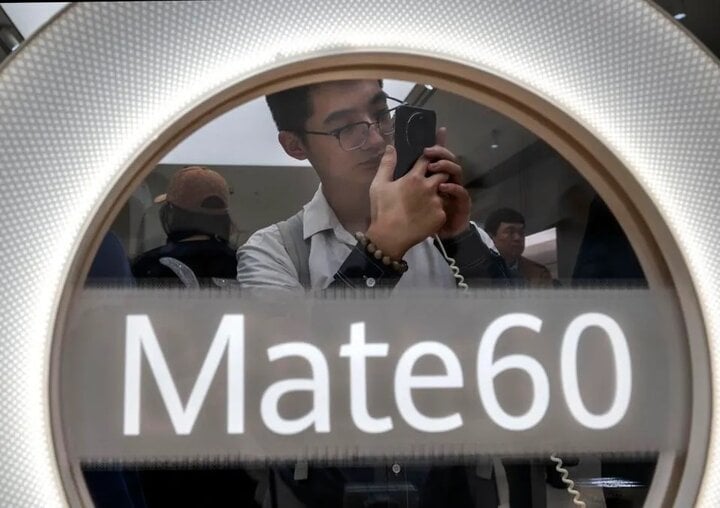
In August 2023, Huawei unexpectedly launched the high-end Mate 60 smartphone, featuring the Kirin 9000s chip manufactured by SMIC using an advanced 7nm process.
"Over the next three years, the percentage of Chinese companies using domestically produced chips will gradually increase to between 30 and 50 percent, which is a fairly significant increase," said Jimmy Yu, a China technology analyst at UBS.
China's domestic semiconductor manufacturing is gradually increasing as its chip market recovers, after a long period of sluggish consumer demand and facing various economic challenges.
In August 2023, Huawei unexpectedly launched the high-end Mate 60 smartphone with the Kirin 9000s chip, manufactured by SMIC using an advanced 7nm process. Based on tests conducted on the phone, the AnTuTu benchmarking website determined that the CPU has 12 cores and a maximum clock speed of 2.62GHz.
According to analyst Ming Chi Kuo, those who benefit from the launch of the Mate 60 Pro include SMIC, chip testing and packaging company Jiangsu Changjiang Electronics Tech, filter supplier Murata, GlobalFoundries, and Win Semi. Meanwhile, SMIC – China's largest chip contractor – can only manufacture 14nm chips because Washington restricts the export of advanced chip manufacturing equipment such as EUV lithography machines.
Analyst Edison Lee suggests that SMIC's progress could challenge the effectiveness of US sanctions. Some theories suggest SMIC is using deep ultraviolet (DUV) lithography to produce 7nm chips, or that the Kirin 9000s chips come from a secret chip stockpile developed by Huawei.
“Clearly, the semiconductor industry plays an extremely strategic role for every country in the world. Given geopolitical tensions, each country is trying its best to stabilize and improve its own operations,” Ajit Manocha, CEO of SEMI Industries, told Bloomberg TV.
Surpassing iOS, challenging Android.
Zhu Yonggang, president of Huawei's Consumer Business Cloud Services, said that more than 200 industry partners have started developing native HarmonyOS applications, and the company aims to have 5,000 partners participating by the end of 2024.
Meituan, the delivery service giant, has completed the first version of its HarmonyOS app with its first development partner group, while other internet companies, such as the lifestyle social media platform Xiaohongshu and the online mapping service Amap, have also made progress.
TechInsights predicts that HarmonyOS will surpass iOS in market share to become the most popular mobile operating system in China by 2024, challenging Android's dominance in the mainland.
Last month, fintech giant Ant Group announced it was building a new version of its Alipay payment app based on HarmonyOS, after Alibaba began developing DingTalk – a work-related tool – for the platform. Several major internet companies, such as JD.com and NetEase, are also hiring developers to write native applications for Huawei's operating system.
McDonald's China – a network of over 5,500 restaurants and more than 200,000 employees serving over 1 billion customers annually – has become one of the first multinational food companies in mainland China to adopt HarmonyOS Next.
According to a statement made in August 2023 by Huawei's consumer division CEO Richard Yu Chengdong, over 700 million devices were running HarmonyOS, with more than 2.2 million third-party developers writing applications for the platform.
The Viet (Source: Compilation)
Source
![[Photo] Prime Minister Pham Minh Chinh receives Lao Minister of Education and Sports Thongsalith Mangnormek](/_next/image?url=https%3A%2F%2Fvphoto.vietnam.vn%2Fthumb%2F1200x675%2Fvietnam%2Fresource%2FIMAGE%2F2025%2F12%2F16%2F1765876834721_dsc-7519-jpg.webp&w=3840&q=75)
![[Image] Leaked images ahead of the 2025 Community Action Awards gala.](/_next/image?url=https%3A%2F%2Fvphoto.vietnam.vn%2Fthumb%2F1200x675%2Fvietnam%2Fresource%2FIMAGE%2F2025%2F12%2F16%2F1765882828720_ndo_br_thiet-ke-chua-co-ten-45-png.webp&w=3840&q=75)
![[Photo] Prime Minister Pham Minh Chinh receives the Governor of Tochigi Province (Japan)](/_next/image?url=https%3A%2F%2Fvphoto.vietnam.vn%2Fthumb%2F1200x675%2Fvietnam%2Fresource%2FIMAGE%2F2025%2F12%2F16%2F1765892133176_dsc-8082-6425-jpg.webp&w=3840&q=75)

![[Live] 2025 Community Action Awards Gala](/_next/image?url=https%3A%2F%2Fvphoto.vietnam.vn%2Fthumb%2F1200x675%2Fvietnam%2Fresource%2FIMAGE%2F2025%2F12%2F16%2F1765899631650_ndo_tr_z7334013144784-9f9fe10a6d63584c85aff40f2957c250-jpg.webp&w=3840&q=75)














































![[Video] Independence and self-reliance linked with international integration through 40 years of reform](https://vphoto.vietnam.vn/thumb/402x226/vietnam/resource/IMAGE/2025/12/16/1765899635777_1-1-8054-png.webp)


























Comment (0)