

AI is no longer a technology of the future; it is already reshaping the geopolitical landscape and altering the global balance of power.
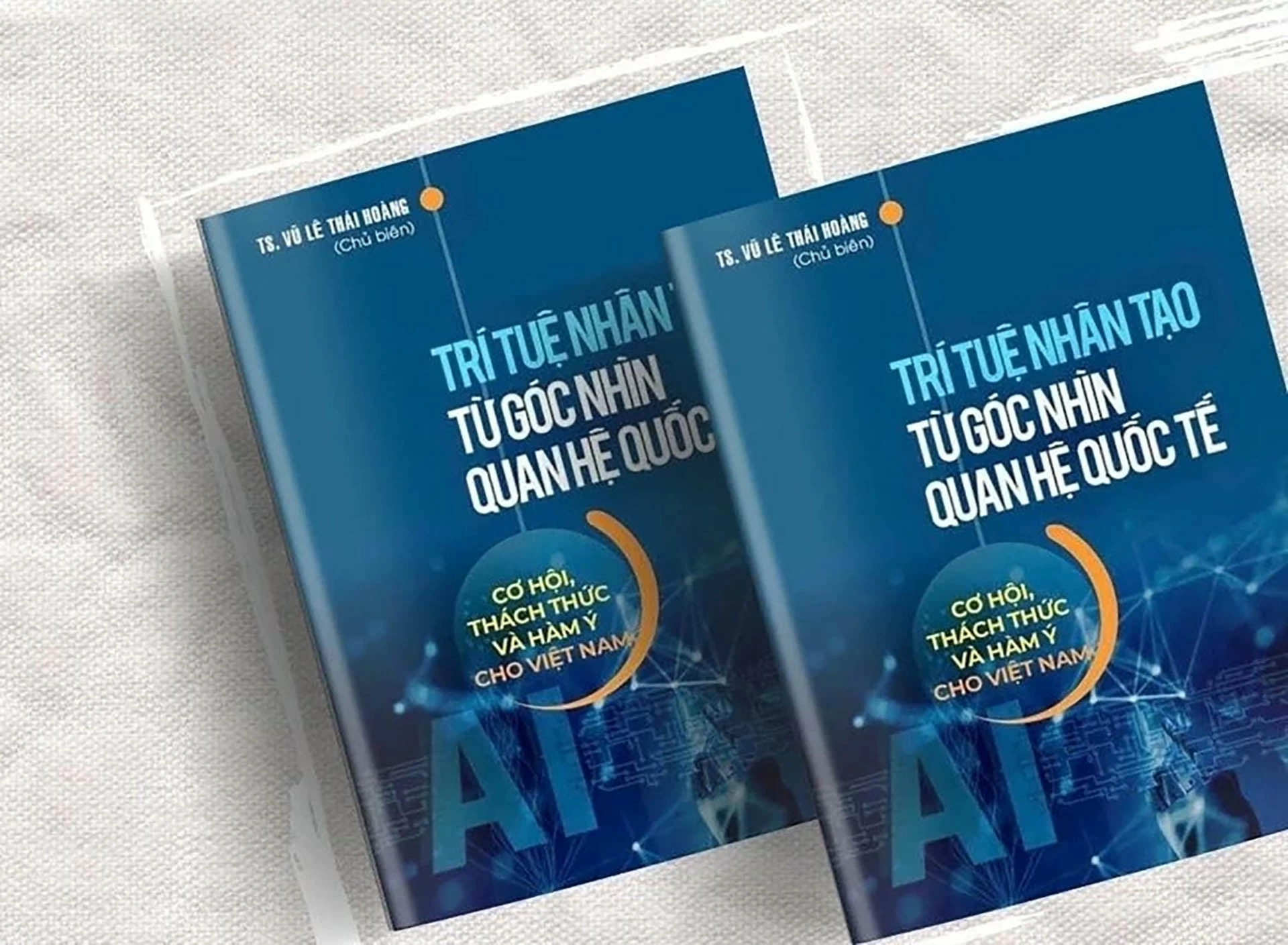 |
| The book "Artificial Intelligence from the Perspective of International Relations: Opportunities, Challenges, and Implications for Vietnam." |
The book "Artificial Intelligence from the Perspective of International Relations: Opportunities, Challenges, and Implications for Vietnam, " edited by Dr. Vu Le Thai Hoang, Director of the Institute for Strategic Studies ( Diplomatic Academy of Vietnam), has sold out quickly since its release, not only because of its appealing title but also because of the meticulousness and dedication of the research work.
According to Dr. Vu Le Thai Hoang, the book is a timely and necessary effort to contribute to identifying the profound changes that AI is creating in international relations. Particularly from 2022-2023, the remarkable development of large language models and AI generation has been creating groundbreaking impacts in many fields.
It can be asserted that AI is no longer a technology of the future, but is already reshaping the geopolitical landscape, altering the global balance of power, and directly impacting the national interests of countries.
Regarding the motivation for compiling the book, Dr. Vu Le Thai Hoang stated that it stemmed from the urgent need for a comprehensive and in-depth understanding of the impact of AI on international relations from Vietnam's perspective. In the context of increasingly fierce strategic competition among major powers in AI technology, researching and understanding the opportunities and challenges that AI presents will be crucial for the country's security and development.
The authors hope that this book will not only contribute to providing an academic reference source but also aim to propose specific policy directions, making a small contribution to efforts to help Vietnam be proactive and self-reliant in the gradually evolving AI era.
The book discusses the future of AI – AGI (Artificial General Intelligence – understood as AI systems capable of performing any intelligent task that humans can do), and then analyzes in depth the impact of AGI on international relations. According to Dr. Vu Le Thai Hoang, the “security dilemma” in the AI era is far more complex and multifaceted than in the nuclear weapons era. While with nuclear weapons we could count the number of warheads, estimate their destructive power and deterrence capabilities, with AI, especially as we move towards AGI, assessing the true potential and capabilities of a nation becomes extremely difficult.
This stems from the "dual" nature of AI – being both a civilian and a military technology, its rapid and unpredictable development, and its widespread impact on all aspects of life.
In the context of major countries accelerating AI development, "measuring" the balance of power requires new metrics and approaches. It's not simply a matter of comparing the number of patents or investment in research and development, but also considering factors such as access to data, computing power, the quality of human resources, and especially the ability to integrate AI into strategic decision-making systems. This makes maintaining strategic stability in the AI era a new challenge, requiring closer coordination and dialogue among nations.
For Vietnam, the book implies a comprehensive AI diplomacy strategy aimed at fostering an active role in shaping international rules and norms for AI development and use.
The book's editor asserts that, as a dynamically developing country with technological potential and a proven role in many important international issues, Vietnam has the opportunity to act as a bridge between developed and developing countries in the field of AI. This can be achieved through actively participating in multilateral forums on AI governance, promoting South-South cooperation in technology development, and sharing experiences on AI applications for sustainable development.
The book also mentions the inclusion of AI as a strategic pillar in the documents of the 14th National Congress, which is not simply the addition of a new technological term, but reflects a strategic vision regarding the crucial role of AI in the country's development. This will be an important basis for directing national resources, promoting innovation, and more importantly, demonstrating Vietnam's determination to seize the opportunities of the digital age to realize its aspiration for a prosperous and happy nation.
Source: https://baoquocte.vn/tu-chu-chu-dong-trong-ky-nguyen-ai-292912.html
![[Image] Leaked images ahead of the 2025 Community Action Awards gala.](/_next/image?url=https%3A%2F%2Fvphoto.vietnam.vn%2Fthumb%2F1200x675%2Fvietnam%2Fresource%2FIMAGE%2F2025%2F12%2F16%2F1765882828720_ndo_br_thiet-ke-chua-co-ten-45-png.webp&w=3840&q=75)

![[Photo] Prime Minister Pham Minh Chinh receives Lao Minister of Education and Sports Thongsalith Mangnormek](/_next/image?url=https%3A%2F%2Fvphoto.vietnam.vn%2Fthumb%2F1200x675%2Fvietnam%2Fresource%2FIMAGE%2F2025%2F12%2F16%2F1765876834721_dsc-7519-jpg.webp&w=3840&q=75)
![[Photo] Prime Minister Pham Minh Chinh receives the Governor of Tochigi Province (Japan)](/_next/image?url=https%3A%2F%2Fvphoto.vietnam.vn%2Fthumb%2F1200x675%2Fvietnam%2Fresource%2FIMAGE%2F2025%2F12%2F16%2F1765892133176_dsc-8082-6425-jpg.webp&w=3840&q=75)
![[Live] 2025 Community Action Awards Gala](/_next/image?url=https%3A%2F%2Fvphoto.vietnam.vn%2Fthumb%2F1200x675%2Fvietnam%2Fresource%2FIMAGE%2F2025%2F12%2F16%2F1765899631650_ndo_tr_z7334013144784-9f9fe10a6d63584c85aff40f2957c250-jpg.webp&w=3840&q=75)










































































Comment (0)