

NDO - Modern healthcare generates a massive amount of complex, high-resolution, and highly detailed image data. While this offers benefits for diagnosis, it also presents a challenge due to the sheer scale of the data. Therefore, the application of artificial intelligence (AI) is a way to make healthcare faster, more accurate, and meet the increasingly demanding requirements of the healthcare industry.
NDO - Modern healthcare generates a massive amount of complex, high-resolution, and highly detailed image data. While this offers benefits for diagnosis, it also presents a challenge due to the sheer scale of the data. Therefore, the application of artificial intelligence (AI) is a way to make healthcare faster, more accurate, and meet the increasingly demanding requirements of the healthcare industry.
AI-powered magnetic resonance imaging (MRI) systems reconstruct detailed images from small data sources, automate scan planning, correction, and data analysis steps, minimizing errors and increasing workflow speed. |
According to the Vietnam-Soviet Friendship Hospital, the demand for diagnosis and treatment from patients is increasing, and the volume of images requiring processing is also growing significantly. Along with this, the need to detect complex and unclear diseases is increasing, and the development of modern imaging systems such as MRI and CT scans, which provide images with very high resolution and detail, results in a large amount of data to be processed. Therefore, it would be very difficult for doctors and medical staff to handle all of these tasks themselves.
Therefore, with the rapid development of technology, the higher demands in image processing and analysis, and the emergence of new challenges, the need for AI applications in diagnostic imaging is also increasing.
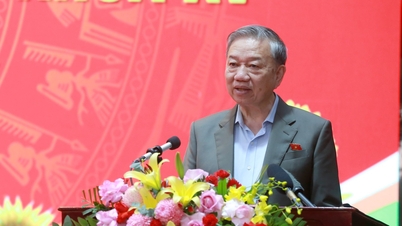
Dr. Nguyen The Anh, Director of the Vietnam-Soviet Friendship Hospital, said that the hospital is deploying magnetic resonance imaging (MRI) machines with artificial intelligence applications to meet the requirements of modern medical examination and treatment, while also aiming to quickly and effectively respond to national innovation and digital transformation efforts to serve patients.
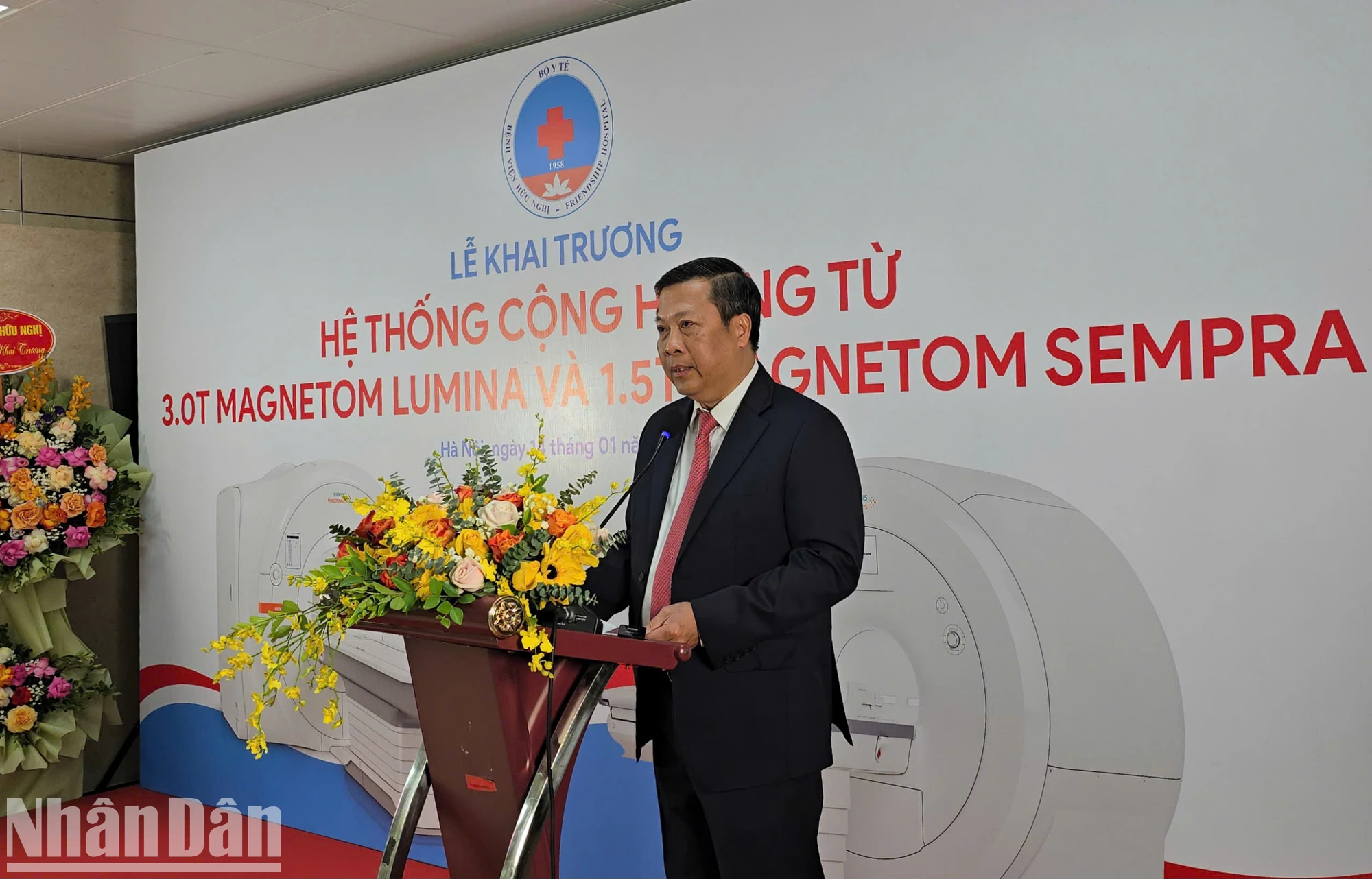 |
Dr. Nguyen The Anh, Director of the Vietnam-Soviet Friendship Hospital, expects that digital transformation and the application of science and technology will contribute to improving healthcare services for patients. |
Previously, doctors and technicians could spend a lot of time analyzing images and drawing conclusions. Now, due to the increased workload and number of patients, optimizing workflows and minimizing diagnostic errors has become a critical factor.
Some lesions or pathological signs are very small or deeply embedded in the body's structure, making them difficult to detect with the naked eye. With its ability to analyze details and recognize complex patterns, AI can help doctors shorten processing time, speed up diagnosis with more accurate findings, and avoid missing small details.
Dr. Nguyen The Anh, Director of the Vietnam-Soviet Friendship Hospital, shared his expectations that the hospital's application of state-of-the-art equipment will mark a major step forward in improving the quality of medical examination and treatment, and diagnostic imaging capabilities in particular. He also affirmed the hospital's goal of applying the most advanced technologies to provide high-quality medical services to best serve patients.
Magnetic resonance imaging (MRI) is a method that uses strong magnetic fields and radio waves to create detailed images of the inside of the body. It is one of the most modern techniques currently available for detecting tumors, metastases, inflammation, and other pathological tissue changes at an early stage.
The application of AI, combined with the fastest scanning speed currently available and a spacious scanning chamber design, reduces patient anxiety when entering the enclosed space. These advantages will give patients more crucial time in stroke treatment.
Professionally, this device helps detect dangerous diseases early with its whole-body scanning function that can detect tumors as small as 1 mm or larger. At the same time, the device allows for high-quality imaging of cerebral blood vessels without the need for significant contrast agent injections.
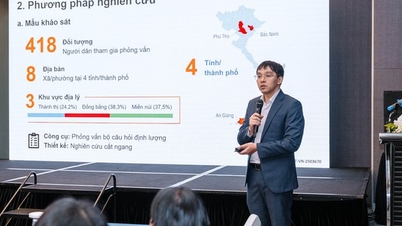
Mr. Fabian Martin Singer, General Director of Siemens Healthineers Vietnam, stated that AI applications in MRI machines help improve scanning efficiency, increase accuracy, and enhance the overall experience for both patients and doctors.
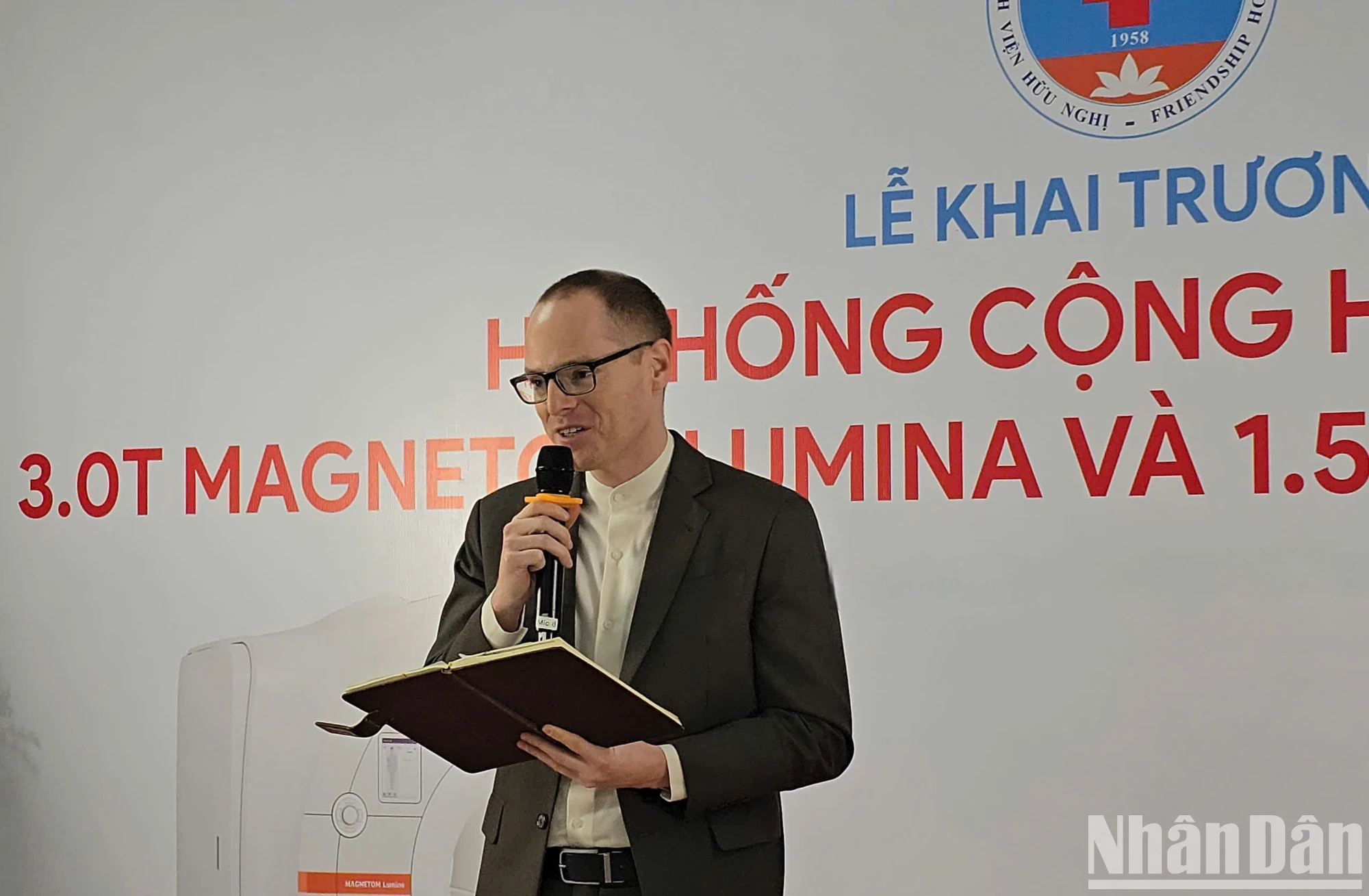 |
Mr. Fabian Martin Singer, General Director of Siemens Healthineers Vietnam, shared about the application of AI in MRI machines to improve healthcare efficiency. |
These include Deep Resolve image reconstruction technology, which uses convolutional neural networks to speed up scanning by reconstructing more detailed and sharper images from less data, thereby reducing machine time; automating scan planning, correction, and data analysis steps, minimizing errors and increasing work speed, detecting abnormalities, highlighting areas of concern, and assisting doctors in making more accurate diagnoses.
With integrated AI, the system can "learn" after operation, synthesize similar cases, and select the appropriate imaging and examination program for the patient. The machine automatically selects the examination program for the patient without requiring breath-holding or electrode placement. This function is particularly effective when examining elderly patients, patients with impaired consciousness such as young children, or unconscious patients. This feature will maximize the precious time available to patients.
Source: https://nhandan.vn/ung-dung-ai-trong-chan-doan-hinh-anh-post856180.html


![[Photo] Two flights successfully landed and took off at Long Thanh Airport.](/_next/image?url=https%3A%2F%2Fvphoto.vietnam.vn%2Fthumb%2F1200x675%2Fvietnam%2Fresource%2FIMAGE%2F2025%2F12%2F15%2F1765808718882_ndo_br_img-8897-resize-5807-jpg.webp&w=3840&q=75)




















































































Comment (0)