

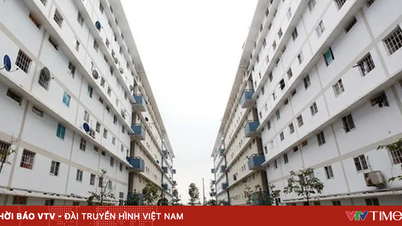
DNVN - The goal of building at least 1 million social housing units by 2030 is considered extremely correct and humane. However, to date, social housing projects and housing for low-income workers have made almost no breakthroughs, while the time until 2030 is getting shorter and shorter.
Still a long way from the goal.
On May 24, 2024, the Party Central Committee issued Directive No. 34-CT/TW on strengthening the Party's leadership over the development of social housing in the new situation, emphasizing the need to prioritize the allocation of land and capital for the development of social housing and workers' housing, and to promote the socialization of capital for social housing development.
The Party and the State have always paid attention to the development of housing for the people, especially social housing. The Resolution of the 13th Party Congress and the 10-year socio -economic development strategy 2021-2030 have addressed many issues to ensure equal access to housing for citizens and to develop social housing.
On April 3, 2023, the Prime Minister issued Decision No. 388 approving the Project "Investing in the construction of at least 1 million social housing units for low-income earners and industrial park workers in the period 2021 - 2030".
Since the beginning of the year, the Government has also held many meetings on social housing. As of May 2024, the Government and the Prime Minister have issued 40 related documents directing the implementation of the project to build at least 1 million social housing units by 2030. Regarding credit for the implementation of the project alone, there have been 14 documents.
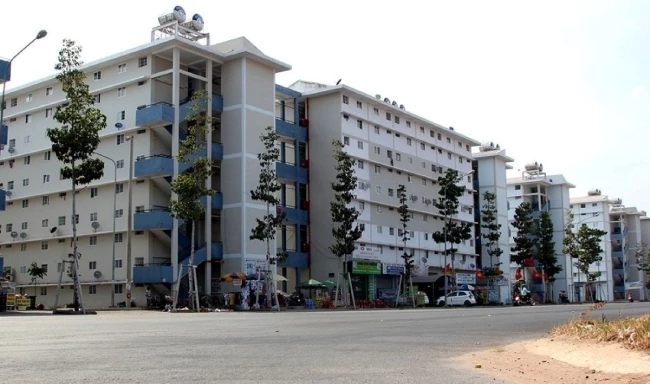
On May 24th, the Party Central Committee issued Directive No. 34 on strengthening the Party's leadership over social housing development in the new situation. This directive emphasizes the need to prioritize the allocation of land and capital for the development of social housing and worker housing, and to promote the socialization of capital for social housing development.
Commenting on the target of 1 million social housing units, Mr. Chu Duc Tam - Member of the Executive Board of the Vietnam Industrial Park Finance Association (VIPFA) - said that this is a very correct and humane plan.
To date, 503 social housing projects have been implemented nationwide, comprising 418,200 units (an increase of 4 projects and 6,950 units compared to the reporting date of March 15, 2024). Of these, only 75 projects with 39,884 units have been completed (an increase of 3 projects and 1,756 units compared to the reporting date of March 15, 2024).
The number of projects that have commenced construction is 128, with a scale of 115,379 units. The number of projects that have received investment approval is 300, with a scale of 262,937 units.
"The target of 1 million units is still very far away, and the time until 2030 is getting shorter and shorter. In large provinces and cities with many industrial zones such as Hanoi, Ho Chi Minh City, Da Nang, Can Tho, Long An, etc., the rate of social housing is low compared to the project's target. For example, Ho Chi Minh City set a target of building 35,000 social housing units in the 2021-2025 period, but so far only 1 project has been completed, and the remaining 34 projects are either under construction or have not yet been started," Mr. Tam observed.
Many procedures
Based on the above figures, according to Mr. Tam, social housing and affordable housing have hardly made any breakthroughs compared to commercial housing because social housing and affordable housing are not given any priority over commercial housing. The legal framework and procedures for social housing and commercial housing are the same, and to some extent, the procedures for social housing are even more difficult.
Currently, the number of procedures involved in implementing social housing projects is greater than that for commercial housing projects. In addition, access to loan capital remains difficult.

Mr. Chu Duc Tam - Member of the Executive Committee of the Vietnam Industrial Park Finance Association (VIPFA).
The fastest time to complete the procedures for a commercial housing project is 3 years, while the slowest is 5-7 years, depending on the legal aspects of the project.
But the processing time for social housing applications is even slower.
To develop social housing, in addition to general procedures such as planning approval, investment policy approval, bidding for investor selection, land allocation, and land leasing, social housing projects also involve procedures for verifying eligible buyers and renters; and procedures for appraising the selling and rental prices of social housing. Therefore, the implementation of procedures for social housing projects is lengthy.
Land needs to be allocated around industrial zones.
To ensure that low-income earners have access to housing and that industrial zone workers can settle down and find stable employment, the government needs to review procedures and processes to reduce project approval times.
Regarding social housing planning, it is necessary to locate social housing projects in areas with convenient transportation, connected to industrial centers, and with sufficient essential technical and social infrastructure. In particular, land should be allocated around industrial zones and clusters for the construction of housing for workers.
In reality, there is currently a situation where people in social housing areas are not low-income earners eligible to buy social housing. This is because social housing is too far from their workplaces, so either workers don't buy it, or if they do, they resell it because it's too far from their jobs, and they accept renting in lower-quality housing closer to their workplaces.
The policy of preferential treatment for purchasing social housing needs to be directed to the right target group: workers and low-income laborers.
In addition, allocating land for social housing development around industrial parks will ensure easy access for investors… Currently, businesses investing in social housing are facing difficulties in accessing land.
In addition to shortening the time for project appraisal and approval, and reducing procedures and barriers to social housing development, to build industrial housing, state agencies need to promote the planning of social housing linked to industrial centers, industrial housing near industrial zones, and synchronized technical and social infrastructure.
Regarding the 120 trillion VND preferential credit package for supporting social housing development, Mr. Tam stated that the disbursement of this credit package for social housing is still slow.
To date, commercial banks have only disbursed 1,144 billion VND, including 1,133 billion VND to developers in 11 projects and 11 billion VND to homebuyers in 4 projects. It seems that preferential credit has only reached developers, while low-income individuals are unlikely to qualify.
"Therefore, to give low-income earners the opportunity to own a home, the preferential loan program for individuals and households to buy, rent, or lease-to-own social housing should be expanded according to social housing policies, with preferential interest rates 3-5% lower than regular commercial loans. In addition, a housing development fund or housing savings fund should be established soon. This fund model has been successful in many countries," Mr. Tâm suggested.
Nguyet Minh
Source: https://doanhnghiepvn.vn/kinh-te/bat-dong-san/vi-sao-cac-du-an-nha-o-xa-hoi-chua-co-su-dot-pha/20240603085857006


![[Photo] Two flights successfully landed and took off at Long Thanh Airport.](/_next/image?url=https%3A%2F%2Fvphoto.vietnam.vn%2Fthumb%2F1200x675%2Fvietnam%2Fresource%2FIMAGE%2F2025%2F12%2F15%2F1765808718882_ndo_br_img-8897-resize-5807-jpg.webp&w=3840&q=75)
























































































Comment (0)