

Many people have experienced dizziness, pale faces, and fainting upon seeing blood or an open wound bleeding. According to Dr. Ngo Hang Vinh, Head of Cardiology Department 2, Xuyen A General Hospital, Ho Chi Minh City, fainting is defined as a transient loss of consciousness due to cerebral ischemia, occurring quickly and completely resolving on its own. It should be distinguished from pseudo-fainting (or simply fainting), which is caused by fatigue and exhaustion from other illnesses, low blood pressure, but without the loss of consciousness seen in fainting.
Several medical conditions present with similar symptoms of loss of consciousness as fainting, leading to confusion in concept and classification. These include neurological conditions such as generalized seizures causing respiratory arrest, cerebral hypoxia leading to loss of consciousness, stroke, conditions causing sudden cardiac arrest that are successfully treated, and toxic conditions causing coma. These conditions cause prolonged loss of consciousness and may leave neurological sequelae, unlike fainting which is completely reversible.
According to Dr. Ngo Hang Vinh, fainting is divided into three main groups: cardiac syncope, orthostatic hypotension, and parasympathetic reflex syncope. For example, a person with an irregular heartbeat that is too fast or too slow for a few seconds can cause fainting and spontaneous recovery; or a sudden change from lying to standing can cause severe hypotension and fainting; or it can be due to parasympathetic reflexes in situations involving nerve pain, abdominal pain, or excessive fear.
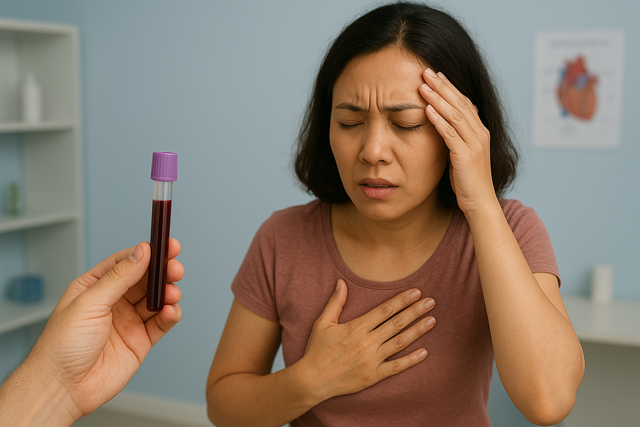
Fainting upon seeing blood is a type of fainting caused by a parasympathetic nervous system reflex.
ILLUSTRATIVE PHOTO: AI
Causes of fainting upon seeing blood
In the case of fainting upon seeing blood, this is a type of parasympathetic reflex syncope with a similar mechanism as described above. When a person sees blood and becomes frightened, the sympathetic nervous system is activated first, causing rapid heartbeat and palpitations, but the parasympathetic nervous system is also activated to restore balance. If the parasympathetic reflex is excessively strong, it will cause a slow heart rate and sudden vasodilation, leading to fainting.
In these conditions, medical examinations will not reveal any physical damage to the cardiovascular or nervous systems, but the problem lies in the dysfunction of the sympathetic and parasympathetic nervous systems. These patients may also experience symptoms such as hypotension when standing for extended periods, and may faint.
"Fainting upon seeing blood, or neurogenic syncope in general, is benign. However, as mentioned above, many neurocardiovascular diseases can cause similar symptoms, which can be misleading. Therefore, patients need to see a cardiologist or neurologist for in-depth examination of underlying cardiovascular diseases such as cardiomyopathy, ischemic heart disease, dangerous arrhythmias, valvular heart disease, epilepsy, cerebrovascular disease, etc.," Dr. Vinh shared.
Source: https://thanhnien.vn/vi-sao-mot-so-nguoi-de-ngat-khi-thay-mau-185251027234105736.htm
![[Photo] Delegation attending the 14th Congress of the Vietnam Trade Union visits the Mausoleum of President Ho Chi Minh.](https://vphoto.vietnam.vn/thumb/1200x675/vietnam/resource/IMAGE/2026/06/03/1780451842301_ndo_br_img-3824-jpg.webp)

































































































Comment (0)