

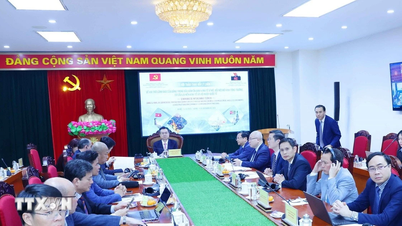
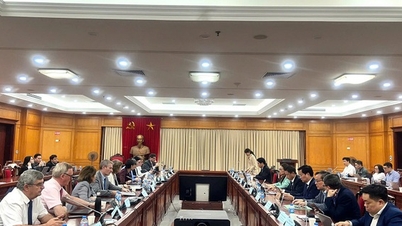
On April 24th in Hanoi, the Vietnam Academy of Social Sciences, in collaboration with the Presidential Academy of the Russian Federation (RANEPA), organized a seminar entitled "Opportunities for Vietnam-Russia Cooperation in the Digital Age."
The event aims to facilitate academic exchange, share experiences, and propose new directions for cooperation between the two countries in the context of increasingly strong global digital transformation.
The workshop was held in a hybrid format, combining in-person and online participation, attracting many experts, researchers, and representatives from scientific institutions in both countries.
In his opening remarks, Associate Professor Dr. Dang Xuan Thanh, Vice President of the Vietnam Academy of Social Sciences, emphasized that the traditional cooperative relationship between Vietnam and the former Soviet Union has laid a solid foundation for the current Comprehensive Strategic Partnership between Vietnam and the Russian Federation.
Amidst geopolitical changes and increasing global competition, the two countries need to strengthen cooperation in strategic areas such as technology, the digital economy, renewable energy, culture, and education.
Associate Professor-Doctor Dang Xuan Thanh expects the workshop to be a substantive academic forum, helping to propose effective solutions to enhance bilateral cooperation, especially within the framework of the Vietnam-Eurasian Economic Union (EAEU) Free Trade Agreement, aiming for a bilateral trade turnover of 15 billion USD by 2030.
From a digital economy perspective, Dr. Pham Anh Tuan, Deputy Director of the Vietnam and World Economics Institute, noted that Russia possesses strengths in core technologies such as artificial intelligence, cybersecurity, and open-source software. This presents a significant opportunity for the two countries to build a Strategic Partnership in the field of digital transformation.
Dr. Pham Anh Tuan proposed the establishment of a Joint Committee on Digital Cooperation; strengthening policy exchanges, organizing technology-business forums, and promoting digital workforce training programs. Potential areas include cloud computing, digital government, smart cities, and regional technology value chains.
Regarding the digitization of documents for teaching and research, Dr. Roman Konchakov, Head of the Department of Philology and History at the Presidential Academy (Russian Federation), stated that new technologies such as handwriting recognition, document description metadata, and machine learning are opening up possibilities for accessing rare historical resources more effectively and in greater depth.
The development of open data platforms, digital maps, and digital interfaces will provide practical support for historical research and teaching in both countries in the new era.
At the conference, delegates unanimously agreed that the digital age opens up tremendous opportunities for the two countries to expand cooperation, especially in areas such as big data, artificial intelligence, cybersecurity, and digital technology for public administration.
Many opinions suggest establishing mechanisms for policy coordination, developing digital infrastructure, supporting technology incubators, and strengthening exchanges of scholars and experts to elevate Vietnam-Russia relations in the new phase, in line with the current trends of globalization and profound digital transformation.
Source: https://www.vietnamplus.vn/viet-nam-va-lien-bang-nga-tang-cuong-day-manh-hop-tac-trong-thoi-dai-so-post1034886.vnp

![[Photo] Prime Minister Pham Minh Chinh holds a phone call with the CEO of Russia's Rosatom Corporation.](/_next/image?url=https%3A%2F%2Fvphoto.vietnam.vn%2Fthumb%2F1200x675%2Fvietnam%2Fresource%2FIMAGE%2F2025%2F12%2F11%2F1765464552365_dsc-5295-jpg.webp&w=3840&q=75)


![[Photo] Closing Ceremony of the 10th Session of the 15th National Assembly](/_next/image?url=https%3A%2F%2Fvphoto.vietnam.vn%2Fthumb%2F1200x675%2Fvietnam%2Fresource%2FIMAGE%2F2025%2F12%2F11%2F1765448959967_image-1437-jpg.webp&w=3840&q=75)































![[OFFICIAL] MISA GROUP ANNOUNCES ITS PIONEERING BRAND POSITIONING IN BUILDING AGENTIC AI FOR BUSINESSES, HOUSEHOLDS, AND THE GOVERNMENT](https://vphoto.vietnam.vn/thumb/402x226/vietnam/resource/IMAGE/2025/12/11/1765444754256_agentic-ai_postfb-scaled.png)








































Comment (0)