Unveiling the sacred path
In 2017-2018, during the restoration and renovation of Tower K, a team of Indian experts noted the presence of two entrances, East and West, at this architectural structure. Additionally, at the eastern entrance of Tower K, there are two sections of wall surrounding a road leading towards the E and F tower groups.
In June 2023, the My Son World Cultural Heritage Management Board, in coordination with the Institute of Archaeology, conducted an exploratory excavation of a 20m2 area around Tower K. By March 2024, the two agencies continued their exploration and excavation of a 220m2 area east of Tower K. As a result, they discovered two sections of the boundary wall of a road extending from Tower K eastward towards Towers E and F.
Documents obtained through excavations have confirmed the presence of a previously unknown architectural structure leading to the center of the My Son complex. This road is distinctly different from the route currently designed to welcome visitors to My Son.
In early July 2025, the My Son World Cultural Heritage Management Board, in coordination with the Institute of Archaeology, continued the exploration and excavation of the area between Tower K and the central group of towers in the My Son Relic Site (total area 770m2). The unearthed remains in the excavation area include a 75m long section of an access road east of Tower K, oriented east-west with a 45º northward deviation; bringing the total area of the road identified from the base of the tower to 132m.
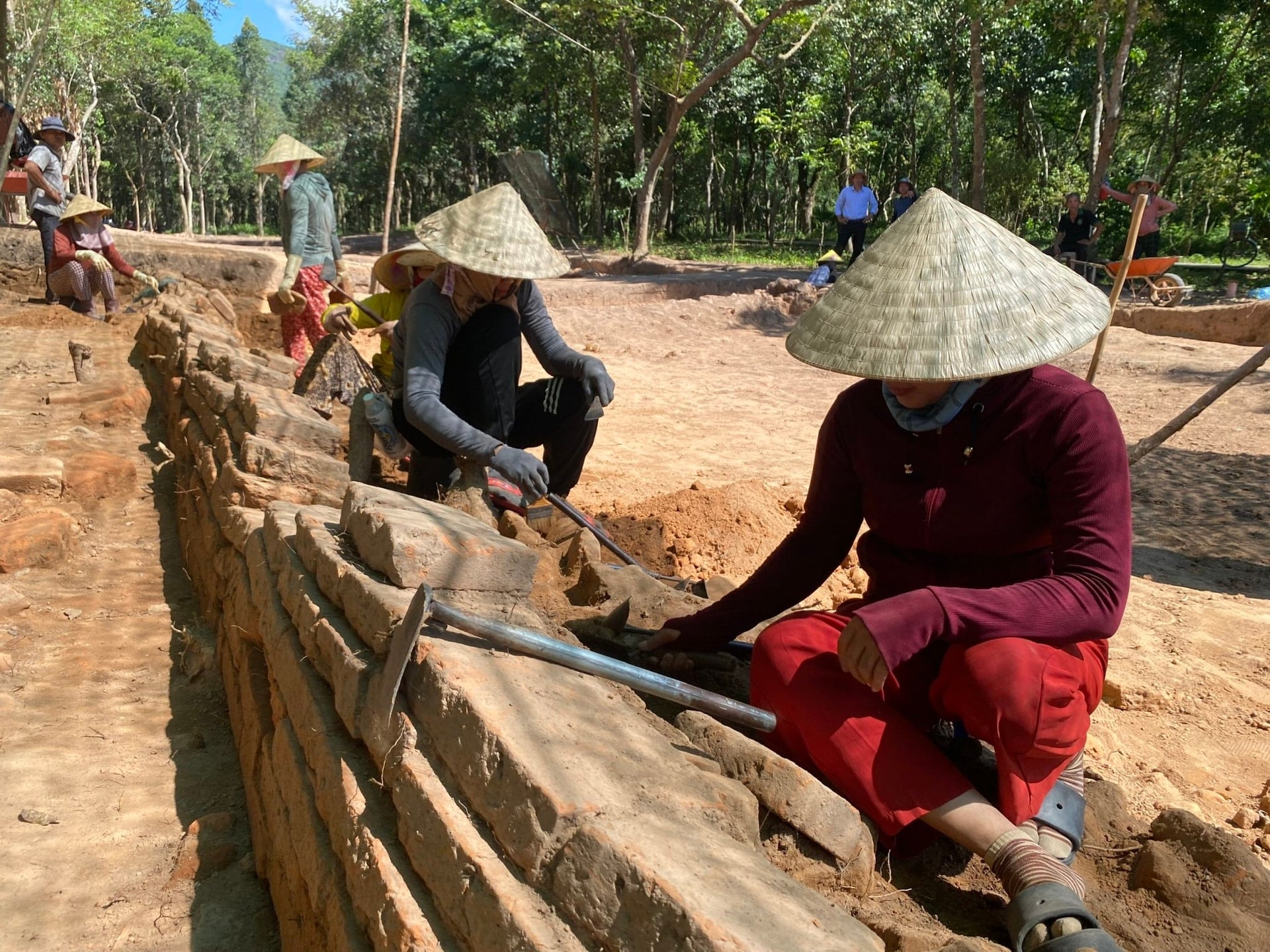
The road structure, similar to the one discovered in 2024, has an overall width of 9m, a carriageway width of 7.9m, a flat surface, and is composed of compacted sand, gravel, and broken bricks, with a thickness of 0.15 - 0.2m; the retaining walls on both sides are made of rows of bricks, with the highest section remaining at about 1m, including the foundation and the collapsed walls. The foundation is reinforced with a layer of compacted gravel and brick powder.


The excavation process also identified four locations for gate entrances on the southern boundary wall. At the gate locations, there were traces of stone gate beams with square mortise holes for supporting stone pillars and round mortise holes for supporting the rotating pillars of the gate. These may have been gates leading to/from the sacred space outside the road.
At the northern wall, which was largely pushed aside, in many sections, traces of the wall collapsing from the outside inward into the road surface were visible, with fallen bricks still in place. Notably, alongside the widespread presence of building bricks and stones, the archaeological excavation also uncovered several fragments of earthenware and glazed pottery dating from the 10th to the 12th centuries.
Change your perspective.
With a total excavated area of 1,010 square meters from 2023 to 2025, archaeological research has uncovered much valuable information. In particular, research conducted from July to the present has identified a road dating back to the 12th century (corresponding to the age of Tower K) and existing only for a period; its total length is approximately 170 meters, extending from the eastern foot of Tower K to the western bank of the dry stream within the My Son Sanctuary. Similarly, archaeological artifacts dating back to the 10th-12th centuries are also found. Among them, glazed ceramics from the Northern Song Dynasty (10th-11th centuries) and the Southern Song Dynasty (12th-13th centuries) are quite common.
According to Dr. Nguyen Ngoc Quy, from the Institute of Archaeology (Vietnam Academy of Social Sciences ), who directly participated in the project, the excavation results have clarified the structure of the road, which was made of natural sand and soil. The retaining walls were constructed by stacking bricks in double rows on both sides, with broken bricks and soil added in between. The foundation of the wall was covered with stone and compacted with brick powder. The walls were stacked using a technique where the bottom was wider and gradually narrowed towards the top until two bricks touched (the width of the top surface was about 0.46m), and the height was about 1m, in order to divide the space inside the road from the outside.
"The materials unearthed in this excavation further strengthen the understanding of the function of a sacred road – a path leading deities, kings, and Brahman priests into the sacred space of the My Son temple complex," said Dr. Nguyen Ngoc Quy.

Simultaneously, it was affirmed that the results of the 2025 exploration and excavation not only supplemented valuable documents determining the religious function of the ruins as a sacred path into the sacred space of My Son from approximately the 9th to 12th centuries, but also opened up a new scientific issue: that My Son still maintained its role as the religious nucleus of Champa throughout the kingdom's history.


Preliminary comparative studies also note that the road associated with Hindu rituals discovered at My Son is unique within the Champa cultural relic system, distinctly different from other sites where the roads are designed along a straight axis from the outside to the central temple tower.
Mr. Nguyen Cong Khiet, Deputy Director in charge of the My Son World Cultural Heritage Management Board, said that in the coming time, the unit and the Institute of Archaeology will continue to cooperate in researching and clarifying the scale, structure, and appearance of the entire road within the My Son historical site; urgently carry out restoration and preservation work to better promote the historical and cultural value of the relic; and organize transportation for tourists along the heritage road left by the Cham people, helping tourists to have a clearer view of My Son and Champa culture in history.
Source: https://baodanang.vn/xac-dinh-con-duong-thieng-tai-khu-di-tich-my-son-3314602.html



![[Photo] Prime Minister Le Minh Hung presides over the thematic session on promoting science and technology development and innovation.](https://vphoto.vietnam.vn/thumb/1200x675/vietnam/resource/IMAGE/2026/06/23/1782207872934_ndo_br_dsc-1724-jpg.webp)