

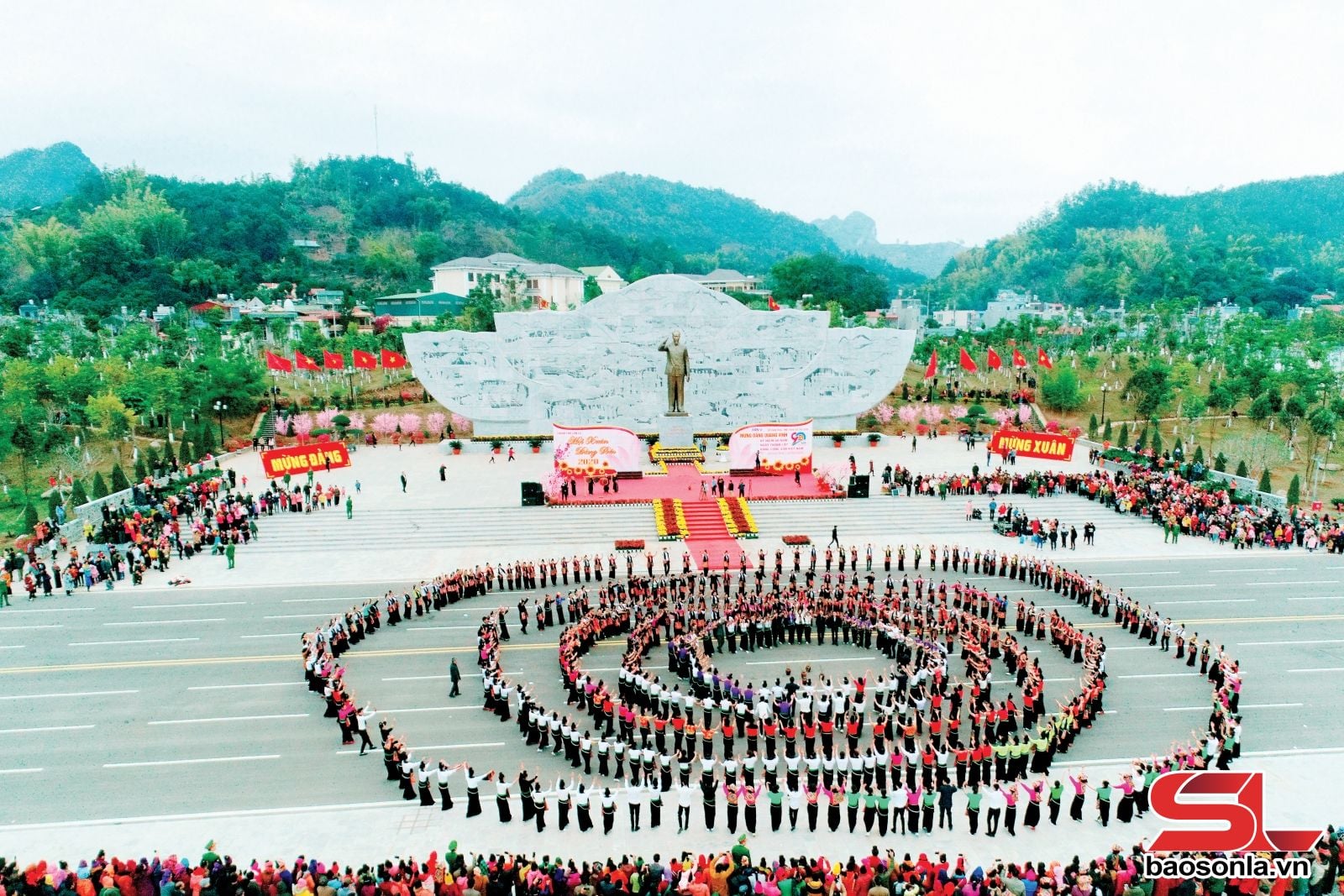
Photo: PV
In the 1960s, the country was still engulfed in the flames of war. Tet was a time of poverty, of poor families, but people's hearts were filled with hope. My family didn't have a calendar, let alone fireworks. The only thing we prepared meticulously for New Year's Eve was... a radio. My father often said, "If you haven't heard Uncle Ho's New Year's greetings, it's not really Tet." The moment Uncle Ho's voice echoed on the airwaves of the Voice of Vietnam , the atmosphere seemed to quiet down. His voice was warm, deep, and slow, both a greeting and a heartfelt conversation like a father with his extended family. Then he recited poetry. Short, memorable verses, simple yet profound. Just as he himself said: "A few simple, affectionate words, both a call to action and a celebration of Spring." At that time, I was young and didn't fully understand the layers of meaning in his poetry. But I remember very clearly the feeling of peace I got listening to Uncle Ho's poems. It seemed that amidst bombs and shortages, simply listening to Uncle Ho speak, listening to him recite poetry, was enough to convince the country that it would surely overcome its hardships.
Growing up, going to school, and then standing on the podium teaching literature, I gradually understood why Uncle Ho's Spring poems held such a special place in the spiritual life of the nation. These were not just ordinary New Year's greeting poems, but historical documents written in poetic language, revolutionary guidelines conveyed from the heart. Throughout his revolutionary life, he composed approximately 22 New Year's greeting poems (spring poems) from 1942 to 1969. These verses were sent to the people and soldiers nationwide every time Tet (Lunar New Year) arrived, often containing predictions, encouragement, and affirmations of faith in the ultimate victory of the nation. Even from the first spring of the Democratic Republic of Vietnam – the Spring of 1946 (Year of the Dog) – Uncle Ho clearly felt the historical significance of that independent spring: “This Tet is truly the Tet of our people / A few words of welcome in the national newspaper / Independence, full and overflowing, three cups of wine / Freedom, golden and red, a forest of flowers.” Rereading these verses during my years as a teacher, I always emphasized to my students: This is the spring of a new era. The spring of a nation that for the first time takes control of its own destiny. The words "independence" and "freedom" in Uncle Ho's poetry are not abstract but appear in very real images: a glass of wine, a forest of flowers... simple yet sacred. During the resistance war against the French, amidst the mountains and forests of Viet Bac, Uncle Ho's spring poems carried the majestic resonance of a marching song. The poem wishing a Happy New Year of the Pig in 1947 that Uncle Ho read on the radio was truly a heroic piece: "The red flag with the yellow star flies in the wind / The trumpet of resistance resounds throughout the land / The whole people resist, comprehensive resistance / Our will is determined, our hearts are united..."
The longer I teach literature, the more I realize that Uncle Ho's spring poems always combine two seemingly opposing yet perfectly harmonious qualities: the steely resolve of a soldier and the spring spirit of a poet. This is most clearly demonstrated in the poem "Nguyen Tieu," a masterpiece of spring that Uncle Ho wrote in 1948: “Tonight, the full moon of the Nguyen Tieu festival / Spring river, spring water, connecting to the spring sky / In the deep mist, discussing military affairs / Returning at midnight, the moon fills the boat.” Even amidst “discussing military affairs,” amidst the fate of the nation hanging in the balance, Uncle Ho still reserved a beautiful moment of tranquility for the moon and the river. When teaching this poem, I often tell my students: That is the demeanor of a great intellect; the heavier the burden, the brighter the soul. The boat of national affairs returns in the full moonlight, carrying with it a complete belief in the day of victory. During the years of the war against America, Uncle Ho's spring poems became concise, compressed, like a battle order. I can never forget the atmosphere of the Spring of 1968, when the whole country fell silent listening to Uncle Ho read: “This spring surpasses previous springs/Victory brings joyful news throughout the country/North and South compete in fighting the American invaders/Forward! Complete victory will surely be ours.” That was not just poetry. It was a historical command. And then there was the Spring of 1969 – Uncle Ho's last spring. When I reread that poem, I always feel choked up: “Last year's victory was glorious/This year the front lines will surely win even greater victories/For independence, for freedom/Fight to drive out the Americans, fight to overthrow the puppet regime/Forward, soldiers and compatriots/North and South reunited, what spring could be happier!” Uncle Ho wrote those verses when his health was very weak, but his faith never wavered. He handed over spring to the nation before entering the eternal realm.
Now that I've left the lecture hall, every spring, I still maintain my old habit: listening to Uncle Ho's spring poems. Not for research purposes, but to remind myself to live up to the trust he placed in me.
For me, Uncle Ho's spring poems exist not just as an aesthetic object or a text to be analyzed, but have become a part of my memory. The memory of a mountain child from the past and of a teacher who dedicated his entire life to the cause of education and training in the remote border regions of our country.
And with each passing spring, I feel even more strongly: As long as there are teachers in the field of education who know how to listen to memories, who cherish the spiritual values that have stood the test of time, then the spring of our nation will continue to be preserved in people's hearts, quietly and ostentatiously, but persistently like an underground cultural stream, flowing throughout the history and people of Vietnam.
Source: https://baosonla.vn/van-hoa-xa-hoi/xuan-ve-nho-bac-dnAhktDvR.html










































Comment (0)