

HIV not only affects the immune system but also leaves its mark on many other parts of the body, including the nails – a part that seems to have little to do with the disease. In people living with HIV, changes in the shape, color or hardness of the nails can be an early warning sign of health problems or side effects of treatment drugs.
Here are the five most common nail changes seen in people with HIV and what they mean for overall health:
1. Clubbed fingers: A warning sign of hypoxia in people with HIV
- 1. Clubbed fingers: A warning sign of hypoxia in people with HIV
- 2. Nail pigmentation: A rare but often related sign to HIV medications
- 3. Nail fungus: A common opportunistic infection in people with HIV
- 4. The crescent part on the nail disappears - A sign of a weakened immune system
- 5. Terry's nails: A warning sign of chronic illness in people with HIV
Clubbing is a condition in which the fingernails curve around the fingertips, making the nails look like upside-down spoons.
Typical symptoms include:
- The fingertips are swollen and rounder than normal.
- Nails are clearly curved vertically (from base to tip)
- Nails change color, thicken, and may become softer
- The nail bed becomes "spongy" or "floating", with a warm feeling at the fingertips
In people with HIV, clubbing of the fingers is common in children with congenital HIV infection, but can also appear in adults with advanced HIV infection who have not received treatment.
This phenomenon is not only associated with HIV but can also appear in many other diseases, mainly due to chronic lack of oxygen in the blood – a condition called hypoxemia. In HIV-infected infants, hypoxemia can occur in the womb or during the birth process. In adults, clubbing is often a sign that accompanies HIV-related lung disease, reflecting impaired gas exchange and blood oxygen levels.
There is currently no specific treatment for clubbing. However, treating the underlying cause – such as improving oxygen deprivation or treating lung disease – can help symptoms gradually improve, returning the nails to a more normal shape.
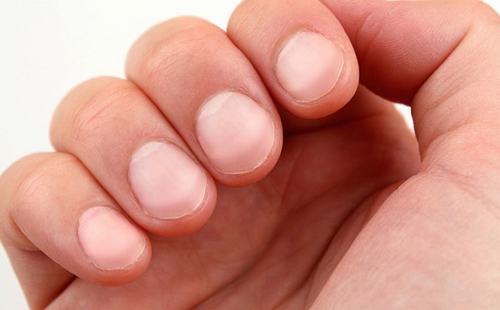
Clubbing of fingers - a warning sign of hypoxia in people with HIV
2. Nail pigmentation: A rare but often related sign to HIV medications
Melanonychia is a discoloration of the nails that appears as black or brown lines or bands running along the fingernails or toenails. It can occur with a variety of conditions, including pregnancy, Addison’s disease, and melanoma, but has also been reported in people with HIV – particularly those taking certain antiretroviral (ARV) medications.
Symptoms often include:
- A black/brown line or stripe running down the length of the nail
- Discoloration spreads over the nail surface
- Slight changes in nail structure or surface
Nail pigmentation is most clearly associated with HIV medications containing zidovudine, usually in combination formulations such as lamivudine/zidovudine or abacavir/lamivudine/zidovudine. It may also develop in some untreated HIV-infected individuals, although the cause is not well understood. It is thought to be more common in individuals with darker skin pigmentation.
Although not painful or dangerous, nail pigmentation can affect the aesthetic and psychological aspects of the patient. In cases of nail discoloration related to zidovudine, the doctor may consider switching to another ARV to improve the condition. Alternatively, the patient can cover the discolored nail with nail polish, as long as the nail is not damaged or has a fungal infection.
3. Nail fungus: A common opportunistic infection in people with HIV
Onychomycosis is a fungal infection of the fingernails or toenails. Anyone can get it, but people with HIV are more susceptible because their immune systems are weakened, making it easier for the fungus to grow and spread. In this group, nail fungus infections tend to be more severe, last longer, and are harder to treat.
Common symptoms include:
- Fingernails or toenails become brittle and break easily
- Nail deformity, rough or bumpy surface Crumbing at the outer edges
- Debris accumulates under the nail
- The nail was lifted off the foundation.
- Loss of natural shine, becomes dull
- Significant thickening of the nails White or yellow streaks appear on the sides of the nails
The disease can affect fingernails, but is more common in toenails, as this area is often moist and airtight, creating conditions for fungus to grow.
Over-the-counter topical antifungal medications are often not effective enough to cure the infection. For people with HIV, doctors often prescribe oral antifungal medications. These medications are more effective, but require two to three months of treatment and can cause serious side effects, including liver damage.
In severe cases of infection, your doctor may recommend removing the entire nail to help the medication reach the infected area more effectively and prevent recurrence.
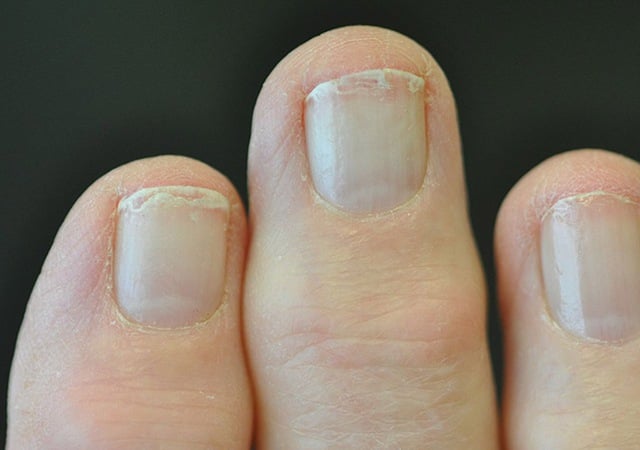
Nail fungus - a common opportunistic infection in people with HIV.
4. The crescent part on the nail disappears - A sign of a weakened immune system
The white crescent at the base of the nail is called the lunula. When this area disappears or is no longer visible, it is called anolunula. This is a painless phenomenon, often without other symptoms, but can reflect changes deep within the body.
In people with HIV, anolunulae appear more frequently than in healthy people, and the degree of lunula loss increases as the immune system weakens, especially when CD4 cell counts drop sharply. Over time, the lunula may gradually shrink and disappear completely, often in the late stages of HIV disease or when untreated.
While lunula loss does not directly affect nail function, it can be a warning sign of an underlying health problem such as anemia, malnutrition, kidney failure, or cardiovascular disease. In people with HIV, chronic inflammation from long-term infection is thought to damage the small blood vessels under the nail bed, causing the lunula to gradually disappear.
There is currently no specific treatment for anolunula. Maintaining effective HIV treatment and improving overall health can help prevent further progression of the condition.
5. Terry's nails: A warning sign of chronic illness in people with HIV
Terry's nails, also known as obvious onycholysis, is a condition in which the tissue underneath the nail becomes abnormally white, causing the entire nail to appear "washed out" of its natural color.
Common signs include:
- The nail surface has a frosted white layer that covers almost the entire fingernail or toenail.
- A thin brown or pink strip appears at the tip of the nail.
- Loss of lunula (white crescent area)
- The nail may thicken or develop vertical ridges.
This condition is often associated with chronic systemic diseases, such as HIV, diabetes, liver disease, or heart failure, and sometimes occurs as a result of the natural aging process. The mechanism of Terry's nails is thought to arise from changes in the blood vessels under the nail bed, reducing blood flow and changing the pigmentation of the tissue.
There is currently no specific treatment for Terry's nails. However, when the underlying condition is well controlled — such as effective HIV treatment or stable blood sugar levels in people with diabetes — the nail color and texture may gradually improve.
Please watch more videos :
Source: https://suckhoedoisong.vn/5-dau-hieu-tren-mong-tay-co-the-tiet-lo-tinh-trang-suc-khoe-cua-nguoi-nhiem-hiv-169251022210830991.htm



![[Photo] Closing of the 14th Conference of the 13th Party Central Committee](https://vphoto.vietnam.vn/thumb/1200x675/vietnam/resource/IMAGE/2025/11/06/1762404919012_a1-bnd-5975-5183-jpg.webp)


































































































Comment (0)