

In Hanoi, the National Children's Hospital is receiving many children with hand, foot, and mouth disease who have developed complications such as encephalitis, exhibiting symptoms like startled reactions, tremors in the hands and feet, and unsteady gait.
On June 22nd, MSc. Dr. Do Thi Thuy Nga, Deputy Head of the Internal Medicine Department at the Center for Tropical Diseases, stated that two common complications of hand, foot, and mouth disease are neurological and respiratory/circulatory failure. However, recently, the unit has been receiving more children with neurological complications, most notably encephalitis.
"The children were admitted to the hospital in a conscious state, without significant disturbances in consciousness, but they showed signs of startling, especially at the beginning and end of sleep. In addition, they experienced tremors in their limbs and walked unsteadily," Ms. Nga said.
For example, a 26-month-old girl from Bac Giang province was hospitalized with a persistent high fever, numerous red rashes, and frequent seizures. She was diagnosed with hand, foot, and mouth disease complicated by encephalitis.
The mother said that earlier this year, the child had contracted hand, foot, and mouth disease with symptoms of fever and mouth sores, but recovered after a few days of home treatment. This time, when the child got sick again, the family didn't think it was serious and delayed taking the child to the hospital. Fortunately, the child received timely treatment and is now alert and preparing to go home.
In another case, a one-year-old boy in Vinh Phuc province had a high fever, was fussy, drooled, and had a poor appetite, but his parents thought it was just teething fever and didn't take him to the doctor. Only when the child started having seizures and vomiting frequently did the family take him to the National Children's Hospital, where he was diagnosed with hand, foot, and mouth disease (EV71 strain) complicated by encephalitis.
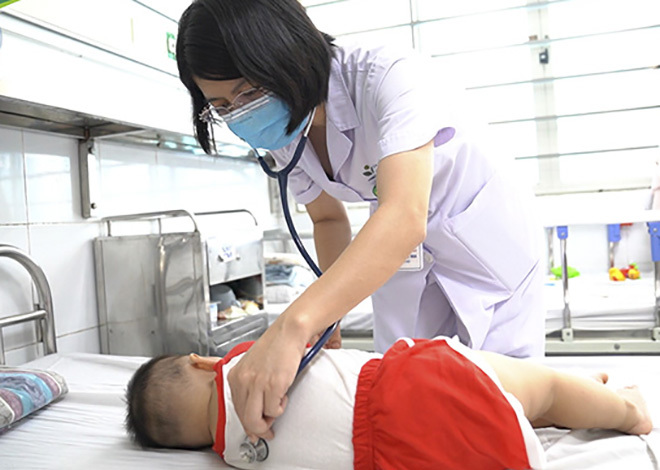
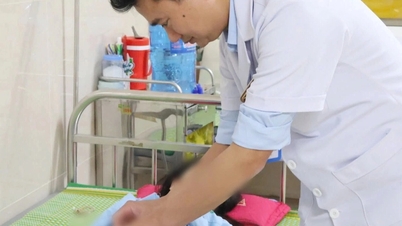
A child with hand, foot, and mouth disease is being cared for at the National Children's Hospital. Photo: Truong Giang
Over the past five years since the 2018 outbreak, severe cases of hand, foot, and mouth disease have been rare. This year, however, the emergence of Enterovirus 71 (EV71), which is highly contagious and virulent, has led to an increase in severe cases. Since the beginning of the year, the National Children's Hospital has received over 1,200 cases, with nearly 500 children requiring hospitalization, 30% of whom were infected with EV71. In Ho Chi Minh City, the number of cases has also increased rapidly, by nearly 150% in the past month, with many severe cases.
Dr. Nguyen Van Lam, Director of the Center for Tropical Diseases, stated that the two most common causative agents of hand, foot, and mouth disease are Coxsackie virus A16 (CA16) and Enterovirus 71 (EV71). While children infected with CA16 usually experience mild symptoms and can be cared for and treated at home, EV71 causes more severe illness with many dangerous complications such as encephalitis, meningitis, myocarditis, pneumonia, respiratory and circulatory failure, and can be fatal if not treated promptly.
Therefore, Dr. Lam advises parents to recognize the signs of the disease early. Children initially present with symptoms such as fever, poor appetite, irritability, and a sore throat. One to two days after the fever, sores appear in the mouth, causing pain and burning. Initially, these are red blisters that often develop into ulcers, mainly on the tongue, gums, and inside the cheeks.
The illness is considered severe when symptoms include persistent high fever unresponsive to medication; fatigue, lethargy, loss of appetite, excessive sleepiness, drowsiness; more than two startles in 30 minutes; profuse sweating, coldness throughout the body or in the hands and feet; rapid breathing, abnormal breathing such as apnea, shallow breathing, chest retraction, wheezing; tremors in the limbs and body, inability to sit steadily, and unsteady gait.
The disease progresses rapidly and unpredictably, so when a child is diagnosed with it, families should take them to medical facilities for advice on care, detection of severe symptoms, and timely treatment. Parents should not self-medicate, as this can worsen the child's condition.
Le Nga
Source link


![[Photo] Two flights successfully landed and took off at Long Thanh Airport.](/_next/image?url=https%3A%2F%2Fvphoto.vietnam.vn%2Fthumb%2F1200x675%2Fvietnam%2Fresource%2FIMAGE%2F2025%2F12%2F15%2F1765808718882_ndo_br_img-8897-resize-5807-jpg.webp&w=3840&q=75)
























































































Comment (0)