

 |
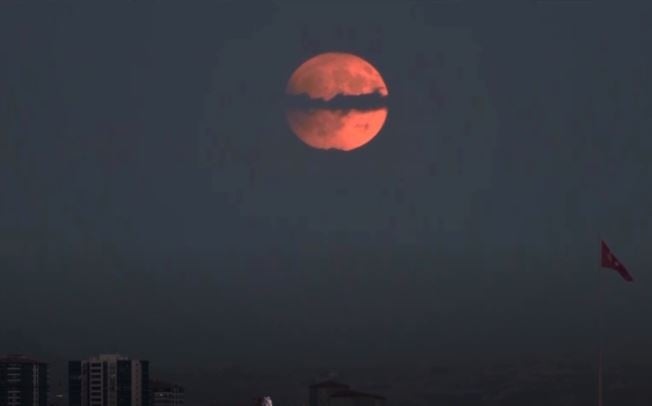
A unique blood moon phenomenon appeared in the sky. Photo: Reuters . |
On the night of September 7th and the morning of September 8th, the global sky was illuminated by the final total lunar eclipse of the year. This rare phenomenon lasted 82 minutes, considered the longest in the past decade.
The phenomenon was observable in Asia, Africa, Europe, and Australia, while most of the Americas could not observe it because it was daytime in that hemisphere. Nevertheless, an estimated 7 billion people, equivalent to 85-88% of the world's population, observed at least part of it.
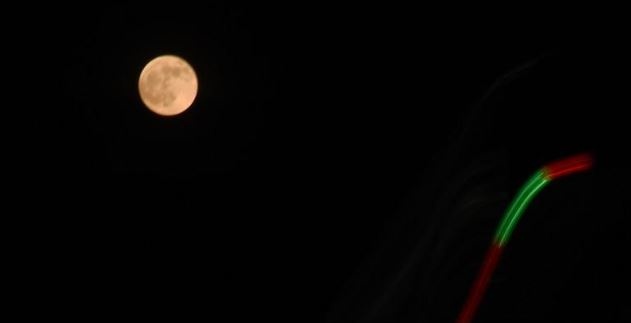 |
The lunar eclipse enters its total phase, photographed in India. Photo: Reuters. |
The lunar eclipse began at approximately 10:28 PM (Vietnam time). The total phase started at 12:30 AM on September 8th and ended at 1:52 AM, while the partial phase ended at 3:55 AM.
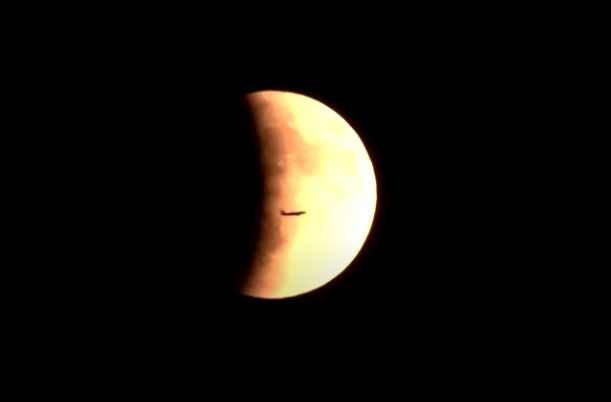 |
An airplane flies through a lunar eclipse in Turkey. Photo: Reuters. |
A total lunar eclipse occurs during a full moon when the Earth passes directly between the Moon and the Sun. When it enters the umbra (the darkest part of the lunar cycle), the Moon is completely obscured and receives no sunlight.
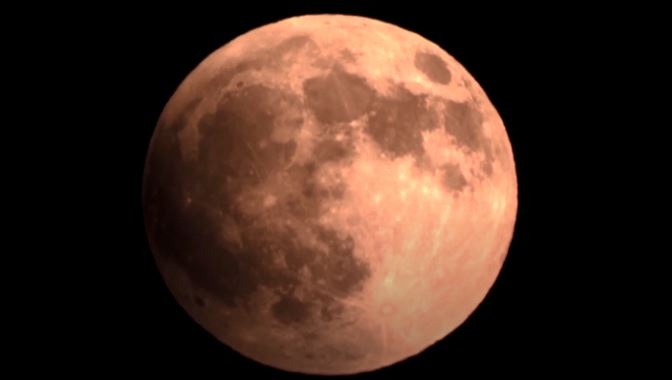 |
The red moon was clearly captured over the Cyprus archipelago. Photo: Reuters. |
However, atmospheric refraction causes sunlight to bend, curving around the Earth's edge to reach the moon. Under these conditions, Rayleigh scattering occurs, scattering much of the short-wavelength blue and violet light, while allowing red and orange light to pass through and continue to reach the Moon.
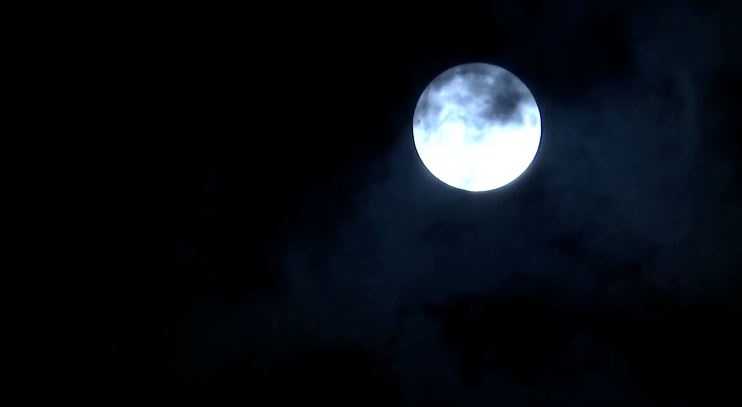 |
Photographers in Beijing captured images of the lunar eclipse. Photo: Reuters. |
The Earth's atmosphere and other factors such as dust, smoke, and volcanic ash will determine whether the Moon appears pale red, deep red, or even dark brown. Additionally, the Moon's orbital position, such as passing through the center of the umbra, will result in a darker color and a longer total duration.
"A total lunar eclipse is one of the most amazing astronomical events to observe without any equipment, and we know exactly when it's going to happen," commented meteorologist and astronomy blogger Dave Samuhel from AccuWeather.
Source: https://znews.vn/ca-the-gioi-don-nguyet-thuc-toan-phan-trang-mau-hiem-hoi-post1583336.html
![[Photo] Closing Ceremony of the 10th Session of the 15th National Assembly](/_next/image?url=https%3A%2F%2Fvphoto.vietnam.vn%2Fthumb%2F1200x675%2Fvietnam%2Fresource%2FIMAGE%2F2025%2F12%2F11%2F1765448959967_image-1437-jpg.webp&w=3840&q=75)



![[Photo] Prime Minister Pham Minh Chinh holds a phone call with the CEO of Russia's Rosatom Corporation.](/_next/image?url=https%3A%2F%2Fvphoto.vietnam.vn%2Fthumb%2F1200x675%2Fvietnam%2Fresource%2FIMAGE%2F2025%2F12%2F11%2F1765464552365_dsc-5295-jpg.webp&w=3840&q=75)



































![[OFFICIAL] MISA GROUP ANNOUNCES ITS PIONEERING BRAND POSITIONING IN BUILDING AGENTIC AI FOR BUSINESSES, HOUSEHOLDS, AND THE GOVERNMENT](https://vphoto.vietnam.vn/thumb/402x226/vietnam/resource/IMAGE/2025/12/11/1765444754256_agentic-ai_postfb-scaled.png)










































Comment (0)