

Phan Thiet City has many ancient village communal houses built hundreds of years ago, including four that are now classified as National Cultural and Artistic Heritage sites.
In the past, the village communal house was a place of worship for the local guardian deity, honoring ancestors and benefactors who had contributed to the village. It was also a meeting place to resolve all matters of the people, and a space for organizing festivals and recreation for the villagers.
Every village communal house has many couplets written in Chinese characters. The content of these couplets can help people today understand a little about the appearance of Phan Thiet in the past, along with the spiritual, cultural, and social life of the community during the time of its settlement.
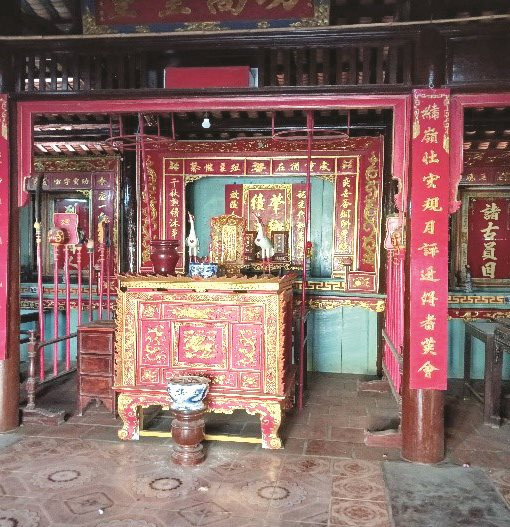
To provide a benchmark for comparing the messages of the village communal houses, we have chosen to present a couplet from each house that bears the name of the communal house. This is the main declaration of each communal house to the villagers, reflecting the thoughts, feelings, and worldview of the community.
Because we want to accurately reflect the meaning and content of our ancestors' words, we have not included any couplets from village temples that we have not thoroughly researched in this article.
Couplets from the Tú Luông village communal house.
The Tú Luông village communal house was built in the early 19th century and completely restored in 1871. It is now located in Đức Long ward, Phan Thiết city. Its name in Chinese characters is Tú Long (鏽龍), but perhaps to avoid the sound of Long being the same as the name of Emperor Gia Long (嘉隆), it was renamed Luông. A couplet bearing the name Tú Long is placed in the ancestral shrine:
鏽 嶺 社 宏 規 月 評 迓 得 耆 英 會
龍 崗 鍾 瑞 氣 世 代 薰 成 遜 讓 鄉
Transcription: Tú lĩnh xã hoành quy nguyệt bình nhạ đắc kỳ anh hội
The majestic dragon's auspicious aura and great merit have made the village humble and yielding.
Rough translation: The beautiful Tu Peak has a spacious pavilion, where every month the esteemed elders and wise men gather for a council.
Long Hill (Dragon Hill) gathers auspicious energy, bringing honor to the community while remaining humble towards the homeland.
"Tinh tinh" refers to those who possess knowledge through academic achievement. "Kỳ lão" refers to those over 60 years old who are still mentally sharp. "Khí lành" refers to those who are talented and virtuous.
The couplet introduced the beauty of the Tu Long area with its high hills and large communal house, highlighting the function of the communal house as a meeting place for the village, and expressing the community's reverence for the esteemed elders and virtuous predecessors who contributed to the village. Those who contributed and remained humble were truly worthy of respect and admiration.
Couplets from Duc Nghia village communal house.
The Duc Nghia village communal house was built in 1846 and is now located in Duc Nghia ward, Phan Thiet city. The couplet of the Duc Nghia village communal house is placed at the gate:
德 發 荣 华 四 季 具 祿 財
義 宗 禮 節 春 秋 同 拜 仰
Transcription: Virtue brings glory, prosperity, wealth, and fortune.
The ancestral lineage pays homage to each other during the spring and autumn festivals.
A rough translation: Abundant resources in all four seasons, enjoying prosperity through virtuous conduct.
In the spring and autumn, during the festivals, we all pay homage to our ancestors.
The couplet above shows that the people of Duc Nghia village in the past enjoyed a prosperous life thanks to its advantageous location, situated both on the riverbank and near Phan Thiet market. Being close to the market and the river made fishing and trading convenient. They enjoyed this prosperity and good fortune thanks to their ancestors who pioneered the village, and the people developed a moral code inherited from their forefathers, so they must remember and respect their ancestors.
Couplets from Lac Dao village communal house
The Lac Dao village communal house was built in the first half of the 19th century and is now located in Lac Dao ward, Phan Thiet city. The couplet of Lac Dao communal house is placed right in front of the entrance:
樂 觀 界 境 亭 前 江 下水 源 流
道 味 淳 風 殿 後 神 坻 地 靈 頭
Transcription: Optimistic scenery, pavilion in front of the river, water flowing downstream.
The Taoist master, Pure Wind Temple, and the ancestral shrine are located at the head of the sacred land.
Rough translation: Before the pavilion, a peaceful scene is seen, with the river flowing below.
Beyond the temple of moral virtues, the sacred mound stands at the head of this holy land.
The Lac Dao village communal house is located next to the Duc Nghia village communal house, overlooking the Ca Ty River. The couplet indicates that the river flows in front of the communal house, a scene of boats and people on the riverbank, a spacious area suitable for festivals and recreation for the villagers. It is said that in the past, there was a large open space in front of the communal house that served as a football field for both Lac Dao and Duc Nghia villages.
Below, the river flows, a reminder to remember the source of the water one drinks, and to never forget the kindness of those who came before when living in peace and happiness. Behind the temple is a residential area, where, due to the virtuous and moral way of life, a deity resides on a high mound to provide protection. This is perhaps a way of expressing the principle of the interaction between heaven and humanity, consistent with the beliefs of the community at that time.
Couplets from Hung Long village communal house.
The Hung Long village communal house is now located in Hung Long ward, Phan Thiet city. The couplet of the Hung Long communal house is placed right in front of the entrance:
興 盛 順 千 秋 乃 長 福 田 先 祖 種
隆 安 和 百 世 所 從 心 地 後 人 耕
Transcription: Prosperity and harmony prevail for a thousand years, a long and blessed land for our ancestors to cultivate.
Long An Hoa, a hundred generations of descendants, following the path of the heart and mind of future generations.
A prosperous and harmonious life for a thousand years, thanks to the long-standing blessings sown by our ancestors.
Prosperity and harmony will last for generations, reminding future generations to follow this example and nurture the land with a peaceful heart.
Hung Long village, located on the left bank of the Ca Ty River, was formerly comprised of hamlets such as Khoai, Dam, and Dua. Due to the villagers' agricultural occupation, the couplet in the village temple depicts plowing and cultivation, closely related to their lives. However, the objects of cultivation are not rice or potatoes, but rather blessings and virtues sown by ancestors in the community, leading to long-lasting prosperity. Remembering those who planted the tree when eating the fruit, future generations should follow this example, cultivating the soil of their hearts to ensure peace, harmony, and prosperity for generations to come.
Couplets from An Hai village communal house.
(Phu Hai)
An Hai village communal house is one of the earliest communal houses, built in the first half of the 18th century. However, it was destroyed during the French resistance war and was only temporarily rebuilt on the old site in 1955, now located in Phu Hai ward, Phan Thiet city. The couplet of An Hai village communal house is placed in the shrine:
安 居 樂 業 崇 修 千 載 新 曾
海 景 清 平 古 肇 萬 代 世 興
Transcription: Living in peace and prosperity, cultivating virtue for a thousand years, a new layer
The tranquil seascape has flourished for millions of generations.
A rough translation: Settling down and prospering thanks to the practice of self-cultivation and cultivation, a tradition renewed over a thousand years.
The tranquil seascape has flourished for generations.
An Hai village, with its long-standing tradition of seafaring, still maintains the custom of holding a Qingming Festival every four years, featuring traditional folk singing and launching boats into the sea to pray for national peace and prosperity, and for peace and abundance in all lands. The couplet in An Hai village includes a scene of peaceful seascapes, but the content is similar to other village temples. It suggests that people who live virtuous lives and remember the contributions of their ancestors will enjoy lasting peace and tranquility.
Conclusion
The couplets in the village temple above are all in the fu (poetic) style. The words in the second, fourth, sixth... positions in the couplet and the last word of each line are all rhyming according to the rules of tonal balance, meaning they achieve perfect rhyme according to the strict requirements of rhyming rules.
In terms of meaning, the couplets generally depict the picturesque beauty of the rivers and mountains, clearly stating that the current peaceful and prosperous life of the villagers is due to the merits of their ancestors and forefathers who pioneered the way. People today must remember this gratitude and preserve the ethical lifestyle and fine customs of the past so that life can be harmonious and prosperous for a long time.
The philosophical views expressed in the couplets of the ancient temples in Phan Thiet mentioned above are insightful and consistent with the long-standing cultural identity of the Vietnamese people, and therefore deserve to be valued and shared with everyone.
Source
![[Photo] General Secretary and President To Lam meets with National Assembly delegates from ethnic minorities.](https://vphoto.vietnam.vn/thumb/1200x675/vietnam/resource/IMAGE/2026/04/20/1776696701056_a1-bnd-8331-3342-jpg.webp)

![[Image] National Assembly discusses the implementation of the socio-economic development plan.](https://vphoto.vietnam.vn/thumb/1200x675/vietnam/resource/IMAGE/2026/04/20/1776696707422_ndo_br_img-20260420-185419-jpg.webp)















































Comment (0)