

|
The city walls and fortresses create a solid, quiet appearance of Cesarea. (Source: Vietnamplus) |
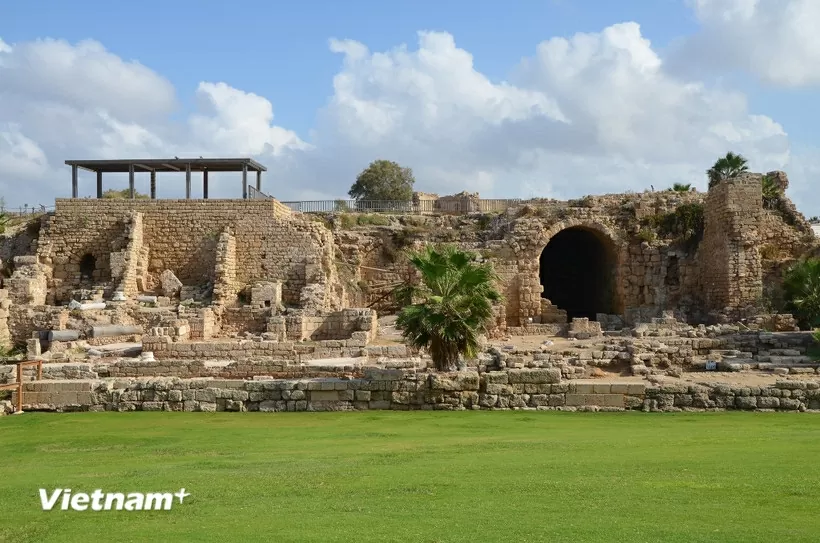
Cesarea, or Caesarea Maritima, lies quietly on the deep blue Mediterranean shore of Israel, where the sound of the waves is like the steady breath of history.
Although more than two millennia have passed, this land still retains the majesty and mystery of a city that once brought glory to the Roman Empire.
Walking through Cesarea today, one feels like stepping into an ancient book, where each page is a layer of relics stacked on top of each other through the ages.
Once upon a time, it was just a small Phoenician settlement called "Tower of Straton." It wasn't until Herod the Great came to power, around 22 BC, that this coastal area was transformed into a massive port city.
Herod devoted much effort to building Cesarea, naming it after the emperor he revered – Caesar Augustus.
With his talent and vision beyond his time, the king built an artificial seaport using hydraulic cement – a rare advanced technology at that time – to create one of the largest commercial centers in the Eastern Mediterranean. In the following centuries, Cesarea flourished under Roman and Byzantine rule.
|
The lid of a stone sarcophagus is decorated with a Gorgon head, a popular symbol in Roman art. (Source: Vietnamplus) |
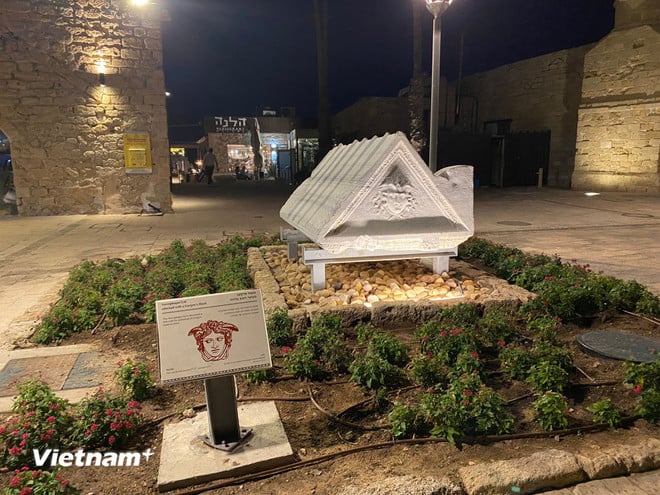
The cobblestone streets, magnificent buildings, theaters, racetracks, bustling markets… all contributed to the city's former prosperity.
Cesarea became the administrative capital of Judea, an important commercial, cultural and religious hub for the entire region.
Countless thinkers and religious leaders have visited here, leaving profound marks on the history of early Christianity.
However, like many other ancient cities, Cesarea was not spared the ravages of war and time. The upheavals of the ages brought the city to decline.
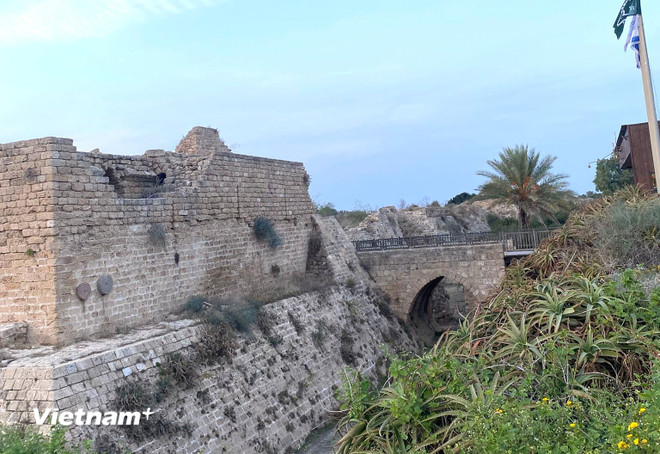
During the Middle Ages, when the Crusaders occupied, they added walls and fortresses, creating a solid, quiet appearance that visitors can still see today on the moss-covered grey stone walls.
Yet perhaps the most beautiful part of Cesarea is the resonance between ancient ruins and modern sea and sky. Under the Mediterranean sun, the ancient Roman theater appears with its arched stone benches as if still echoing somewhere the cheers of ancient audiences.
Not far away, the foundations of Herod's palace lie at the water's edge, where a seaside pool once reflected the brilliant sunlight of its heyday.
And if you walk along the coast, you will easily come across the remains of the racecourse - where wooden wheels once raced in thrilling races. Each step on the stone floor makes people feel the breath of the past more clearly.
|
The city walls and fortresses create a solid, quiet appearance of Cesarea. (Source: Vietnamplus) |
Cesarea is today a national park, a great destination for those who love history and exploration .
The coastal path stretches between sunshine and salty breeze, cafes overlooking the sea, diving services to see underwater ruins – all create an experience that is both ancient and modern.
There, visitors can leisurely sit by the beach, letting the waves tell the two-thousand-year-old story of this city.
Looking at Cesarea, one can easily realize that history is never just numbers or events on paper. History here has shape, color, breath, and echoes of the civilizations that have crossed over.
Cesarea is more than just an ancient fortress or a Roman trading port; it is a living witness of time, a meeting point between the past and the present, between the prosperity of the past and the tranquility of today.
Source: https://baoquocte.vn/cesarea-di-san-la-ma-ben-bo-dia-trung-hai-israel-336939.html
![[Photo] Explore the US Navy's USS Robert Smalls warship](/_next/image?url=https%3A%2F%2Fvphoto.vietnam.vn%2Fthumb%2F1200x675%2Fvietnam%2Fresource%2FIMAGE%2F2025%2F12%2F10%2F1765341533272_11212121-8303-jpg.webp&w=3840&q=75)



























![[Video] The craft of making Dong Ho folk paintings has been inscribed by UNESCO on the List of Crafts in Need of Urgent Safeguarding.](https://vphoto.vietnam.vn/thumb/402x226/vietnam/resource/IMAGE/2025/12/10/1765350246533_tranh-dong-ho-734-jpg.webp)





























































Comment (0)