

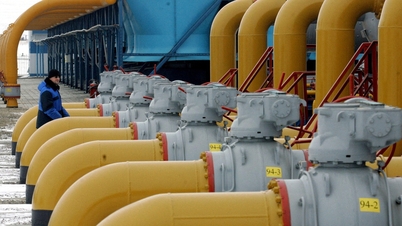
Recent statistics show that gas imports from Russia to Europe are on the rise, raising questions about whether Europe can completely break free from its dependence on this energy source by 2027 as promised?
Following the outbreak of the Russia-Ukraine conflict, at the Versailles summit, European Union (EU) leaders affirmed their determination to completely eliminate Russian energy sources by 2027, including oil, gas, and coal.
Since then, Europe has drastically reduced its dependence on Russian oil, with only a few countries, supplied via pipelines, continuing to import this energy source.
 |
| EU imports of LNG from Russia increased by 18% in the first half of 2024, and pipeline gas imports also increased during the first six months of this year. (Source: Oilprice) |
However, the situation regarding gas is far more complicated. Due to its deep reliance on Russian gas, the EU has not imposed a gas embargo. In the summer of 2022, Russia drastically reduced its pipeline gas exports to Europe. As a consequence, in 2023, Russia supplied only 15% of Europe's gas consumption, compared to around 38% in 2021.
Despite reduced dependence, gas imports from Russia have recently shown an upward trend. In particular, liquefied natural gas (LNG) from Russia is gradually gaining a significant position in the European market.
According to the Institute for Energy Economics and Financial Analysis (IEEFA), EU imports of LNG from Russia increased by 18% in the first half of 2024 compared to the same period in 2023. In addition, gas imports from Russia via pipeline also increased in the first six months of 2024.
This shows that Europe is not only not getting closer to the goal of completely eliminating Russian gas by 2027, but is actually going against this trend.
The Belgian port of Zeebruges is one of three major ports in Europe that receive the majority of LNG from Russia. According to figures from the Belgian Ministry of Energy, the port increased its LNG imports from Russia in 2023 and the first half of 2024. Between 2022 and 2023, imports increased by more than 11%. In the first half of 2024, Zeebruges received 64.25 TWh of LNG from Russia, while the figure for the whole of 2023 was 86.25 TWh.
However, the majority of LNG imported from Russia to the port of Zeebruges is not consumed directly in Belgium but is transshipped, meaning that after unloading from the ship, the gas is loaded onto another vessel for export to other markets, such as Asia and Africa. A small portion of the LNG is vaporized and put into the gas network for export via pipelines to other countries. Only about 28% of the Russian LNG imported to Zeebruges in 2023 was consumed domestically in Belgium.
Europe recently imposed a ban on the transshipment of Russian LNG to markets outside Europe. This ban will take effect from March 2025, and after that date, the Belgian company Fluxys will no longer be allowed to unload LNG from Russian icebreakers and load it onto other vessels for export to markets outside Europe. This may explain why Russia has increased its LNG exports this year, aiming to take advantage of the time before the ban takes effect.
Nevertheless, Europe will need to take stronger measures if it wants to achieve its goal of completely cutting off its dependence on Russian gas by 2027.
Another factor that could accelerate this process is the termination of the agreement for the transit of Russian gas through Ukraine, which is scheduled to end on January 1, 2025.
Completely reducing Europe's dependence on Russian gas in the next few years remains a major challenge. While progress has been made in cutting Russian oil production, LNG and natural gas remain difficult to replace in the short term, especially as imports from Russia continue to rise.
Source: https://baoquocte.vn/chau-au-tu-di-nguoc-muc-tieu-loai-bo-nang-luong-nga-kha-nang-nghi-choi-voi-moscow-van-kho-290600.html

![[Photo] Closing Ceremony of the 10th Session of the 15th National Assembly](/_next/image?url=https%3A%2F%2Fvphoto.vietnam.vn%2Fthumb%2F1200x675%2Fvietnam%2Fresource%2FIMAGE%2F2025%2F12%2F11%2F1765448959967_image-1437-jpg.webp&w=3840&q=75)

![[Photo] Prime Minister Pham Minh Chinh holds a phone call with the CEO of Russia's Rosatom Corporation.](/_next/image?url=https%3A%2F%2Fvphoto.vietnam.vn%2Fthumb%2F1200x675%2Fvietnam%2Fresource%2FIMAGE%2F2025%2F12%2F11%2F1765464552365_dsc-5295-jpg.webp&w=3840&q=75)









































![[OFFICIAL] MISA GROUP ANNOUNCES ITS PIONEERING BRAND POSITIONING IN BUILDING AGENTIC AI FOR BUSINESSES, HOUSEHOLDS, AND THE GOVERNMENT](https://vphoto.vietnam.vn/thumb/402x226/vietnam/resource/IMAGE/2025/12/11/1765444754256_agentic-ai_postfb-scaled.png)








































Comment (0)