

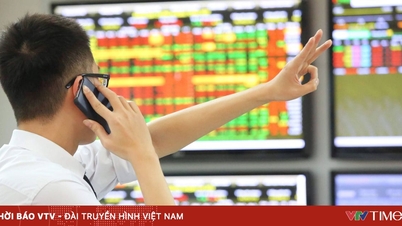
The Vietnamese stock market witnessed a trading session likened to "Black Friday" on December 12th, as a wave of sell-offs spread across almost all stock groups. The electronic trading board was covered in red, with numerous stocks hitting their lower limit by the end of the session, creating a pessimistic sentiment in the market.
There are no special elements.
Statistics show that the entire market saw over 600 stocks decline in price, while fewer than 200 stocks increased. Corrections of 3%-4% were widespread, with many large-cap stocks even hitting their lower limit, indicating intense and widespread selling pressure.
At the close of trading on December 12, the VN-Index lost 52 points, equivalent to a 3.06% decrease, falling to 1,646 points and officially losing the 1,650-point support level. The index's decline was heavily impacted by blue-chip stocks.
Notably, this was the fourth consecutive day of decline for the VN-Index, after the index repeatedly attempted to break through its peak but failed. Pressure from foreign investors also continued, with them net selling nearly 600 billion VND on the HoSE. However, compared to previous sessions, the pace of net selling showed signs of slowing down. The December 12th session also marked a streak of six consecutive net selling sessions by foreign investors, further putting pressure on market sentiment.

Stock prices plummeted on December 12th, causing concern among many investors.
The unexpected turn of events in this trading session quickly became a hot topic of discussion on investment forums. Many investors sought the reasons for the market's sharpest decline since mid-October, especially given the absence of any sudden negative macroeconomic news.
Leaders of securities companies all affirmed that "there are no particular factors to explain the sell-off on December 12." Mr. Truong Hien Phuong, Senior Director of KIS Vietnam Securities Company, analyzed that if each specific factor is considered separately, it is very difficult to pinpoint a direct cause of the sharp decline.
In fact, the market had been trading sideways for about two weeks prior, but there was no sufficiently strong news to create new momentum. Capital flows remained cautious, mostly observing from the sidelines, while large capital inflows had not yet returned, leaving the market lacking the impetus to continue its upward trend.
From a technical perspective, Mr. Phuong believes that after a prolonged period of sideways movement, the market usually experiences a clear shift. This could be an increase if there is positive news or a decrease if supporting information is weak and investor sentiment weakens. In the case of the December 12th session, the downward scenario occurred as selling pressure surged towards the end of the session, quickly spreading and leading to widespread sell-offs.
According to Mr. Phuong, the most notable factor in this session was the weakening of Vingroup 's group of stocks. For the past two months, while the VN-Index remained high around 1,600-1,800 points, the index's support largely came from this group of stocks. If Vingroup is excluded, the VN-Index is actually only around 1,500 points.
"When the market lacks supporting information, coupled with a prolonged sideways movement, investor sentiment becomes more sensitive. The fear that the index could fall further triggered strong selling pressure. Not to mention, foreign investors continued to net sell, focusing on large-cap stocks, making domestic investors – who are already fragile – even more cautious," this expert analyzed.
According to Mr. Phuong, observations in recent days show signs of large capital outflows from the market. Strong selling pressure often appears at the end of the trading session, with large volumes and pushing many stocks to their lower limit. This development does not come from small retail investors but mainly from institutions or large-scale investors, causing the impact to spread more quickly and strongly.
Short-term risks remain.
From another perspective, Mr. Nguyen Thanh Lam, Director of the Research and Analysis Department at Maybank Securities Company, believes that the sharp decline was the result of a confluence of factors. First and foremost is the net selling pressure from foreign investors that occurred throughout the previous week. This created significant psychological pressure, especially in the context of weak market liquidity.
According to Mr. Lam, the end of the year is usually a period when cash flow is less active. Therefore, even a stronger-than-normal selling pressure can create a significant price drop. In addition, the following week is the final derivatives expiration week of 2025.
"Developments during the derivatives expiration week often create a certain level of concern, so some investors tend to reduce their stock holdings before this period," Mr. Lam commented.
Furthermore, Mr. Lam also mentioned concerns related to the recent increase in interest rates. However, he believes this factor may be seasonal and temporary, and not sufficient to create a prolonged negative trend for the market.
Given the current market developments, according to the leaders of several securities companies, there is a risk of further market decline in the short term, especially with the possibility of some investors' accounts being subject to margin calls (requiring additional deposit). In fact, during the last trading session of the week, the accounts of quite a few investors were subject to margin calls.
Mr. Truong Hien Phuong analyzed the possibility that in the next 1-2 sessions, margin calls may still occur, and some investors will be forced to sell due to lack of funds to make additional payments, creating further technical downward momentum.
However, this decline does not stem from macroeconomic risks, nor from problems faced by businesses or the economy , but mainly from technical and psychological factors. "If the market continues to fall, the downward momentum will weaken as forced selling subsides. This is most likely a short-term correction rather than a major risk."
"For investors holding good stocks, in my opinion, they shouldn't sell at any price at this time. In fact, over the past 2-3 weeks, most stocks have fallen by 5%-30%. The rallies only lasted 1-2 sessions before falling even more sharply, so most investors are currently losing money. Even so, there's no reason to panic sell, especially since the correction is purely technical," Mr. Phuong added.
The outlook for 2026 is very good.
Ms. Hoang Thi Hoa, Senior Director of Securities Operations at Dragon Capital Investment Fund, believes that if Vingroup's group of stocks are excluded, the current P/E valuation of the VN-Index remains quite attractive.
The business results of many companies in the first three quarters of 2025 show that operational efficiency is genuinely improving, not just a result of cash flow fluctuations. This profitability foundation will determine their ability to attract investment in the future.
According to experts at Dragon Capital, the Vietnamese market is attractive and has the potential to achieve double-digit growth. Compared to many markets that only experience single-digit growth, the increase in Vietnamese consumption demonstrates its immense appeal.
Mr. Vu Huu Dien, General Director of VPBank Securities Company, believes that the outlook for 2026 will be particularly favorable thanks to stable macroeconomic conditions and the interest rate cutting cycle of the US Federal Reserve (FED).
The after-tax profits of listed companies have grown by approximately 20%, and this trend is likely to continue, strengthening company valuations. Despite the rise in the VN-Index, the market still has many stocks at attractive price levels.
"The upgrading of Vietnam's stock market and the return of foreign capital (projected to reach up to $5 billion) will be important drivers, attracting large investment funds worth hundreds of billions of dollars to Vietnam," Mr. Dien expects.
Source: https://nld.com.vn/chung-khoan-giam-sau-khong-ly-do-ro-ret-196251212215905521.htm

![[Photo] Prime Minister Pham Minh Chinh attends the Conference summarizing and implementing tasks of the judicial sector.](/_next/image?url=https%3A%2F%2Fvphoto.vietnam.vn%2Fthumb%2F1200x675%2Fvietnam%2Fresource%2FIMAGE%2F2025%2F12%2F13%2F1765616082148_dsc-5565-jpg.webp&w=3840&q=75)




























































































Comment (0)