

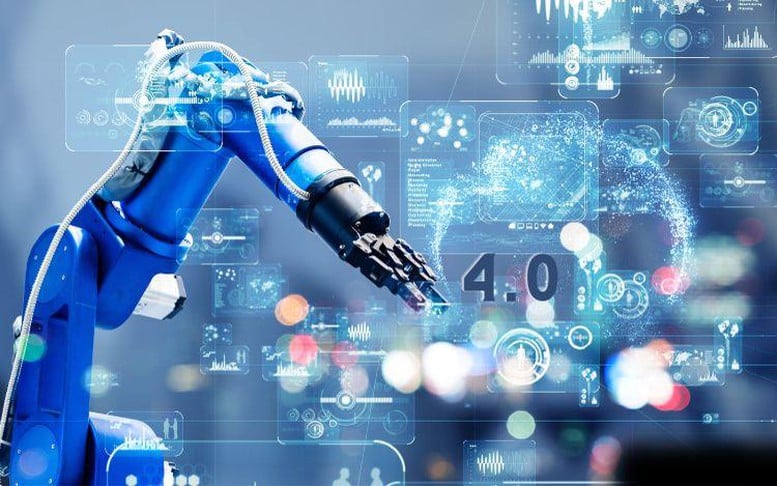
The Ministry of Science and Technology is implementing the program "Supporting research, development and application of Industry 4.0 technologies" - Illustration image.
In the context of increasingly fierce global competition and unprecedented technological change, investment in research, development, and application of Fourth Industrial Revolution technologies has become a vital requirement for every economy . For Vietnam, where over 85% of businesses are small and medium-sized enterprises (SMEs), the challenge of accessing new technologies is even more urgent.
Years of experience have shown that, despite rapid industrialization, Vietnam's labor productivity remains lower than the average of the ASEAN 4 group; many key manufacturing sectors still rely heavily on manual labor, and the level of automation and digitalization is limited. The percentage of businesses applying robots, smart sensors, or data platforms remains modest.
Meanwhile, the Fourth Industrial Revolution, with technologies such as artificial intelligence (AI), big data, the Internet of Things (IoT), blockchain, cloud computing, robotics, and automation, opens up rare opportunities to bridge the development gap.
However, high investment costs, a shortage of technological personnel, and a lack of model examples have prevented many Vietnamese businesses from daring to "cross the threshold" of technology. Therefore, a support program that acts as a "lever" is essential.
The program "Supporting research, development and application of Industry 4.0 technologies" implemented by the Ministry of Science and Technology focuses on two main groups of activities: supporting research and development of technologies and supporting businesses in applying Industry 4.0 technologies to production, management, and services.
In the research and development component, the program prioritizes core foundational technologies such as AI, machine vision, deep learning, natural language processing, intelligent sensors, IoT systems, automatic control, digital twin, collaborative robotics, blockchain, and cloud computing.
A series of scientific and technological tasks have been implemented, directly aimed at solving practical problems in the processing and manufacturing industry, agriculture, logistics, healthcare, smart cities, and public services.
One of the program's outstanding results is the formation and spread of "Vietnamese versions of smart factories."
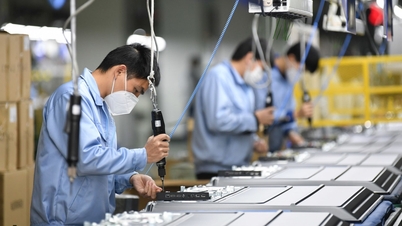
In several large industrial zones, many businesses producing electronic components, mechanical parts, and packaging have boldly invested in robotic pick-and-place systems, welding robots, and automated production lines integrated with sensors and real-time monitoring software. The introduction of AI and machine vision into quality control has helped reduce product defects by 30%–50%, shorten inspection cycles, and improve the stability of the production line.
In particular, some businesses have built digital twin models to simulate the entire production line, thereby predicting failures, optimizing maintenance, and significantly reducing unexpected downtime. These results show that smart manufacturing is no longer a distant concept, but can be fully adapted to suit the scale and resources of the country.
Not limited to the manufacturing industry, the program has also brought about significant changes in high-tech agriculture. Thanks to support in deploying IoT sensors, smart drip irrigation systems, and AI for analyzing environmental data, many farms growing vegetables, flowers, fruits, and aquaculture have shifted from experience-based management to data-driven management.
Real-time monitoring of humidity, nutrients, temperature, and light allows for more precise adjustments to farming practices, saving water and fertilizer and increasing yields by 10%–25%.
Some models even apply blockchain technology for traceability, meeting the stringent standards of export markets. As agriculture is digitized, added value comes not only from the product but also from data, services, and the ability to manage the value chain.
In the logistics and supply chain sector – where there is significant pressure on costs and delivery speed – the program has promoted the deployment of many modern technological solutions such as smart warehouses, RFID product identification, temperature sensors for cold storage, route optimization systems, and fleet management platforms.
As a result, many logistics businesses have recorded a significant reduction in cargo losses, more accurate inventory control, and a 20%–30% reduction in order processing time. This is especially important in the context of the booming e-commerce market and the increasing demand for fast delivery.
A key highlight of the program is its "dual" support mechanism: providing both financial support for research and development activities and technical support to businesses during implementation.
Businesses not only receive funding but are also connected with research institutes, universities, and leading experts to jointly develop solutions, test technologies, and evaluate investment effectiveness.
The "four-party" linkage model – government, scientists, businesses, and investors – has proven remarkably effective, helping many small and medium-sized enterprises (SMEs) successfully implement robotics, IoT, and AI for the first time, minimizing risks and avoiding scattered investments.
Furthermore, the program contributes to the formation of digital platforms serving national digital transformation. Some research results have been integrated into smart urban management systems, local government data analysis platforms, and air quality and traffic monitoring systems. The shared use of technology platforms by businesses and government agencies not only creates synergy but also helps improve the efficiency of social resource utilization.
Despite achieving many positive results, the program still faces numerous challenges. There are significant disparities in technological capabilities among businesses; many are hesitant to invest in core technologies; there is a shortage of highly skilled technology personnel; and scattered data hinders connectivity and sharing.
In light of this reality, the Ministry of Science and Technology has determined that it is necessary to continue promoting the training of Industry 4.0 human resources, perfecting the system of technical standards and regulations, expanding the network of experts, and promoting a co-investment mechanism between the state and businesses to enhance the sustainability of the program.
The era of accelerating mastery of core technologies.
The period 2026–2030 is identified as a period of acceleration, focusing on mastering core technologies such as AI, smart sensors, robot control chips, edge computing, and cloud computing; developing open platforms to support smart manufacturing; supporting businesses in building smart factories based on the Vietnamese model; and expanding technology demonstration projects to new fields such as energy, digital healthcare, finance and banking, and smart education. Simultaneously, the program will be closely linked to national strategies on artificial intelligence, digital economy and society development, national technological innovation, and the development of supporting industries.
From an overall perspective, it can be affirmed that the "Program to support research, development and application of Industry 4.0 technologies" has created a significant change in how Vietnamese businesses approach new technologies.
From a state of hesitation, lack of information, and limited resources, many businesses have boldly invested in core technologies, built internal research capabilities, and gradually transformed their growth models.
The effectiveness of the program is not only measured by the number of projects or technologies transferred, but more importantly by the formation of a new development mindset – a mindset that places science, technology, and innovation at the center of growth.
In the context of increasingly fierce global competition, this is the foundation for Vietnam to not only catch up but also to rise strongly in the digital economy era.
Thu Giang
Source: https://baochinhphu.vn/chuong-program-ho-tro-cong-nghe-40-don-bay-giup-doanh-nghiep-viet-nam-but-pha-102251213170452174.htm






















































































Comment (0)