

 |
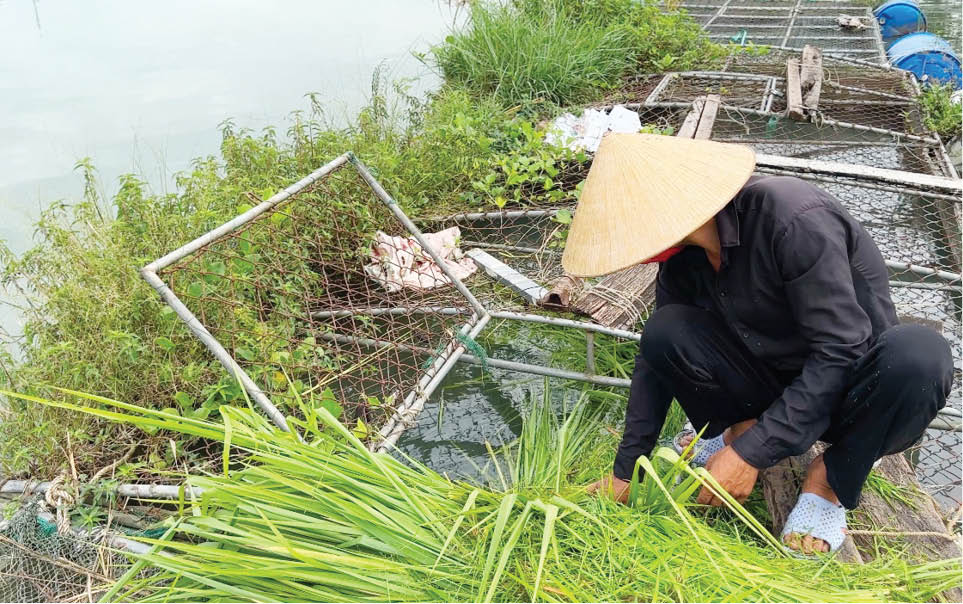
| Raising fish in cages on the Bo River is a traditional occupation of the local residents. |
Creating jobs and stable income.
For many years, fish farming on the Bo River has helped hundreds of families in Dan Dien and Quang Dien communes stabilize their lives and create a sustainable source of income. Currently, Dan Dien commune has more than 320 fish cages and rafts; Quang Dien commune has nearly 700 fish cages.
According to Mr. Phan Dinh Son, a long-time fish farmer in Dan Dien commune, people previously used iron cages covered with B40 steel mesh to mainly raise tilapia; now, many households, including his, have invested in sturdy steel cage systems and expanded to floating raft farming. Each cage requires about 45 million VND in capital, which is not too much, so people are confidently investing.
"If conditions are favorable, each fish cage can generate revenue of 60-70 million VND per year. After deducting expenses, the profit is approximately 20-30 million VND. For households raising 5-10 cages, earning hundreds of millions of VND is commonplace," Mr. Son shared.
In fact, in recent years, people along the Bo River have boldly switched from traditional cage fish farming to an improved raft farming model, combining natural and recycled feed. Many households have chosen to raise grass carp and silver carp in a semi-industrial manner.
According to Mr. Nguyen Van Tuat, an official from the Economic Department of Dan Dien commune: The highlight of this model is the reduced stocking density, which helps the fish grow healthily, have firm flesh, and reduces disease outbreaks. Thanks to the application of scientific care procedures, the rearing time is shortened, the capital turnover is faster, thereby increasing economic efficiency. Many households achieve revenue of 120 - 300 million VND per year, 1.5 - 2 times higher than the old model.
The newly designed floating fish farm features a rust-resistant frame and a safety netting system underneath. This design not only allows for easy disassembly and relocation in bad weather but also facilitates cleaning and waste collection, significantly reducing water pollution.
Reduce environmental pollution
According to Mr. Nguyen Van Tuat, if fish farming on the Bo River is not properly controlled, it will lead to the risk of water pollution from excess feed, fish waste, etc.
To minimize environmental impact, the authorities of Dan Dien and Quang Dien communes have coordinated with relevant agencies to implement various solutions such as rationally planning aquaculture areas, increasing the distance between cages to ensure water flow and reduce localized pollution. They encourage the use of natural and clean processed feed, reducing the use of industrial feed high in protein that causes pollution; provide training on waste treatment techniques, guide farmers in collecting sludge and utilizing it as organic fertilizer for crops; and apply biotechnology and herbal remedies to treat water environments within the cages, limiting disease outbreaks.
Mr. Nguyen Ngoc Tien, Chairman of the People's Committee of Dan Dien commune, emphasized: "Economic development must go hand in hand with environmental protection. If the water source is polluted, the fish farming industry will not be able to survive in the long term. We are guiding people to raise fish using a circular model, utilizing by-products to reduce emissions and aiming for VietGAP certification to meet market standards."
In addition to improving farming models, the communes of Dan Dien and Quang Dien are also considering building a brand for Bo River fish linked to traceability. This will not only increase the value of the product but also expand the market to other provinces and cities and aim for export.
Furthermore, the local government encourages fish farming cooperatives and associations to link up with processing and distribution businesses. The formation of this linkage helps farmers reduce price risks while ensuring the quantity and quality meet market demands.
In addition, a model of experiential tourism focusing on fish farming on the Bo River is also being studied for implementation. With this model, tourists can visit the fish farms, experience feeding the fish, and enjoy the fish on the spot. This is a direction that combines aquaculture and tourism, contributing to promoting the local image and creating additional income for the people.
| Previously, the People's Committee of the former Quang Dien district decided to relocate 121 fish cages belonging to 38 households within the protected area of the clean water supply plant in Ha Lang village, former Quang Phu commune (now part of Dan Dien commune) according to a relocation plan from 2025 to 2028. To ensure the livelihoods of the people, the former Quang Dien district supported investment in infrastructure for the relocated cages, such as building embankments, roads, and electricity grids in the new farming area... |
Source: https://huengaynay.vn/kinh-te/chuyen-doi-mo-hinh-nuoi-ca-long-tren-song-bo-157675.html
![[Photo] Two flights successfully landed and took off at Long Thanh Airport.](/_next/image?url=https%3A%2F%2Fvphoto.vietnam.vn%2Fthumb%2F1200x675%2Fvietnam%2Fresource%2FIMAGE%2F2025%2F12%2F15%2F1765808718882_ndo_br_img-8897-resize-5807-jpg.webp&w=3840&q=75)





















































Comment (0)