

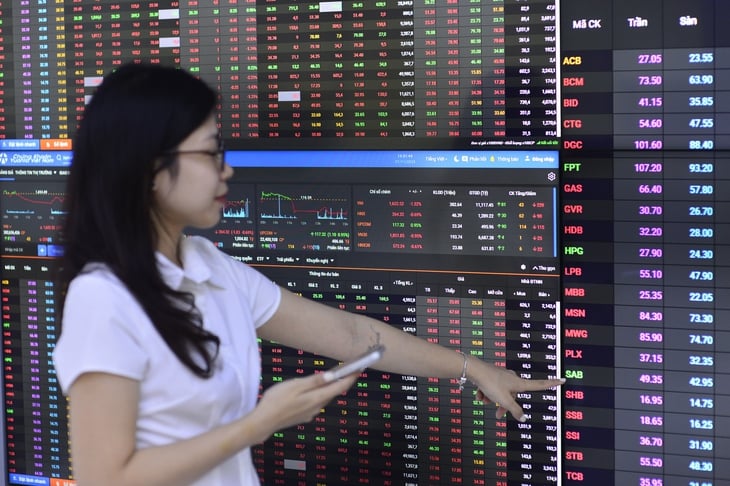
Retail sector stocks show strong divergence - Photo: QUANG DINH
Retail and consumer sector stocks are polarized, with companies telling different stories.
Although the VN-Index is nearing its all-time high, retail and consumer sector stocks have not yet created a truly positive picture across the board.
This group only noted a few stocks with outstanding performance, while the majority were still lagging behind, or even experiencing negative growth.
The group of outstanding gainers included MWG - Mobile World Investment Corporation and PET - PetroVietnam General Services Corporation, both of which recorded gains exceeding the VN-Index (+37.9%).
Conversely, stocks like HAX - Hang Xanh Auto Services Joint Stock Company, and PNJ - Phu Nhuan Jewelry Joint Stock Company, create a stark contrast.
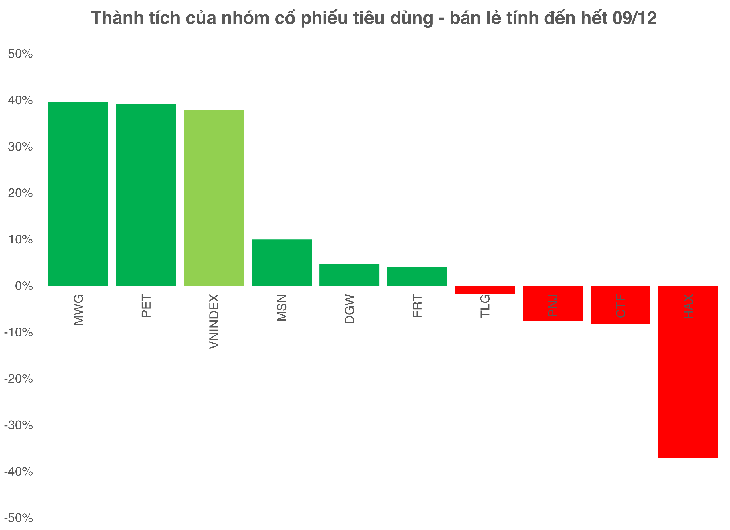
Specifically, MWG shares are up nearly 40% with several promising factors: the Mobile World and Dien May Xanh chains are planning IPOs, while Bach Hoa Xanh is accelerating its expansion into the North.
Meanwhile, PET shares surged by 39.2%. Investors are focusing on the auction of 24.9 million PET shares by PVN at a starting price of 36,500 VND per share on December 11th, which will "reveal" a new strategic shareholder.
Behind the leading group, stocks like MSN (+10%), DGW (+4.8%), and FRT (+4.1%) continued to rise but did not make a significant impact.
Meanwhile, some businesses are facing negative growth. Despite a surge in growth at the end of November 2025, Thien Long's TLG stock is still down 1.7% since the beginning of 2025. The significant fluctuations in TLG's stock price occurred after news that Kokuyo (Japan) wanted to spend over 4,700 billion VND to acquire a majority stake in TLG.
Perhaps the hardest hit group is the automotive distribution sector, with HAX shares falling by as much as 37.2%. Next is City Auto's CTF, which also dropped 8.2%.
Households prioritize saving.
These fluctuations stem not only from within the businesses themselves but also from general household trends.
According to Michael Kokalari, Chief Economist of VinaCapital, the savings rate of Vietnamese households has increased to 30% of income after COVID-19. Disposable income increased by 6–7%, but spending only increased by 5% in 2025. This reflects that people are prioritizing saving and limiting non-essential purchases.
In fact, consumer growth in 2025 will be largely driven by international tourism, particularly the return of Chinese tourists, accounting for approximately 1 percentage point of the overall retail market growth.
Mr. Kokalari predicts that by mid-2026, new purchasing power could recover significantly as the financial accumulation cycle comes to an end.
From another perspective, Mr. Nguyen Anh Khoa, Director of Analysis & Research at Agribank Securities Joint Stock Company (Agriseco), noted that the year-end natural disasters have led many households to prioritize their budgets for post-storm recovery, which will result in differentiation among various related stock groups such as consumer goods, construction materials, and insurance.
Restructuring - Listing: A New Driving Force for the Industry?
With domestic purchasing power needing time to recover, restructuring or listing deals have become major attractions.
A notable upcoming deal is PET, where PVN is auctioning off nearly 25 million shares. If a new strategic investor emerges, PET's business model may also change.
This is also a story attracting attention from TLG, as it involves a partner from Japan. This is expected to help expand cooperation in research and design, elevating product quality both domestically and internationally.
Meanwhile, MSN is also preparing to transfer its MCH shares – Masan Consumer Holdings JSC – to the HoSE, with plans to list on the HoSE. One of the goals set by MSN's leadership is to include MCH in prestigious indices such as VN30.
Mr. Bui Van Huy, Director of Investment Research at FIDT, assessed that the wave of IPOs and divestments has only just begun a new phase. Besides the positive developments in the private sector, the divestment of state-owned enterprises is also attracting attention.
"Divesting at the right time and in the right place helps the state recover invested resources to reallocate to key infrastructure projects," Mr. Huy said.
However, the most important factor is the quality of implementation. If the divestment-capitalization process is well-prepared in terms of valuation methods, information transparency, and protection of minority shareholders' rights, investors will see it as a genuine opportunity, not just an internal transfer transaction.
Source: https://tuoitre.vn/co-phieu-nhom-ban-le-tieu-dung-tuong-phan-manh-trong-boi-canh-ho-gia-dinh-viet-siet-chat-chi-tieu-20251210185025315.htm
































![[Video] The craft of making Dong Ho folk paintings has been inscribed by UNESCO on the List of Crafts in Need of Urgent Safeguarding.](https://vphoto.vietnam.vn/thumb/402x226/vietnam/resource/IMAGE/2025/12/10/1765350246533_tranh-dong-ho-734-jpg.webp)
























































Comment (0)