


In Vietnam, the right to access information is a fundamental right of citizens and of human beings, as enshrined in the Constitution (1992 Constitution, 2013 amended Constitution). To implement this, the state has concretized it into the Law on Access to Information (2016). The law specifically stipulates the public disclosure and transparency of all types of information created, received, or held by state agencies (except for cases classified as confidential). Information must be publicly disclosed and transparent in the sense of being complete, timely, specific, accurate, clear, easy to understand, easily accessible, and viewable, listenable, recordable, copyable, and photographable. (Legal documents must not only be publicly disclosed in terms of content, but also in terms of soliciting feedback and input from the main affected parties. Socio -economic reports must publicly disclose the data sources from the statistics sector or specialized sources, and some indicators must be compared with the general level of the region and the whole country as prescribed). The most widespread and accessible form of public disclosure is through mass media, especially online newspapers, television, and websites. The content and methods of transparent disclosure are also specifically regulated in the Law on Anti-Corruption, the Law on Grassroots Democracy, and the Press Law. The Law on Government Organization and the Law on Local Government Organization also stipulate the responsibility for transparent disclosure of the organization and operation of administrative levels. Specialized laws (the Budget Law, the Bidding Law, and laws related to education and training, healthcare, science and technology, and construction, etc.) also regulate the content of transparent disclosure according to their respective sectors. Transparency is a principle and method of operation of the rule of law and democratic regimes; it is a fundamental driving force for national and local development, and provides a foundation for combating corruption at all levels and in all sectors.
Currently, neither the international community nor Vietnam has an annual national and provincial-level index for assessing and ranking access to information. In 2019, Vietnam scored 76 out of 150 points, ranking 78th out of 123 countries (after the Law on Access to Information was enacted). It is likely that Vietnam's score and ranking have improved since then. Regarding transparency and openness, neither the international community nor Vietnam has a common index for national and provincial-level assessment and ranking. However, some indices do include components related to transparency and openness.
Transparency and openness in the fight against corruption are key indicators. Vietnam's Corruption Perception Index (CPI) in 2024 reached 40/100 points, ranking 88th out of 180 countries. While the "Transparency" category wasn't mentioned, this is a fundamental aspect of corruption prevention and control, and is generally understood to be on par with (and often above) the perceived level of corruption. Vietnam also achieved a budget transparency index of 51/100 points, higher than the world average (45 points), ranking 57th out of 125 countries (2023). Furthermore, Vietnam's stock and real estate markets also received international ratings for transparency above the world average.
Transparency and openness are one of ten anti-corruption measures in the Provincial Anti-Corruption Index (PACA Index), with a maximum score of 6 out of 30 points. In 2023, the highest scores were achieved in the areas of cashless payments, rotation of civil servants, and implementation of codes of conduct, reaching 92-95% (compared to the maximum score). Controlling the assets and income of civil servants also falls under this group, but public opinion is concerned about its reliability. Transparency and openness (in the public sector) reached nearly 90%. Administrative reform and the implementation of regulations and standards were also at a similar level. Digital transformation and the implementation of Directive No. 10/CT-TTg dated April 22, 2029, of the Prime Minister on strengthening the effective handling and prevention of harassment and inconvenience to citizens and businesses in resolving issues reached over 60%. The lowest score was in controlling conflicts of interest, below 50%. Thus, transparency and openness scored relatively high, 15% higher than the overall score for prevention (75%) and 20% higher than the overall score for the anti-corruption index (nearly 70%). As many as 29 out of 63 provinces and cities achieved the maximum score.
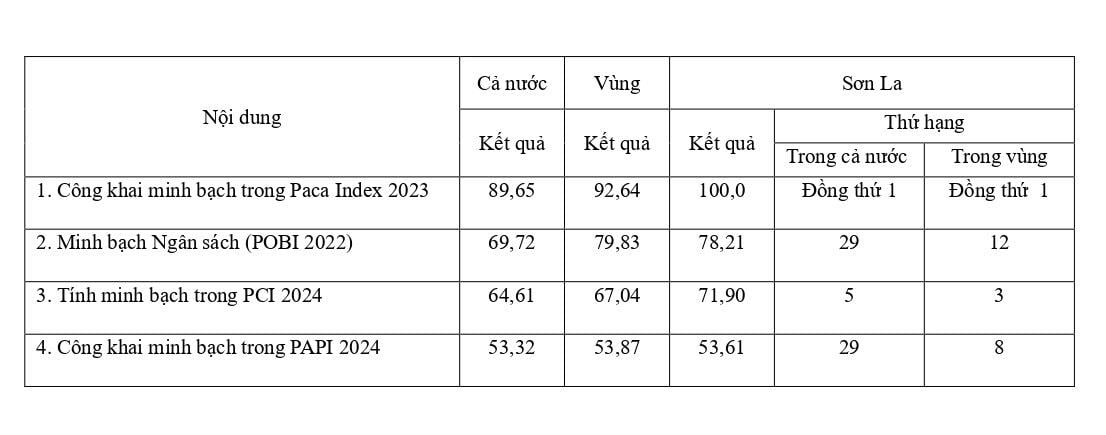
Son La province is among the provinces that achieved the maximum score (100%) in transparency and openness, 27.50% higher in the Paca Index (72.52%) and 20% higher in the prevention content (80%), ranking first in the country and the Northern Midlands and Mountains region.
Transparency and openness also face some challenges. Both the Law on Access to Information and the Law on Anti-Corruption specifically stipulate the categories of information that must be made public and transparent. However, the assessment of transparency and openness at the provincial level in general, and in Son La in particular, is a general overview rather than a detailed breakdown by category, making it difficult to guide improvements tailored to each specific category. Public opinion also expresses concern, suggesting that the assessment of transparency and openness leans towards public disclosure, while lacking sufficient specific data on transparency.
Budget transparency. Specifically, budget transparency includes independent national-level indicators (OBS) and provincial-level indicators (POBI). OBS is led by the International Budget Partnership (IBP), and POBI is led by the Budget Transparency Alliance. The content includes (1) Budget development guidelines, (2) Budget drafts, (3) Budget estimates, (4) Citizen Budget (basic, concise, and easy-to-understand content), (5) Periodic implementation reports (quarterly, semi-annually, annually), and (6) Audit reports.
In 2023, at the national level, the OBS index reached 51% of the maximum score (100), higher than the world average (45%), ranking 57th out of 125 countries, an increase of 14 places compared to 2020. The provincial POBI index (only published in 2022) was higher, averaging nearly 70% of the maximum score, a significant increase compared to 30.5% in the first year of publication (2017), but not significantly higher than 69.09% in 2020. And only over 50% of provinces have fully disclosed their data, reaching 75% or more, but no province has yet reached the maximum score.
Son La province's POBI index reached 78.24% (2022), significantly higher than the national average (70%), but also significantly lower than the top provinces (90-95%). In terms of ranking, Son La is 29th, above the national median, but ranks 12th in the bottom group of the Northern Midlands and Mountains region (the region with the highest average score in the country, reaching nearly 80%).
Provincial budget transparency is a core aspect of public disclosure and transparency. While progress has been made over the years, it still raises some significant concerns. The budget transparency index is significantly lower than the overall transparency index, with a ratio of 70%/90%, and 78%/100% for Son La. Budget disclosure is currently limited to revenue and expenditure estimates and final accounts, while the effectiveness and shortcomings in the use of public finances and public investment remain unclear. There is very little information available on provincial-level public finance audits. In provinces, including Son La, some provincial departments and agencies, as well as most districts and (formerly) communes, rarely disclose their budgets on their websites, making them difficult to access.
Transparency is a key component of the Provincial Competitiveness Index (PCI). Transparency has a maximum score of 10 out of 100 points in the PCI. It comprises nine areas (including the quality of the Provincial People's Committee website, accessibility of important information, transparency and negotiation regarding taxes, policy stability, and policy critique). The national transparency index (2024) shows: the median province at 64.6%, the highest at 73.9%, and the lowest at 48.0%. Son La province scored 71.9%, placing it in the top tier, ranking 5th out of 63 provinces and cities nationwide and 3rd out of 14 provinces in the Northern Midlands and Mountains region (based on the old provincial ranking). Son La province also has a high transparency index regarding taxes, with 25% of businesses frequently having to negotiate (to obtain tax reductions), while the national average is 40%, and other provinces are above 60%. However, Son La province is currently at an average level in terms of policy stability, policy critique, quality and usefulness of its website, and access to important information (land, bidding, etc.).
Transparency and openness are key components of the Provincial Public Administration and Governance Performance Index (PAPI). Transparency and openness have a maximum score of 10 out of 80 points in the index. The average PAPI score for provinces in 2024 was 53.32% of the maximum score, with the highest score at 62.31% and the lowest at 44.15%. Specifically, access to information accounted for 33.46%; public disclosure of poverty lists 70.36%; local budget revenue and expenditure 55.04%; and public disclosure of land use plans and land price lists 54.04% (Each component index has a maximum of 2.5 points).
Son La's transparency index is 53.61%, ranking 29th nationwide and 8th in the Northern Midlands and Mountains region. Specifically, access to information is 32.90%, public disclosure of poverty lists is 70.18%, public disclosure of local budget revenue and expenditure is 57.09%, and public disclosure of land use plans and land price lists is 54.26%. Overall, it is around the provincial average, with only small differences, but significantly lower than top-ranked provinces and considerably higher than bottom-ranked provinces.
This summarizes the general content of public disclosure and transparency at the provincial level in Son La province, compared with the rest of the country and the Northern Midlands and Mountains region.
Phan Duc Ngu
References: Annual report on anti-corruption results, thanhtra.gov.vn; Transparency of state budget in the context of the digital economy, quanlynhanuoc.vn; PCI Index, pcivietnam.vn; PAPI Index, papi.org.vn.
Source: https://sonla.dcs.vn/tin-tuc-su-kien/noi-dung/cong-khai-minh-bach-o-cap-tinh-5580.html




























































































Comment (0)