

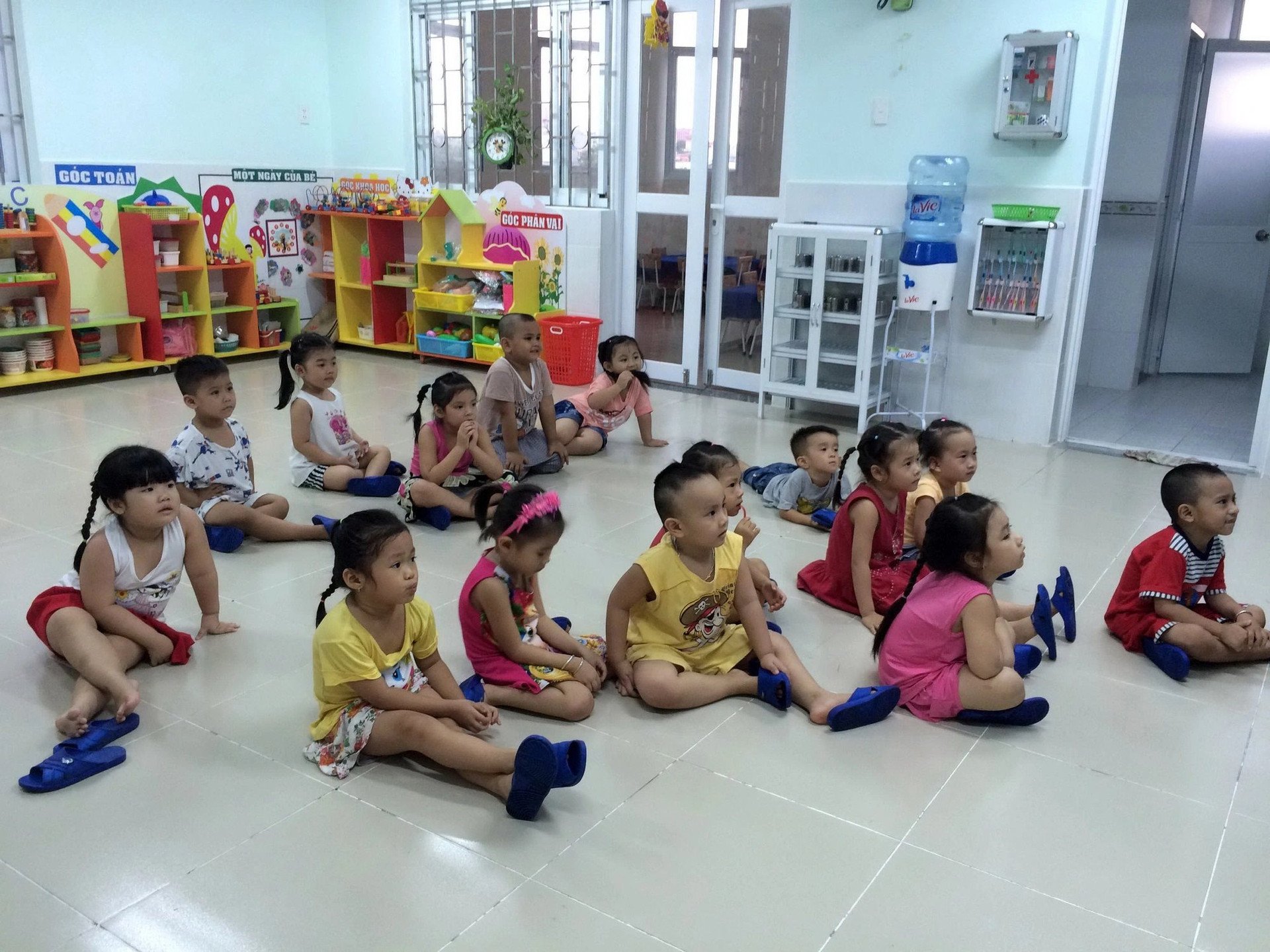
According to a survey by the Institute of Workers and Trade Unions, there are currently nearly 400 industrial parks nationwide with over 4 million workers. Many workers have been employed in the processing and manufacturing industries since before they started families, and continue to do so after getting married and having children. In two industrial parks, Hanoi and Dong Nai, the rate of workers getting married and having children is very high, reaching 60-70%. This creates a huge demand for education for the children of workers at the preschool , primary, and secondary levels.
Ms. Nguyen Thi Hoa, from Kim Chung commune (Dong Anh district, Hanoi), used to work as a factory worker in Thang Long Industrial Park. However, due to difficult circumstances—her husband is also a factory worker, and there was no one to care for their two children—she had to quit her job and stay home to sell goods online. Ms. Hoa said that her factory worker salary was 5-6 million VND per month, and only in months with continuous overtime could it increase to 8-9 million VND. She also changed companies several times due to the unstable salary, but still hasn't found a stable job.
“During the most difficult times, the children were constantly sick, and even though their grandparents came from the countryside to help, they could only stay for a few days before returning to work in the fields, while my husband and I were constantly working overtime. Therefore, we couldn't manage. Sending the children to daycare wasn't reassuring because the schools weren't up to standard. Many working-class families here also tried to send their children to school, but they were always worried because the schools weren't reliable. Out of desperation, I had to quit my job and stay home to sell goods so I could take care of the children,” Ms. Hoa shared.
Ms. Nguyen Thi Minh, a factory worker residing in Thach That district (Hanoi) but originally from Son La province, shares a similar situation. Ms. Minh is a hardworking and diligent woman, earning a much higher income than she would have earned from farming back home. However, real difficulties arose when her child reached kindergarten age. Without grandparents' support, she struggled to send her child from daycare to kindergarten. The child was frail and fussy, so daycare centers were reluctant to accept her. This continued with the first and second child. She almost had to quit her job to care for her children. When the child started school, the situation became truly dire. Schools that met the requirements were too far away, making it inconvenient for the parents working shifts to drop off and pick up their child. Suitable schools were impossible to get into due to lack of household registration and the cost exceeded the couple's means… After months of deliberation, they finally decided to return to their hometown.
According to Ms. Pham Thi Thu Lan, Deputy Director of the Institute of Workers and Trade Unions, sending young children back to their hometowns is the first choice for workers if their parents have the means and time to care for them. However, children being away from their parents for extended periods raises issues regarding the parent-child relationship, as well as the opportunities for parents to educate, nurture, and love their children. Workers don't get to talk to or be close to their children daily, they don't know how their children are eating, playing, studying, or how to care for and educate them in a timely manner. Therefore, sending children to private facilities is the choice of many workers, despite their low incomes (70% of workers nationwide earn less than 10 million VND and live in rented accommodation). Even so, they still have to "tighten their belts" to send their children to school.
According to Ms. Do Hong Van, Head of the Women's Affairs Department of the Vietnam General Confederation of Labor, the Confederation has consistently shown concern and sought solutions to promote the implementation of policies on kindergartens and preschools for the children of workers, contributing to protecting the legitimate rights and interests of union members and workers. Specifically, the Confederation has proposed that all industrial parks that are formed and developed in the future should have land allocated for the construction of kindergartens and preschools; and that land for kindergartens and preschools should be added to existing industrial parks. It has also directed all levels of trade unions to implement Prime Minister's Directive 09 on promoting solutions to address the issue of preschools in industrial parks and export processing zones. In addition, it has accelerated the construction and operation of trade union facilities in industrial parks and export processing zones, including preschools for the children of workers. Directing trade unions at all levels to coordinate and encourage businesses to build nurseries and kindergartens, and provide financial support for childcare for the children of workers, typical examples include Dong Nai, Binh Duong, and Tien Giang provinces...
However, the reality of school shortages, forcing workers to find schools for their children on their own, persists. This necessitates more urgent and thorough action from all sectors, levels, and localities in building schools for industrial zones.
The shortage of schools forces workers to find their own solutions for childcare while they go to work, and most have to send their children to daycare centers, grandparents' homes, or private schools. According to a survey of the lives, jobs, and annual incomes conducted by the Institute of Workers and Trade Unions, 40% of workers have to send their children back to their hometowns to be looked after by relatives, and nearly 22% send them to family-run daycare centers or private nurseries. Some send their children to neighbors or acquaintances near their rented accommodation, while others have one spouse stay home to care for the children or rely on relatives from their hometown to come and help. Some workers even leave their children alone at their rented accommodation during their work shifts, although this is not a frequent occurrence.
Source

![[Photo] General Secretary and President To Lam meets with National Assembly delegates from ethnic minorities.](https://vphoto.vietnam.vn/thumb/1200x675/vietnam/resource/IMAGE/2026/04/20/1776696701056_a1-bnd-8331-3342-jpg.webp)

![[Image] National Assembly discusses the implementation of the socio-economic development plan.](https://vphoto.vietnam.vn/thumb/1200x675/vietnam/resource/IMAGE/2026/04/20/1776696707422_ndo_br_img-20260420-185419-jpg.webp)



















































































Comment (0)