


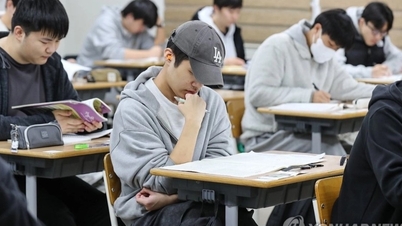
Candidates at the exam center at Nguyen Gia Thieu Secondary School (Tan Binh District, Ho Chi Minh City) discuss after completing the 2025 high school graduation exam - Photo: NGUYEN KHANG
Amidst the heated debate surrounding the 2025 high school graduation exam, many teachers and experts believe that the core issue should be whether the exam accurately assesses students' foreign language proficiency.
Help students know where they stand.
Associate Professor Pham Vu Phi Ho, deputy head of the Faculty of Foreign Languages at Van Lang University, believes that the issue is not whether the exam is difficult or easy, but rather that the English exam must measure students' ability to use the language.
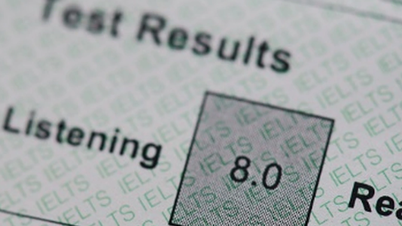
"International standardized tests like IELTS do this very well. After taking the test, candidates know what level they are at, their strengths and weaknesses, and how well they can use English in communication, study, or work," Mr. Ho said.
Meanwhile, high school graduation exams that are too difficult or too easy do not accurately reflect true abilities.
"Candidates may score 6-7 or even 8-9 points, but still don't fully understand where their language proficiency stands. The difficulty level changes every year, making the assessment of proficiency even more ambiguous and inconsistent," Mr. Ho commented.
He proposed a reorientation in how English exams are constructed, suggesting that instead of simply classifying students based on the difficulty level of the questions, the focus should be on assessing their practical foreign language skills. To achieve this, the exams need to be thoroughly researched, widely tested, and referenced from international competency frameworks.
The question library must also be continuously updated in this direction, avoiding question design based solely on the subjective feelings of a particular group of experts. "Exams should be tools to help students understand where they are on their language learning journey, not a puzzle-solving competition," he emphasized.
"There's a problem with the exam."
Dr. Nguyen Thi Thu Huyen, an expert in bilingual and international education , believes that the debate surrounding the current high school graduation exam should not revolve around whether the questions are "good" or "bad." According to her, that is a subjective way of judging, lacking an academic basis.
"In academia, there is no such thing as a 'good exam.' A good assessment must accurately measure the required abilities, be consistent, fair, transparent, motivate learning, and be connected to the teaching and learning process," she emphasized. Compared to those criteria, this year's English exam has many problems.
She pointed out that the high school curriculum only requires students to reach B1 level, while the exam includes a lot of content at the C1 level - such as the reading passages on project farming and greenwashing - which are both long and challenging.
"About 30-35% of the content at level C1 exceeds the requirements," she said. This leads to unfairness, especially for public school students who follow the standard curriculum, whose teachers only reach levels B1-B2. "If the teachers haven't even reached C1, how can the students possibly do well on this exam?" she questioned.
Furthermore, the discrepancies between the sample exam and the actual exam led students and teachers to prepare in the wrong direction. On social media, she only saw responses expressing confusion and discouragement, instead of inspiration for learning. The exam also did not accurately reflect the reality of teaching, as most secondary schools do not have the resources to provide C1 level instruction.
According to Dr. Huyen, to improve the quality of exam questions, the important thing is not to start with the question-setting technique, but to start with the evaluation mindset. And especially, any exam question needs to be tested and evaluated on a wide scale before being officially implemented.
Accurately measuring students' abilities.
Ms. Nguyen Thuy Vuong Khanh, Director of the Admissions Center at Ho Chi Minh City College of Economics , analyzed that the problem doesn't lie in chasing grades or achievements, but rather in the fact that for many years, grades have been considered a "measure of a student's ability." A student who scores 6 points on an exam can immediately be labeled as "poor student" or "incompetent."
Therefore, the important thing is not whether the exam is difficult or easy, but how to ensure that the exam truly measures students' abilities, helping them understand where they stand and which path suits them best – university, vocational training, or another direction – without falling into a state of inferiority or confusion.
Source: https://tuoitre.vn/de-thi-tieng-anh-tot-nghiep-thpt-qua-kho-co-van-de-can-xem-lai-tu-duy-danh-gia-20250630081414174.htm



































![[Video] The craft of making Dong Ho folk paintings has been inscribed by UNESCO on the List of Crafts in Need of Urgent Safeguarding.](https://vphoto.vietnam.vn/thumb/402x226/vietnam/resource/IMAGE/2025/12/10/1765350246533_tranh-dong-ho-734-jpg.webp)

































































Comment (0)