

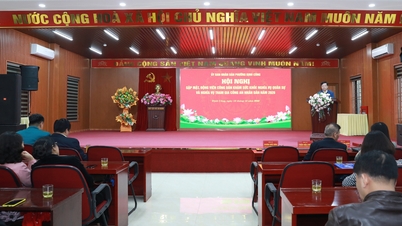
On the morning of December 18th, the Department of Agriculture and Rural Development organized a workshop to assess the current situation and propose the development of agricultural cooperatives linked to production and product consumption, contributing to the xây dựng nông thôn mới (new rural development) program in the province.

Innovation and development of agricultural cooperatives, linked with production and product consumption, is one of the important contents in the task of restructuring the agricultural sector and building new rural areas in the province. Cooperation and production linkages associated with the consumption of agricultural products are increasingly developing.
According to a report by the Center for Agricultural Science and Technology Consulting and Transfer (Agricultural Science and Technology Association - Department of Agriculture and Rural Development), by the end of 2023, the province had 688 agricultural cooperatives, an increase of 126 cooperatives compared to 2019; of which, 420 cooperatives were operating effectively (an increase of 146 cooperatives compared to 2019), accounting for 61.3% of the total number of cooperatives in the province.

Surveys show that in the province, there are 215 cooperatives providing product distribution services for members (an increase of 19 cooperatives compared to 2019); many new cooperative models have emerged, linking production, processing, and consumption of products, with labels and traceability, creating a value chain from production to consumption; and over 45 agricultural cooperatives are applying high technology in the fields of agricultural production and processing.
Despite the positive results achieved, the collective economy , with cooperatives as its core, has not yet developed to its full potential and advantages. The development of the collective economy is uneven across sectors and regions, and in some important economic sectors such as fisheries, farming, forestry, and rural industries, the role of cooperatives has not been fully utilized.
The management structure of cooperatives still has many shortcomings, lacking dynamism and management capacity; production scale is small and fragmented; linkages between production and product consumption along the value chain are still limited; and there are not many new-style cooperatives that operate effectively and sustainably enough to be replicated in the area.

To continue innovating and developing agricultural cooperatives in conjunction with production linkages in an effective and sustainable manner, contributing to the construction of new rural areas in the 2024-2030 period, the Center for Agricultural Science and Technology Consulting and Transfer proposes nine groups of solutions. Specifically, these solutions include: information and communication; human resource development; application of science and technology and digital transformation; policy mechanisms; infrastructure and logistics development; production organization; preliminary processing, processing, trade promotion and product consumption markets; improving the quality of new rural area construction and implementation resources; and solutions to enhance and promote the management role of state agencies and socio-political organizations.

At the workshop, seven presentations focused on clarifying the current state of agricultural cooperative development linked to production and product consumption; and sharing experiences to make cooperative operations more effective...
Ms. Vo Thi Nhung, Deputy Director of the Department of Agriculture and Rural Development, acknowledged the contributions of the delegates and the cooperatives' management in achieving success over the past years. However, to further enhance the effectiveness of cooperatives, the most important factors are human resources, financial resources, land, and policy mechanisms. Therefore, in the coming period, cooperatives need to overcome difficulties and obstacles to actively contribute to the new rural development program.
Source































































































Comment (0)