

It took Tran Thi Phuong nine months to find a job in a remote area, despite having a master's degree from a prestigious university and having previously worked at one of the world's top four auditing firms.
The 27-year-old woman couldn't remember how many job applications she had sent out since receiving her Master's degree in Information Systems from the University of Melbourne in June 2023. She also had two years of experience working at EY Vietnam before that. But neither of these things seemed to give her much of an advantage when looking for a job.
After sending out so many job applications, all Phuong received were rejections, or even silence.
"I've never felt so confused and anxious," Phuong told VnExpress International . "Sometimes I wonder if I'll even find a job here."
After nine months of hard work, Phuong landed a job as a strategic analyst for a real estate consulting firm in Perth, a small city nearly 3,500 km from Melbourne.
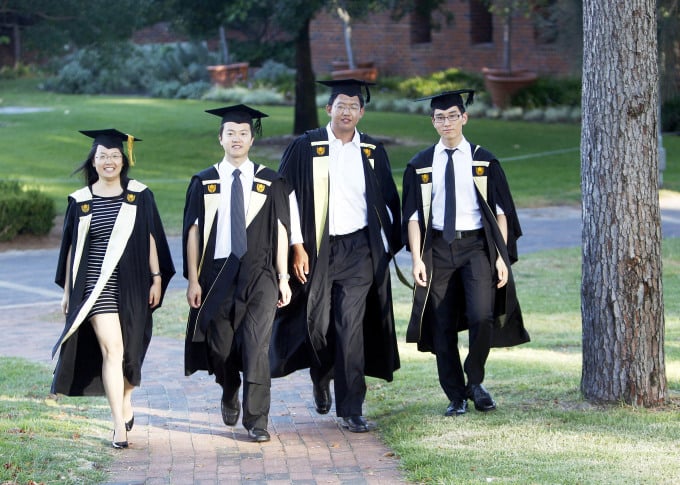
International students in graduation attire at Curtin University, Western Australia. Photo: AFP
Phuong's story reflects some of the challenges faced by recent international graduates with temporary visas in Australia.
A 2022 survey by the Quality Indicators for Learning and Teaching (QILT), funded by the Australian government , showed that 28.5% of international students there were unable to find employment within six months of graduation. For those with master's or doctoral degrees, this figure was 14.4%.
Moin Rahman, 28, from Bangladesh, is one such person. Despite applying for over 80 positions, Rahman has been unable to find a full-time job in civil engineering, the field he studied at the University of Queensland.
"I was under immense psychological pressure," Moin told the Australian Broadcasting Corporation (ABC).
The temporary visa for international students after graduation didn't help him get more than temporary or manual labor jobs.
"If, by some miracle, I pass the interview, I'll be asked about my visa," he recounted.
"Then, when I mention that I'm an international student but am allowed to work full-time, I get shrugs. And so all the qualities I've shown before, everything that interested the employer, are overshadowed."
Even after finding a job, the challenges for these recent international graduates are far from over. They often receive lower salaries than their local colleagues.
According to the report "The Precarious Status of Overseas Graduates: Visa Pathways for International Students After Graduation" published by the Grattan Institute in October 2023, "only half (of newly graduated international students with temporary visas in Australia) find full-time employment. Most of these take jobs that do not require high skills. Half of these receive salaries lower than AUD 53,300 (VND 869 million) per year."
Nearly 75% of those with temporary graduate visas earned less than the average Australian worker's salary in 2021, making them comparable to "backpackers" (people who travel and work at the same time).
Specifically, international students graduating with a Master of Business Administration degree earn approximately AUD 58,000 less per year than local workers with the same qualifications.
Those with master's degrees in computer science and engineering earn around AUD 40,000 less. International students with bachelor's degrees in engineering or computer science earn AUD 12,000 less than domestic students. For business graduates, the difference is around AUD 10,000 per year.
Phuong said that her friends from India, Thailand, and the Philippines all said they would find it difficult to find jobs with salaries comparable to those of local people.
Besides being paid low wages, recent international graduates often end up taking jobs that don't require their qualifications or aren't related to their field of study.
The Australian Financial Review (AFR) cited a study conducted by Deakin University and the University of Adelaide, surveying recent international graduates from 35 Australian universities, which found that only 36% of the 1,156 participants found full-time jobs in their field of study; 40% took menial jobs in sectors such as retail, hospitality, cleaning, or driving.
Ruva Muranda, a 2018 graduate in Biomedical Sciences, said she had to work in a warehouse until early 2020.
"I was really desperate," Ruva told the Guardian . "Not being able to find a job in my field made me feel really inadequate."
Ruva became even more disheartened when comparing herself to her friends, who had found jobs, gotten promotions, bought cars, bought houses, and achieved their career goals.
"It feels like you're left behind at the starting line," Ruva said.
Swastika Samanta, who holds a master's degree in Environmental Management, shared that she had to work part-time jobs in Australia.
"A beggar shouldn't be asking for sticky rice with gac fruit," Swastika said. "You have to accept the best that's possible."
Uncertain residency status is one reason employers are reluctant to hire international students. According to the report "International Students in Australia and the Transition to Work" by researchers at Deakin University and the University of Technology Sydney (UTS), most employers indicated they prefer hiring permanent residents.
Dr. Thanh Pham, a researcher at Monash University, told ABC : "They (employers) assume that international graduates holding temporary visas are unlikely to be long-term residents.... In my interview, they explained that hiring international students means having to find replacement workers after only a few years."
After many experiences, Phuong realized this was the main obstacle in her job search.
As someone who loves and has worked in the oil and gas industry, Phuong wants to find a job in this sector. "However, employers tend to prioritize local candidates. They believe that people in this industry will have access to a lot of documents about minerals and gas, which are considered sensitive information in Australia," Phuong said.
Dr. Pham also stated that she has observed some employers needing to consider the factor of cultural integration.
According to a report by Deakin University and UTS, employers believe that international students need training to adapt to the Australian work environment, and this training comes at a high cost.
Therefore, unless there is a severe manpower shortage, they tend to prioritize hiring local people to avoid lengthy and costly sponsorship processes.
A difficult future
The Australian Department of Education announced on February 28th that the length of time international students can stay after graduation in many fields and professions will be reduced to 2-4 years, instead of 4-6 years as before, starting from mid-year.
The agency said the decision was considered in the context of a changing economic environment, as well as a new immigration strategy.
In addition, the age requirement for this visa will be reduced from the current 50 to 35. Currently, there are approximately 350,000 international students holding temporary visas in Australia.
With many employers reluctant to hire international graduates due to uncertain residency status, this new regulation could make their job opportunities even more difficult.
However, in the view of many, shortening the visa validity period has positive aspects, helping to ensure more sustainable development for students and for Australia itself.
"This creates more fairness for students, and is better for Australia as a whole," Andrew Norton, a policy analyst at the Australian National University, told Times Higher Education .
"If you're young and have a good start to your career, your future will be very promising," he said.
Despite facing many difficulties, Phuong supports this positive viewpoint.
"I consider myself much luckier than many other international students in my job search," Phuong shared. "Although the future is unpredictable, if I encounter obstacles, I will do whatever it takes to overcome them."
Linh Le
Source link



![[Photo] Prime Minister Pham Minh Chinh attends the Conference summarizing and implementing tasks of the judicial sector.](/_next/image?url=https%3A%2F%2Fvphoto.vietnam.vn%2Fthumb%2F1200x675%2Fvietnam%2Fresource%2FIMAGE%2F2025%2F12%2F13%2F1765616082148_dsc-5565-jpg.webp&w=3840&q=75)




















































































Comment (0)