

Students want to be loved.
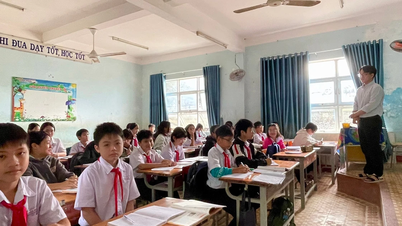
During the discussion in the program, Nguyen Ha Chi, a student from class 8A6 at Tran Duy Hung Secondary School, said that a happy school is one where she and her classmates can share joyful moments with friends and teachers, where they can study, improve their physical and mental health, be loved and respected, and be themselves.
Ha Chi hopes that when students go to school, they won't be afraid of anyone's judgment so they can express themselves in various activities.

Ms. Nguyen Thu Ha, Principal of My Dinh High School, shared that her school is only 5 years old. When it first started operating, it faced many difficulties, from a lack of facilities to a shortage of teachers. Even now, with over a thousand students and 47 classes, there are fewer than 50 staff and teachers, showing that many challenges remain.
"Happiness in school doesn't come from the efforts of any one individual, but requires the collective effort of everyone," Ms. Ha said.
With that perspective, the teachers and students of the school have worked together to build a green, clean, and beautiful school environment with creative spaces. In this environment, the relationships between teachers and students, and between teachers and parents, are supportive and close-knit, preventing incidents of school violence.
Previously, the school only invited parents to participate in activities as observers; recently, it has intensified its project of inviting parents to attend classes together. This involves parents being invited to participate in life skills and career guidance lessons to gain a better understanding of the students' needs.
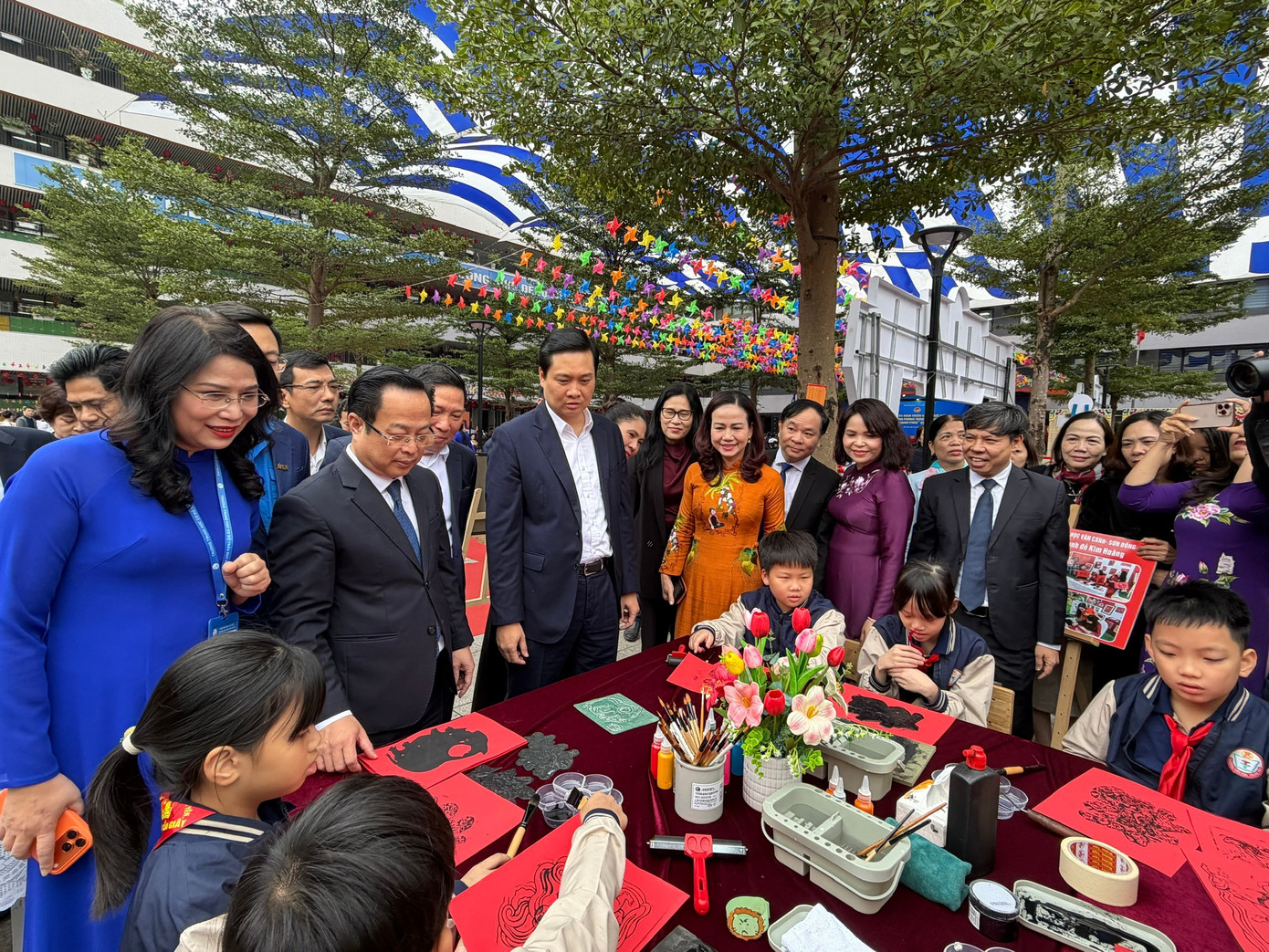
Dr. Nguyen Ngoc An, President of the Vietnam Education Union, stated that in reality, some principals struggle to manage their schools when teachers are burdened with worries and students are not truly striving to learn. After implementing the happy school model, there has been a noticeable change; teachers have been equipped with the skills to overcome difficulties, have positive emotions, overcome barriers to innovation, and are more confident.
According to Mr. An, in Hanoi during the past school year, there were still incidents occurring in some schools that certainly need to be addressed and changed in order to build a safe and friendly learning environment.
"A school is like a home; even if it's big and beautiful, it doesn't guarantee the children's happiness if teachers and parents don't know how to manage and transform their emotions in the face of various situations. Therefore, it's necessary to equip teachers with the skills to be confident and ready to handle incidents and situations in the school and classroom," Mr. An said.
The risk of school violence remains.
The Director of the Hanoi Department of Education and Training, Tran The Cuong, hopes that teachers in schools will build a learning environment where every student feels joy, safety, and respect when coming to school; where every teacher will be supported to fulfill their educational mission with all their heart; and where every parent will feel secure knowing their children are studying in an environment filled with love.
According to Mr. Cuong, incidents such as the student's physical assault on a teacher at Dai Kim Secondary School, and the student fight in Soc Son, are isolated, exceptional cases, like "a few bad apples spoiling the bunch."
Nevertheless, Hanoi has a very large number of schools, and the risk of school violence remains, especially when students are influenced by social media and violent video games.
In the coming period, the Hanoi Education Department will continue to develop training programs to improve teachers' skills, including skills in handling situations and understanding the psychology of students of different age groups, so that teachers can be more confident.
Hanoi also recognizes the crucial role of school psychological counselors, who can share and support students and teachers in relieving stress in their studies and lives. Currently, this role is mainly performed by teachers as an additional responsibility. In the future, the sector will propose job positions, staffing structures based on professional titles, and staffing quotas for school psychological counseling positions.
In addition, schools are strengthening programs to educate students on ethics and lifestyle.
Regarding Circular 19 of the Ministry of Education and Training regulating forms of student discipline, Mr. Cuong stated that, in the past, if students had poor handwriting or violated school rules, teachers would immediately hit them on the hand or make them face the wall. However, education today has changed, focusing on the student, with a humane approach, and disciplinary measures are also aimed at helping students change. During the discussion program, students expressed their desire to be loved and respected at school.
In teaching, teachers and administrators need to set a good example for students to follow, using what is good to overcome what is bad.
"However, moral education for students cannot be done effectively by schools alone; it requires the joint efforts of both families and society," Mr. Cuong said.
After a year of implementing the "Happy School" emulation movement, the Hanoi Department of Education and Training assessed that schools have undergone significant changes. Hanoi will continue to expand the model to all schools throughout the city in the period 2025-2030.
Source: https://tienphong.vn/giam-doc-so-gddt-ha-noi-cac-vu-viec-bao-luc-hoc-duong-la-con-sau-bo-rau-noi-canh-post1790024.tpo


![[Image] Close-up of the newly discovered "sacred road" at My Son Sanctuary](/_next/image?url=https%3A%2F%2Fvphoto.vietnam.vn%2Fthumb%2F1200x675%2Fvietnam%2Fresource%2FIMAGE%2F2025%2F12%2F13%2F1765587881240_ndo_br_ms5-jpg.webp&w=3840&q=75)




































































Comment (0)