

Vietnamese entrepreneur Anh Duong, Co-founder of AirX Carbon: The journey to commercializing negative carbon
By producing and commercializing carbon-negative products and materials, entrepreneur Anh Duong and AirX Carbon have opened up a promising path to contribute to Vietnam's goal of environmental protection and achieving net-zero emissions by 2050.
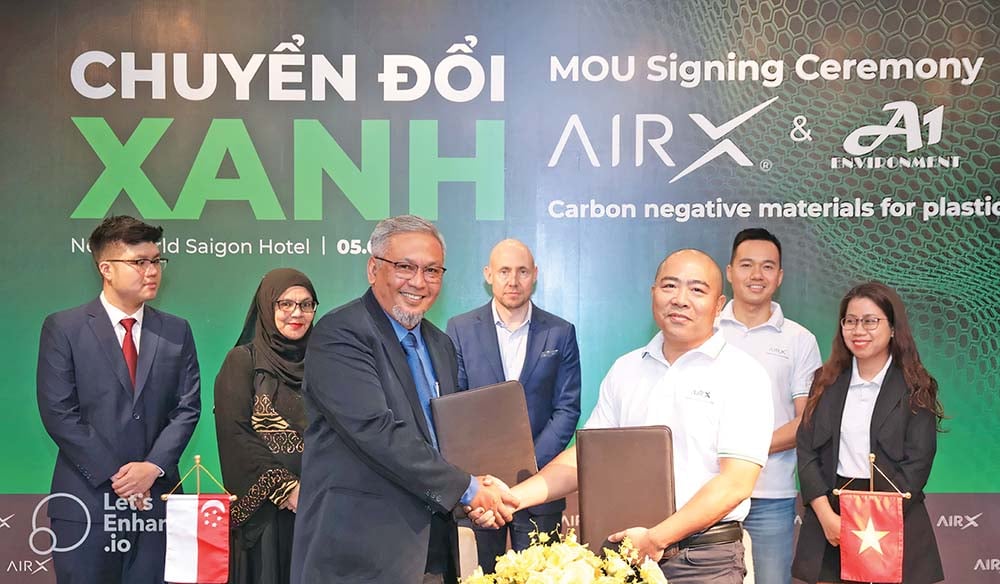 |
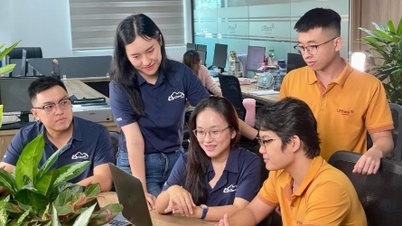
| Vietnamese entrepreneur Anh Duong (top right), Co-founder of AirX Carbon. |
"Tuition fees" for starting a business.
Before starting AirX Carbon, Mr. Anh Duong and his colleagues had been working on a project to produce and sell shoes, sandals, and face masks from coffee grounds. At that time, Mr. Duong's team had to import bio-based raw materials from abroad for production. From this, he realized the great potential of the market for bio-based raw materials.
In 2020, Mr. Duong and his colleagues founded AirX Carbon, branching out into the research, production, and development of biomaterials. Recalling this period, Mr. Duong shared that because biomaterials, especially carbon-negative biomaterials, were still quite new in Vietnam, the AirX Carbon team had to pay a considerable "learning fee."
"Sometimes, we produce a material similar to what we find abroad, but we can't use it in domestic production because Vietnam doesn't have the machinery to process that material. Once, we ordered a sample material, but the supplier delivered the wrong item. We didn't realize it, so we kept trying to produce the finished product without success," Mr. Duong recounted.
Due to a lack of machinery and research facilities, AirX Carbon collaborated with several universities to accelerate research and product development. However, the facilities at these research institutes were only at the laboratory level, and large-scale industrial production required much more. Despite these difficulties, Mr. Duong and his team were not deterred.
Opportunities abound
AirX Carbon's main product is carbon-negative feedstock derived from plant-based agricultural by-products, enabling businesses to create their own bioplastic products and materials, replacing traditional petroleum-based plastics.
Simply put, carbon-negative means removing CO2 from the atmosphere or isolating more CO2 than is emitted. AirX Carbon utilizes agricultural by-products such as coffee grounds, sugarcane bagasse, coconut fiber, cocoa shells, soybean meal, etc., without using food crops. The company then converts all the carbon isotopes (C14) found in the biomass through a complex material synthesis process to create plant-based plastics.
"Because plants absorb CO2 through photosynthesis and store carbon in their structure, when reusing 'discarded' structural parts, such as coffee grounds and sugarcane stalks, to produce bio-composite materials, AirX Carbon can ensure that the carbon previously absorbed by the plants is retained, does not enter the atmosphere, and remains throughout the product's lifecycle. In some special bio-materials, the carbon element is permanently locked and does not revert back to CO2," Mr. Duong explained.
Similarly, by synthesizing various materials during production, AirX can achieve carbon negativity due to its high bio-content and the fact that the production process requires less energy than producing new plastic from virgin materials. At the end of its lifespan, the bioplastic product can be recycled to create a new material, ensuring continuous carbon capture and recycling within the material. This feature not only promotes the circular economy but also helps limit carbon emissions.
AirX Carbon offers a range of bioplastics, from low-carbon storage (0.841 tbson carbon/ton of plastic) to high-carbon storage (1.5 tbson carbon/ton of feedstock). The company is currently developing a new bioplastic capable of storing up to 3.5 tbson carbon/ton of feedstock.
In 2023, AirX Carbon launched the world's first carbon-negative material derived from coffee grounds. Mr. Duong proudly stated that while there are currently about 3 or 4 companies capable of producing carbon-negative materials from coffee grounds, AirX Carbon is the only one that can commercialize this material.
The market for biomaterials and carbon-negative materials is vast, so the opportunities for AirX Carbon are immense. “The green economy and Net Zero trends are driving businesses to transform. With a product that keeps pace with these trends, we’ve received considerable attention,” said Mr. Duong.
Speaking to Investment Newspaper, Mr. Anh Duong said that within the next 12 months, AirX Carbon will officially complete and put its factory in Long An into operation with a capacity of approximately 500 tons of raw materials per month. Notably, the company already has a guaranteed buyer for its output.
For example, in a collaborative project with a Japanese partner, AirX Carbon utilized coffee grounds/bamboo to create virgin granules as a replacement for oil-based products, with a bio-content exceeding 51%. In the Japanese market, products with a bio-content exceeding 51% are not considered plastic and benefit from many preferential policies. This enabled AirX Carbon to secure a pre-purchase agreement for several hundred tons of bio-based raw materials with its Japanese partner.
Currently, AirX Carbon's main source of revenue is still from selling finished products made from carbon-negative biomaterials, such as cups, mugs, and furniture. “The carbon-negative materials market needs another 5 to 7 years to become more favorable. Right now, the finished products are easier to bring to market and generate better sales. We use this profit to continue investing, serving our main goal of producing and supplying carbon-negative biomaterials,” Mr. Duong shared.
Source


![[Photo] Prime Minister Pham Minh Chinh holds a phone call with the CEO of Russia's Rosatom Corporation.](/_next/image?url=https%3A%2F%2Fvphoto.vietnam.vn%2Fthumb%2F1200x675%2Fvietnam%2Fresource%2FIMAGE%2F2025%2F12%2F11%2F1765464552365_dsc-5295-jpg.webp&w=3840&q=75)


![[Photo] Closing Ceremony of the 10th Session of the 15th National Assembly](/_next/image?url=https%3A%2F%2Fvphoto.vietnam.vn%2Fthumb%2F1200x675%2Fvietnam%2Fresource%2FIMAGE%2F2025%2F12%2F11%2F1765448959967_image-1437-jpg.webp&w=3840&q=75)































![[OFFICIAL] MISA GROUP ANNOUNCES ITS PIONEERING BRAND POSITIONING IN BUILDING AGENTIC AI FOR BUSINESSES, HOUSEHOLDS, AND THE GOVERNMENT](https://vphoto.vietnam.vn/thumb/402x226/vietnam/resource/IMAGE/2025/12/11/1765444754256_agentic-ai_postfb-scaled.png)




































Comment (0)