

In Hai Phong, while staying home to care for her newborn child, Ms. Nguyen Thi Ha learned how to sow rice seedlings in trays and gradually became a skilled farmer with many innovative ideas for making a living from farming.
Honored by the Central Committee of the Vietnam Farmers' Association as one of the 100 outstanding farmers of 2023, Ms. Nguyen Thi Ha, 38 years old, said she was very happy that her efforts over the years had been recognized. Her initiatives have brought economic benefits to thousands of farming households in the North.
Born into a farming family with nine siblings in Ninh Giang district, Hai Duong province, Ms. Ha decided to enroll in the Vietnam Academy of Agriculture with the hope of using her knowledge to change agricultural practices. However, her mother passed away early, and the family faced increasing hardship, forcing Ms. Ha to drop out in her second year.
After spending two years in the capital working as a domestic helper and babysitter, in 2009 Ms. Ha returned to her hometown to work as a factory worker and married her high school friend, a border guard. Feeling sorry for the young couple living in cramped conditions, a relative lent Ms. Ha a house in Truong Son town, An Lao district, Hai Phong city.
When she gave birth to her first child, her husband went to South Korea to study, so Ms. Ha was busy and quit her job as a factory worker. During her time as a stay-at-home mother, reminiscing about her agricultural student days, she occasionally watched videos on YouTube about Japanese farming methods. She stumbled upon their tray seedling method, a highly effective technique not yet used in Northern Vietnam.
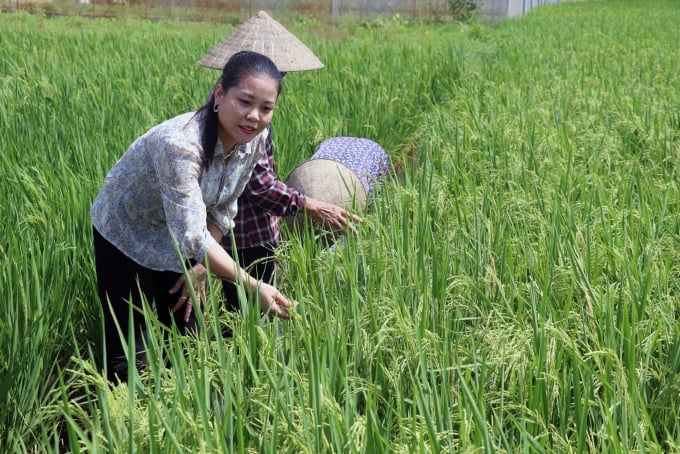
Ms. Nguyen Thi Ha, one of the top 100 outstanding Vietnamese farmers in 2023. Photo: Provided by the interviewee.
Driven by the desire to develop a new farming model, Ms. Ha bought seedling trays, obtained rice seeds, and transported soil to try it out. The first batch of seedlings sown in the trays failed; the plants didn't root. While racking her brains for a solution, she heard that someone in Thanh Hoa had succeeded. The young mother left her small child behind, packed her bags, and went to learn from them.
"The key is to mix in some hill soil and let it ferment for at least six months. The soil is only suitable when you bury an egg in it for 30 minutes and then remove it; if the egg is cooked, then the soil meets the standard," Ms. Ha said. She brought some of this standard soil from Thanh Hoa to sow rice seedlings and succeeded.
Because her family didn't own any rice fields, Ms. Ha hired neighbors from the same village for 50 kg of rice per sao (a unit of land measurement) per crop. When the stay-at-home mother brought out the trays of seedlings to plant, the villagers scolded her, calling her "crazy," because no one had ever done it like her before. However, when they saw the rice plants growing well, the fertilizer needed less, and the grains were large and shiny, they began to believe her and asked about her method.
Ms. Ha explained that sowing rice seedlings in a field or yard requires 2-2.5 kg of rice seeds per 360 m2 plot; sowing in trays only requires 1-1.5 kg. Tray seedlings quickly take root, produce strong tillers, can be transplanted by hand or machine, are convenient to care for, and the field is well-ventilated, resulting in fewer pests and diseases. Combining tray sowing and machine transplanting reduces costs by 30-40% and increases productivity by 10-12% compared to traditional methods.
Starting with 5 sao (approximately 0.5 hectares) of rented land, in the following season, Ms. Ha reported to the commune authorities and collaborated with other households to expand the tray seedling cultivation model. Initially, some households, seeing that the fields were too spacious, arbitrarily took seedlings from the trays and planted them in their own fields. "Ideally, only 8 trays of seedlings were needed per sao, but the villagers used up to 13 trays. I lost 115 million dong that harvest season," Ms. Ha recalled.
Despite incurring losses, the effectiveness of tray seedling cultivation was still good, so Ms. Ha began to gain recognition. Many households sought her cooperation. Learning from the previous season, she established clear contracts, guaranteeing the rice crop's growth, but prohibiting farmers from independently changing cultivation techniques. By 2014, she had firmly established herself by expanding the tray seedling model to 60 hectares in Hai Phong.
Just as things were looking promising, disaster struck. At the end of 2014, thousands of rice seedlings, already covered with plastic sheeting and ready to be transplanted to the fields, were hit by acid rain and a sudden cold snap. In just a few days, the green seedlings turned yellow like straw.
"I was stunned. Losses of nearly one billion dong were unavoidable, but what was more worrying was the loss of people's trust. The thought of fleeing crossed my mind at that moment," Ms. Ha shared.
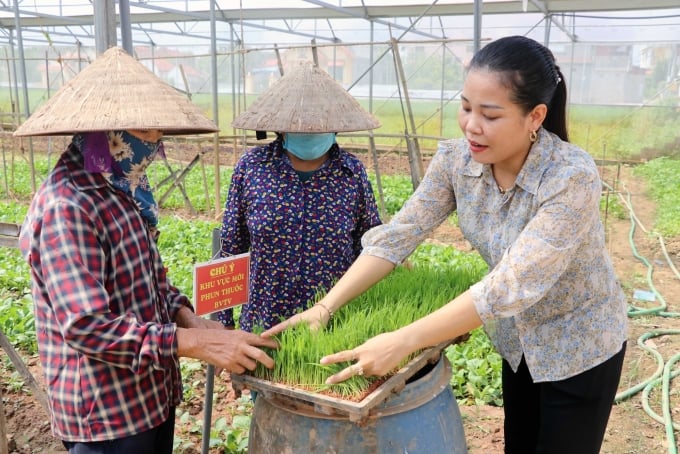
Ms. Ha instructs technical staff on sowing rice seedlings in trays. Photo: Provided by the interviewee.
Knowing that the rice seedlings could not be saved, Ms. Ha sought the help of three village chiefs to gather the villagers for a meeting to discuss a solution. Previously, she had charged the villagers 450,000 VND per sao (a unit of land measurement) for hybrid rice seeds, but now, replanting would not guarantee the planting time. She asked the villagers to replant with a short-day rice variety, guaranteeing the progress and yield, at a cost of only 250,000 VND per sao.
Ms. Ha borrowed 500 million VND at high interest rates to buy rice seeds, hire laborers, and bring machinery from Thanh Hoa to work quickly to meet the deadline. "At that time, my family was bankrupt, and my husband and I almost separated," Ms. Ha recalled. The rice fields that Ms. Ha sowed and cultivated for the villagers yielded a bountiful harvest that year.
Having overcome major challenges, she expanded her tray seedling cultivation model to Hai Phong, Thai Binh, and Hai Duong. Not only does she provide services and guarantee the purchase of output for over 1,000 hectares of rice, but she has also accumulated about 100 hectares of abandoned land to cultivate herself.
In 2017, with the support of the Thuy Huong commune government, Ms. Ha established an agricultural cooperative, investing in 10 rice transplanters, 2 harvesters, 2 seedling racks, and 10,000 seedling trays. The cooperative currently provides employment for 45 permanent workers and hundreds of seasonal workers.
Besides providing agricultural services and guaranteeing product sales for farmers, Ms. Ha encouraged a household to cultivate ST24 and ST25 rice varieties in their mud-farmed rice fields. Thanks to the application of scientific and technical methods and the use of organic fertilizers, both the mud-farmed rice and the rice thrived, yielding 80-90 kg of rice per sao (approximately 1000 square meters), and fetching prices three times higher than regular rice. In 2019, she entered the OCOP program with her mud-farmed rice and received a 3-star city-level product certification.
Currently, rice grown in fields with earthworms is sold in stores and supermarkets in more than 20 provinces and cities, with a production of about 100 tons per year. In 2022, agricultural activities brought Ms. Ha an annual revenue of about 2 billion VND, with a profit margin of 40%.
Commenting on Ms. Ha, Mr. Tran Quang Tuong, Chairman of the Hai Phong City Farmers' Association, said that this woman has a strong passion for farming. She has actively contributed to building new rural areas, applying farming models that yield high productivity and quality products, bringing outstanding economic efficiency.
Le Tan
Source link

![[Photo] General Secretary and President To Lam presides over a meeting on preparations for the review of one year of operation of the three-tiered government system.](https://vphoto.vietnam.vn/thumb/1200x675/vietnam/resource/IMAGE/2026/06/02/1780391821195_a1-bnd-4595-9717-jpg.webp)

































































Comment (0)