

According to information from the Vietnamese peacekeeping force at the UNMISS mission (Republic of South Sudan), on November 26, a 35-year-old female patient of Ghanaian nationality experienced severe lower abdominal pain after a high-intensity military physical training session involving long-distance running.
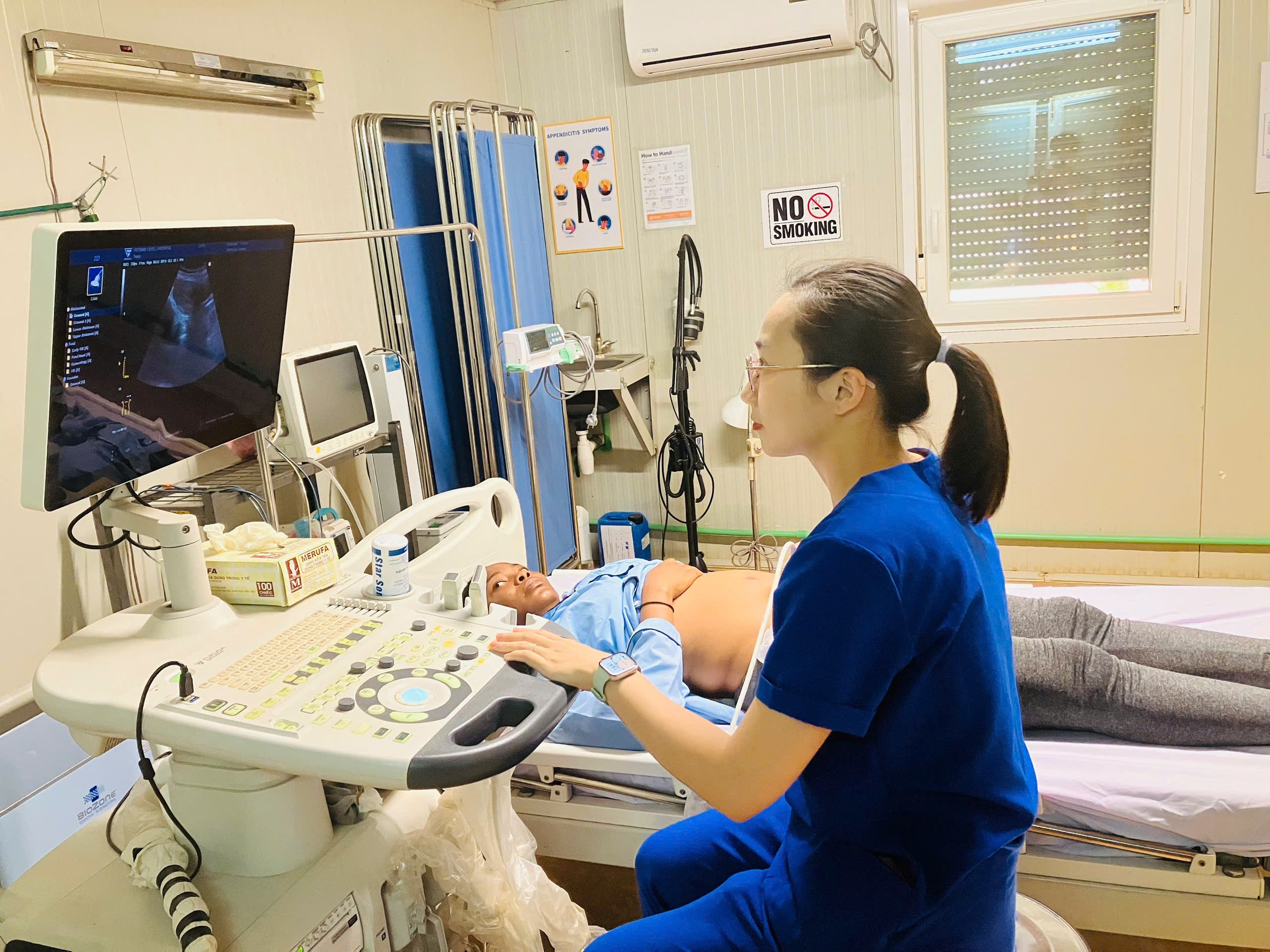
Doctors at the field hospital perform an ultrasound on a female soldier from Ghana. Photo: Field Hospital.
The patient had a history of giving birth to two children, one of whom was delivered by cesarean section, resulting in the removal of the right ovary. At Ghana Level 1 Hospital, doctors suspected ovarian cyst torsion and transferred her to Vietnam's Level 2 Field Hospital No. 6 for emergency treatment.
Upon arrival at the hospital, the patient's blood pressure had dropped significantly. Immediately, the obstetricians and gynecologists, abdominal surgeons, and gastroenterologists at the hospital held an emergency consultation and sought advice from obstetricians and gynecologists at Military Hospital 103, Military Medical Academy.
Clinical examination and laboratory tests revealed the patient had intra-abdominal hemorrhage syndrome due to rupture of a functional ovarian cyst in the left ovary. Ultrasound showed an abnormal mass in the ovary measuring 46×42 mm, with bleeding within the ovarian cyst and fluid in the cul-de-sac. Blood tests showed anemia with Hb levels as low as 108 g/L.
The on-call team promptly implemented intensive emergency measures, including intravenous fluids, hemostatic drugs, antibiotics, and anti-inflammatory medication. The patient was then transferred to the Surgical Department for further treatment and intensive care. During monitoring, at one point, hemoglobin levels dropped to as low as 97 g/L.
To avoid the risk of invasive surgery, the patient was completely immobilized, nourished intravenously, and treated medically according to the prescribed protocol. After 7 days of treatment, the patient's condition improved significantly: the abdominal pain disappeared, the ascites was gone, and the ovarian cyst decreased in size to 25×22 mm.
This patient had a history of right oophorectomy and a previous cesarean section, resulting in abdominal adhesions, which added to the surgical challenges. Furthermore, the patient expressed a desire to have more children, so the doctors prioritized preserving as much healthy ovarian tissue as possible, even when surgical intervention was necessary.
Furthermore, this female patient holds an important position in a peacekeeping unit in Ghana. This means her treatment is receiving special attention from her colleagues and fellow soldiers.
Functional ovarian cysts, or De Graaf cysts, are normal structures in the menstrual cycle that release a mature egg. However, in some cases, cyst rupture can cause bleeding into the abdominal cavity, leading to acute blood loss and even life-threatening consequences if not detected and treated promptly. This is a gynecological emergency requiring rapid diagnosis and urgent treatment.
The successful treatment of the Ghanaian female soldier is a testament to the high level of expertise and dedication of the medical team at Vietnam's Level 2 Field Hospital No. 6, contributing to strengthening international trust and friendship.























































































Comment (0)