

Transfer requirements: not just a degree.
Decision 18/2017 of the Prime Minister stipulated the conditions for students from vocational and college-level health-related fields to register for university-level bridging programs. Accordingly, those with a medical assistant diploma are eligible to register for bridging programs to university in the following fields: general medicine, traditional medicine, preventive medicine, and dentistry. Meanwhile, those with a vocational or college-level pharmacy degree are allowed to bridging to university-level pharmacy programs. University training institutions may apply entrance examination, selection based on academic records, or a combination thereof, depending on the admission regulations of the Ministry of Education and Training.
In 2025, many universities will continue to offer transfer programs in health-related fields. The range of transfer programs is quite diverse, including nursing, pharmacy, medical laboratory technology, and general medicine. Some universities offering transfer programs include Tra Vinh University, Cuu Long University, Tan Tao University, Hue University of Medicine and Pharmacy, and Can Tho University of Medicine and Pharmacy. Several colleges also offer health-related programs, such as Pham Ngoc Thach College of Medicine, Saigon College of Pharmacy, Vien Dong College, Dai Viet Saigon College, and Thai Binh College of Health Sciences.
According to regulations, admission for transfer between vocational and college levels with university level is carried out through entrance examinations, selection based on academic records, or a combination of both, as decided by the head of the higher education institution in accordance with the current regulations on university admissions of the Ministry of Education and Training.
Notably, the quality of admissions for transfer programs is tightened depending on the field and the university. Not only do they require a degree in a relevant major, but many universities also demand work experience or professional certifications in the field of study. Transfer admissions are currently conducted by universities through selection based on academic records, entrance exams, or a combination of both.
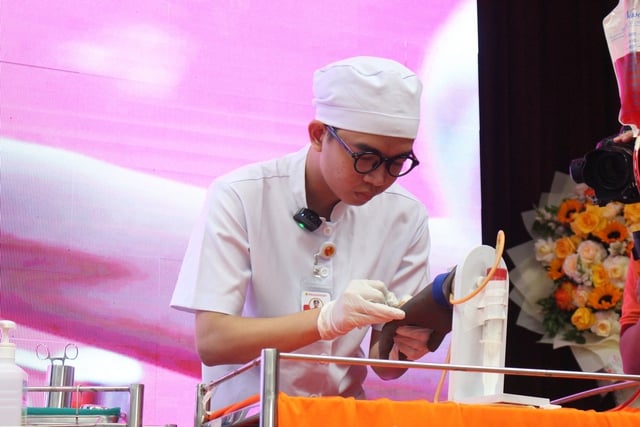
Admission requirements for university transfer programs in medicine are tightened depending on the specific field and the university.
PHOTO: YEN THI
At Cuu Long University, candidates who have graduated from vocational schools, colleges, or universities in health-related fields but whose 12th-grade academic performance is only average must have at least 5 years of relevant work experience.
The University of Medicine and Pharmacy (Hue University) requires candidates who graduated from a college-level pharmacy program with a "good" grade to have a minimum of 3 years of experience. For nursing, medical laboratory technology, and medical imaging technology programs, if candidates have an average grade in 12th grade or graduated from high school with a "good" grade, they need to accumulate 5 years of work experience before being considered for admission.
Nguyen Tat Thanh University (Ho Chi Minh City) stipulates that candidates wishing to study pharmacy must have a good academic record in 12th grade or graduate from vocational school/college/university with a good academic record and have at least 3 years of professional work experience; for nursing or laboratory science, candidates with an average academic record in 12th grade must have 5 years of experience to be eligible.
Overall, seniority requirements are considered an important factor in helping training institutions screen the practical abilities of students, while ensuring that transfer students have a solid foundation to keep up with university programs, which are more specialized and demanding.
According to Ms. Phan Thi Le Thu, Vice Principal of Vien Dong College, almost all college-level medical students have a desire to pursue higher education. General medicine and nursing are the two fields most frequently chosen by students at Vien Dong College for further studies.
Ms. Le Thu, M.A., believes that the reality of student enrollment over the years shows that the trend for students transferring from college and vocational schools is mainly to continue studying in the same field. These fields have a high demand for human resources, a clear transfer pathway, and are suitable for the abilities and time constraints of the students.
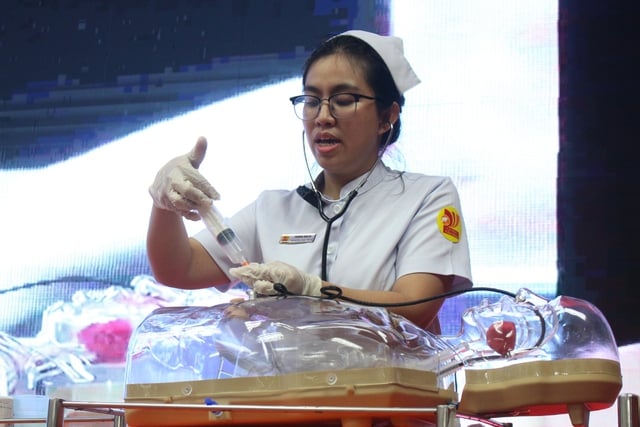
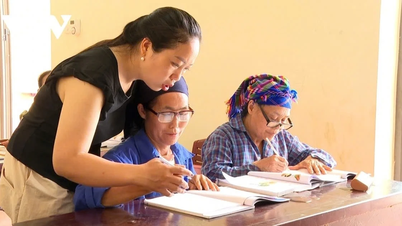
Nursing students who want to transfer to become doctors need to spend extra time studying and converting to medical assistant training.
PHOTO: YEN THI
The reality of the "shortcut" to becoming a doctor.
Among healthcare fields, the path to becoming a doctor from the vocational or college level is of particular interest. Dr. Nguyen Thanh Son, Vice Principal of Thai Binh Medical College, said that currently, medical assistant students at the vocational or college level have the opportunity to pursue further studies to become general practitioners.
According to Dr. Son, if college students graduate with excellent grades, they can continue their studies immediately after graduation, while others need work experience to be eligible to apply. Most universities base their admissions on high school transcripts and college medical student grades.
The bridging program to become a general practitioner lasts 6 years, equivalent to students who study directly from high school. Medical assistant students may be exempted from some previously completed courses; however, the total duration of the program cannot be shortened. This means that even with an advantage in foundational knowledge, bridging students still face significant pressure and a heavy workload to meet the graduation standards of the general practitioner program.
According to Master Phan Thi Le Thu, the requirement for pursuing a doctorate is that students must have a vocational or college-level medical assistant degree with a distinction or higher. "Most general medical assistant students want to pursue a doctorate because it's a 'shortcut' for them," added Ms. Thu.
For medical students, the entrance exam scores for regular university programs are very high. Therefore, when transferring from a college to a university, there are even stricter requirements, such as graduating with honors from a college-level general medical practice program. With this regulation, students are forced to strive from the beginning to achieve good academic results at the college level in order to be eligible to pursue higher education.
"In reality, many general medical students choose to work at health stations, preventive medicine centers, commune/ward health stations, or clinics after graduation to gain experience before pursuing a doctorate," Master Thu further shared.
For nursing students or those in other medical fields who want to become doctors, most must complete supplementary courses, transitioning to general medicine before transferring to a higher level program. However, due to the long study period and high pressure, only a very small number choose this path. Those who pursue a career as a doctor are usually students who have a clear career direction from the start and begin with a background in general medicine.
"This path is considered 'misguided' and is generally discouraged because students are essentially starting from scratch. The training programs for nurses and doctors are fundamentally different, from objectives and professional standards to specialized content, so it is very difficult for someone who has transitioned from nursing to becoming a doctor," added Ms. Thu.
Source: https://thanhnien.vn/lien-thong-bac-si-tu-cao-dang-con-duong-co-de-tho-185251212174531514.htm


![[Image] Close-up of the newly discovered "sacred road" at My Son Sanctuary](/_next/image?url=https%3A%2F%2Fvphoto.vietnam.vn%2Fthumb%2F1200x675%2Fvietnam%2Fresource%2FIMAGE%2F2025%2F12%2F13%2F1765587881240_ndo_br_ms5-jpg.webp&w=3840&q=75)



























































































Comment (0)