

In the context of the Fourth Industrial Revolution creating profound shifts, Vietnamese education faces the need for comprehensive reform to keep pace with the rapid development of science and technology.
On December 12th, the Ho Chi Minh City School of Educational Management organized the National Scientific Conference 2025 with the theme "Developing human resources to meet the requirements of scientific and technological development and digital transformation in educational institutions".
The event brings together scientists, administrators, and experts from both within and outside the country to exchange experiences, announce research results, and propose solutions for human resource development in the digital age.
Human resource development - the cornerstone of digital transformation.
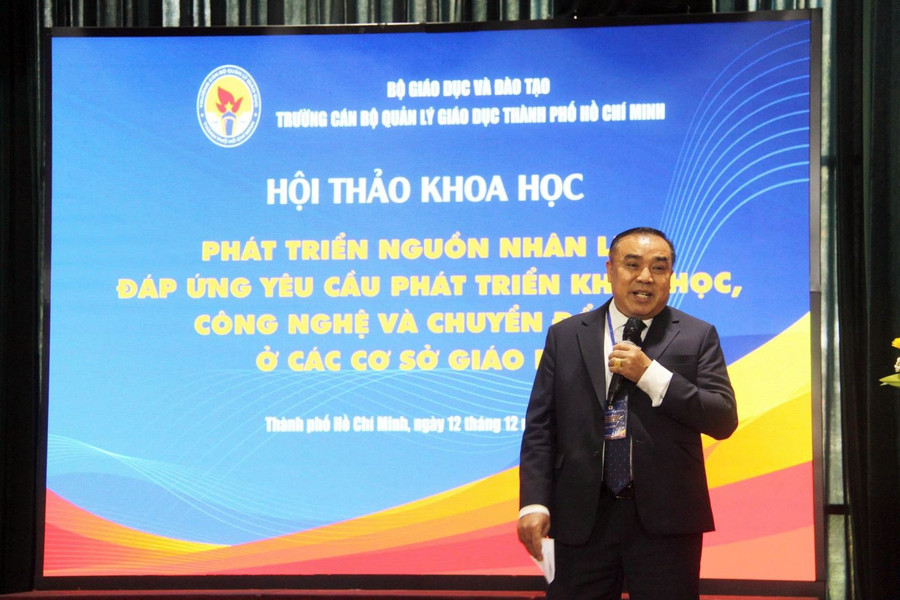
In his opening remarks, Dr. Vu Quang, Principal of the Ho Chi Minh City School of Educational Management, emphasized the need for strong innovation in management thinking and human resource training.
According to Dr. Quang, although education has seen positive changes, the digital skills of the workforce still vary significantly across regions; training activities have not kept pace with the speed of technological development; and the human resource management model in many educational institutions remains heavily bureaucratic.
The explosion of new technologies such as artificial intelligence, big data, cloud computing, the Internet of Things, blockchain technology, and especially semiconductor technology has created a historical turning point in production methods, growth models, state governance, and social governance.
"These profound changes are impacting not only industries but also presenting unprecedented challenges and opportunities for the education sector."
"Vietnamese education, in this context, faces the need for strong and comprehensive reform to meet the demands of the digital age. In this context, the task of developing high-quality educational human resources is considered a decisive factor and a cornerstone for the sustainable and effective transformation of the education system," said Dr. Quang.
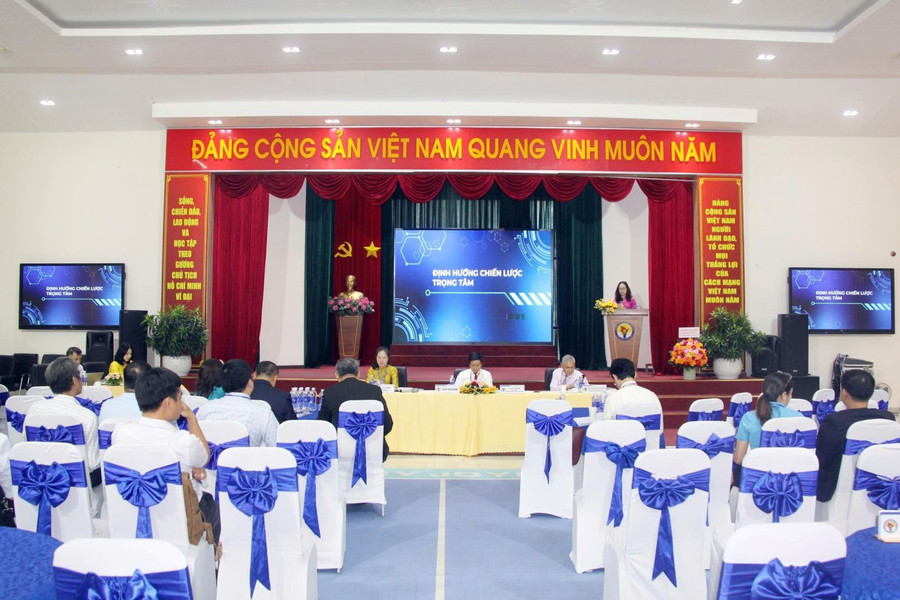
Within the framework of the conference, the organizing committee selected more than 40 papers from scientists, education administrators, and educators who are conducting research and teaching at educational institutions.
The studies presented in the proceedings also clearly reflect limitations such as a reward system that does not strongly motivate faculty; insufficient investment in scientific research; and ineffective linkages between universities, businesses, and research institutes in training high-tech human resources.
Many presentations at the conference proposed models for university-business collaboration, building a semiconductor workforce competency framework, developing internationally standardized training programs, and establishing a fund to support technology students in order to attract and nurture young talent.
Furthermore, university governance in the digital age needs to shift strongly towards a data-driven governance model, enhance autonomy, and develop a culture of innovation.
"Training and professional development must be closely linked to practical needs, the demands of the labor market, and the development of science and technology ."
"Human resource development must place people at the center of digital transformation; technology is just a tool, while the workforce is the decisive factor," Dr. Quang said.
Ensuring high-quality human resources at training institutions.
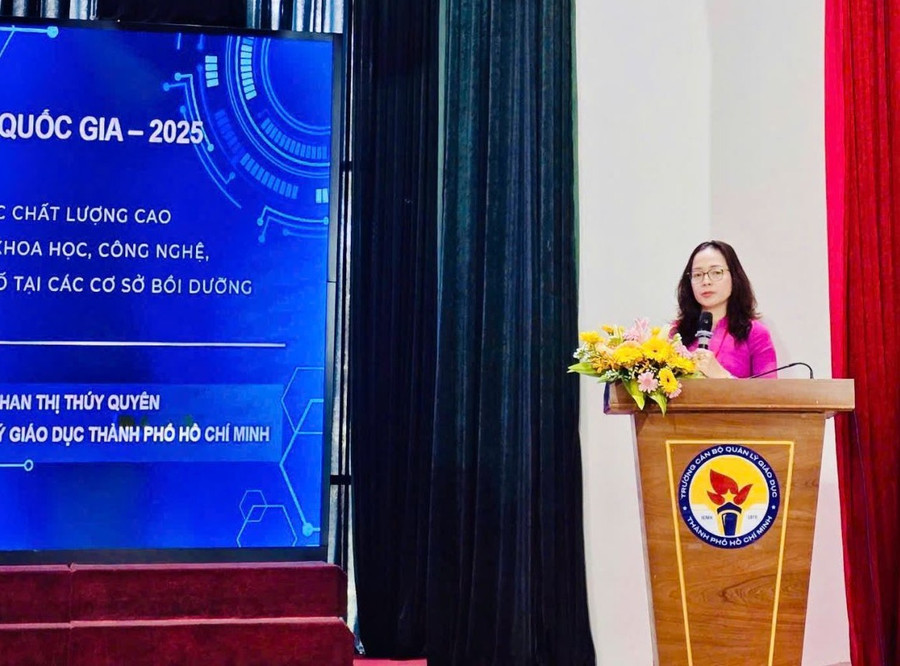
Speaking at the workshop, Dr. Phan Thi Thuy Quyen, Vice Principal of the Ho Chi Minh City School of Educational Management, provided an in-depth analysis of the role of training institutions in the modern educational ecosystem.
According to Dr. Quyen, as digital transformation and innovation become the driving force of development, training institutions are forced to shift from the function of imparting knowledge to the role of developing comprehensive capabilities for teachers and administrators.
Dr. Quyen pointed out four key competency groups that staff at training institutions need to possess: digital competency, research and development competency, innovation competency, and international integration competency.
These are essential requirements for the team to be able to design programs, apply technology, lead innovation, and participate in international collaborations.
However, in reality, many gaps still exist in digital capabilities, applied research, and innovation due to barriers related to recruitment, compensation, innovation culture, and a lack of synchronized digital infrastructure.
In particular, the rapid pace of technological change and the increasing demands for international standardization continue to put pressure on the workforce.
From there, Dr. Quyen proposed a development orientation based on a human resource ecosystem model, considering digital competence as a cross-cutting capability, innovation as an intrinsic driving force, and expanding cooperation with businesses, research institutes, and international organizations.
"Once this ecosystem is built, training facilities will create a favorable working environment, supporting staff to develop their capabilities and improve the quality of training in the context of rapidly changing education," said Dr. Quyen.
Source: https://giaoducthoidai.vn/phat-trien-nhan-luc-giao-duc-trong-thoi-dai-so-post760310.html





















































































Comment (0)