

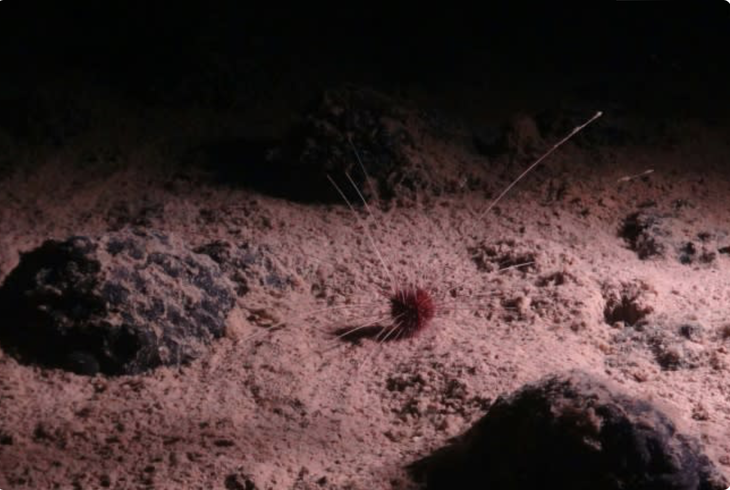
Can polymetallic nodules produce oxygen without photosynthesis? - Photo: Handout/National Oceanography Centre/Smartex project (NERC)/AFP
This finding overturned long-held theories about the origin of life on Earth. However, the study sparked heated debate. At least five peer-reviewed papers were submitted to scientific journals to verify the findings.
Scientists divided over shocking discovery
For a long time, the traditional scientific view has held that life originated approximately 2.7 billion years ago, when organisms began producing oxygen through photosynthesis – a process that requires sunlight.
However, recent research suggests that these multi-metallic nodules at the bottom of the ocean may generate an electric current strong enough to split seawater into hydrogen and oxygen, a process known as electrolysis. In other words, without the presence of sunlight, these metallic nodules in the deepest and darkest parts of the ocean can still produce oxygen.
Some scientists agree with this view, but others refute the claim that "black oxygen" is created in the dark, lightless depths of the ocean floor.
The discovery was made in the Clarion-Clipperton area, a vast underwater region in the Pacific Ocean between Mexico and Hawaii, which is attracting increasing interest from mining companies.
Here, scattered across the seabed at a depth of 4km below the surface, are clusters of polymetallic nodules containing manganese, nickel, and cobalt – metals used in electric vehicle batteries and other low-carbon technologies.
The research that led to the discovery of "black oxygen" was partly funded by a Canadian deep-sea mining company, The Metals Company, to assess the ecological impact of such exploration activities.
The company has sharply criticized marine ecologist Andrew Sweetman, the lead author of the study, alleging that the research suffers from "methodological flaws."
Fragile ecosystem
In response to the criticism, Sweetman said he was preparing a formal response. According to him, in science, debate is normal. He also acknowledged that more research is needed to verify the findings.
The deep-sea discoveries have raised questions about the origins of life on Earth, according to the Scottish Association for Marine Science. The findings also have important implications for mining companies looking to extract the precious metals contained in these polymetallic nodules.
According to environmentalists, the existence of "black oxygen" shows that humans know very little about life at extreme depths in the ocean. This strengthens their argument that deep-sea mining poses unacceptable ecological risks.
"Greenpeace has long campaigned to stop seabed mining in the Pacific Ocean because of the damage it can cause to fragile deep-sea ecosystems," the environmental organization said. "This remarkable discovery underscores the urgency of that call."
Meanwhile, Michael Clarke, environmental manager at The Metals Company, told AFP that the findings "could more reasonably be explained by poor scientific technique and superficial research, rather than being a previously unobserved phenomenon."
Many in the scientific community have also expressed skepticism or rejected Sweetman's conclusions.
"He failed to present clear evidence for his observations and hypotheses," said biochemist Matthias Haeckel at the GEOMAR Helmholtz Centre for Ocean Research in Kiel, Germany. "Many questions remain unanswered after the publication. So now the scientific community needs to conduct similar experiments and either prove or disprove it."
Meanwhile, geochemist Olivier Rouxel at Ifremer, the French National Institute for Ocean Science and Technology, told AFP that there is currently "no consensus on these results."
“Sample collection at the bottom of the sea is always a challenge,” he said, adding that it was possible that the oxygen detected was “trapped air bubbles” in the measuring devices.
Source: https://tuoitre.vn/kham-pha-chan-dong-ve-oxy-gay-chia-re-gioi-khoa-hoc-20250317172458106.htm


























![[Video] The craft of making Dong Ho folk paintings has been inscribed by UNESCO on the List of Crafts in Need of Urgent Safeguarding.](https://vphoto.vietnam.vn/thumb/402x226/vietnam/resource/IMAGE/2025/12/10/1765350246533_tranh-dong-ho-734-jpg.webp)






























































Comment (0)