

In the space race, one of the biggest obstacles isn't how to get to Mars, but how to survive and find shelter once you've landed there.
With shipping costs reaching tens of thousands of dollars per kilogram of material from Earth, the idea of bringing steel and cement to build a base is a far-fetched and economically impractical dream.
However, a new study published in the journal Frontiers in Microbiology on December 2nd has sparked new hope, not from giant machines, but from the smallest microorganisms.
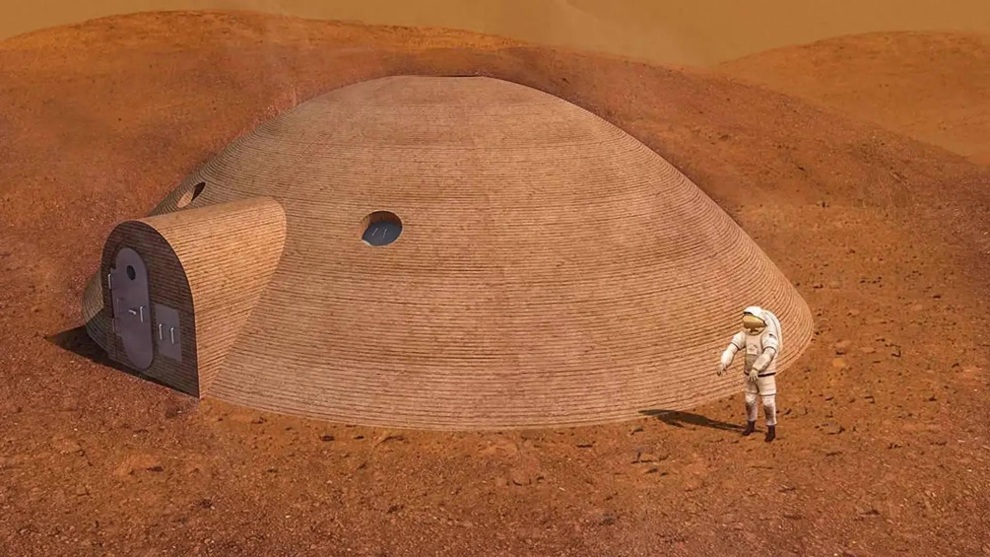
Solutions from the "little builders"
Researchers at the Polytechnic University of Milan (Italy) have proposed a bold approach: instead of bringing houses from Earth, let the houses "grow" from the barren soil of Mars.
This technology is called "biocement," based on the principle of biomineralization—a natural process that has built the Earth's magnificent coral reefs over billions of years.
By utilizing in-situ resource utilization (ISRU), scientists aim to transform the loose, dusty regolith soil of the red planet into a solid material with properties similar to concrete.
This is considered the most viable path to creating sustainable infrastructure that can withstand the harsh environment of high radiation and low pressure in this area.
The perfect duo: Supplier and creator
At the heart of this technology is the symbiotic partnership between two special types of bacteria, carefully selected to face the harsh environment of Mars.
First is Chroococcidiopsis , a type of cyanobacteria dubbed the "great survivor." Belonging to the group of extreme microorganisms, this species is capable of withstanding intense ultraviolet radiation and arid conditions.
Its role is not only about survival but also about being a "lifeline" for the entire system: it photosynthesizes to release oxygen and secretes protective mucus, creating a favorable environment for its teammates.
That teammate is Sporosarcina pasteurii , which acts as a "construction engineer." This bacterium is capable of secreting a special enzyme that stimulates the precipitation of calcium carbonate. This substance acts as a natural glue, binding loose Martian dust and rock particles together, solidifying them into sturdy building materials.

Towards a closed ecosystem
What makes this research particularly fascinating is not only its construction aspect, but also its potential to create a circular ecosystem. The processes of these two types of bacteria produce invaluable byproducts for human life.
Oxygen produced by Chroococcidiopsis can be recovered to supply the astronauts' life support systems. Meanwhile, ammonia—a byproduct of Sporosarcina pasteurii 's metabolism—is an excellent fertilizer for agricultural systems on Mars.
Despite the immense potential, the research team still faces challenges. In fact, they haven't yet been able to test this technology on actual Martian soil samples.
However, with these advances, humanity is gradually realizing its dream of settling in space by learning from the oldest survival skills of life on Earth.
Source: https://dantri.com.vn/khoa-hoc/vi-khuan-la-chia-khoa-giup-xay-dung-can-cu-dia-dau-tien-tren-sao-hoa-20251210180312670.htm













![[Video] Application of Biofloc technology in building an industrial-scale shrimp farming model](https://vphoto.vietnam.vn/thumb/402x226/vietnam/resource/IMAGE/2025/12/11/1765415061532_1765268925610-jpg.webp)

















![[Video] The craft of making Dong Ho folk paintings has been inscribed by UNESCO on the List of Crafts in Need of Urgent Safeguarding.](https://vphoto.vietnam.vn/thumb/402x226/vietnam/resource/IMAGE/2025/12/10/1765350246533_tranh-dong-ho-734-jpg.webp)





























































Comment (0)