

(NLĐO) - An archaeological treasure that could reshape human history has been found deep within the equatorial rainforests of Africa.
At the Río Campo site hidden deep in the jungles of Equatorial Guinea, scientists have found a large archaeological treasure trove, the world's oldest evidence of organized human habitation in an equatorial rainforest environment.
The finds include 418 stone tools. Given their role at the time they were made, how they were made, their dating back up to 40,000 years, and the groundbreaking information they provide, it is an unparalleled find.
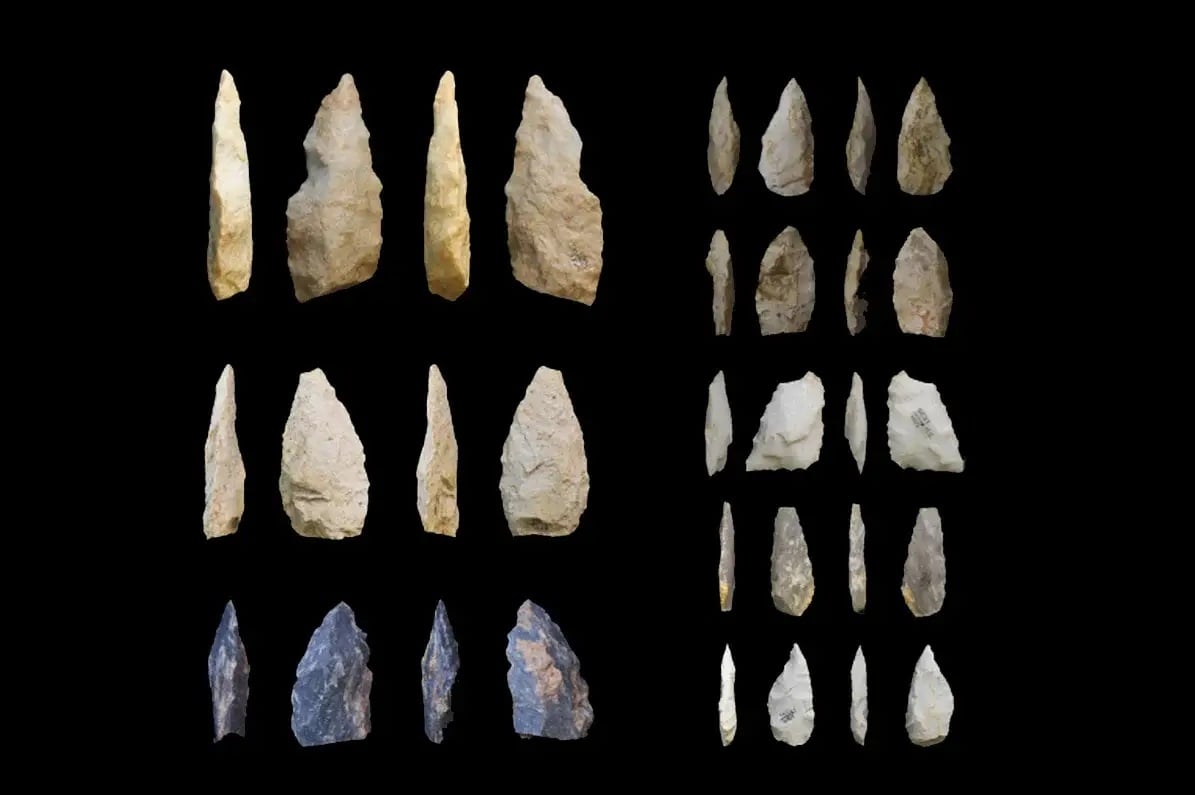
Some stone tools from the archaeological treasure trove recently excavated in Equatorial Guinea - Photo: IPHES-CERCA
According to Heritage Daily, studies on human evolution have often focused on the arid and semi-arid regions of Africa.
However, recent discoveries suggest that prehistoric tribes existed in places that were previously thought uninhabitable.
Their "superhuman" ability to cope with harsh nature is actually their ability to create technology "ahead of its time", according to a team of authors from MCNN-CSIC and IPHES-CERCA in Spain.
MCNN-CSIC and IPHES-CERCA are a research consortium comprising the National Museum of Natural Sciences, the National Council for Scientific Research, the Institute of Archaeology and Human Social Evolution of Catalonia, and the Association of Research Centers of Catalonia.
They examined 30 outcrops in the Río Campo area, of which 16 yielded the 418 stone tools mentioned above.
Using radiocarbon dating and optically stimulated luminescence (OSL), they determined the tools dated between 76,000 and 20,000 years ago.
Despite their antiquity, they are considered highly sophisticated, reflecting advanced craftsmanship and adaptive cultural strategies.
It was this remarkable ability to invent tools that helped their owners navigate dense vegetation, extreme temperatures, and unpredictable resources to survive.
Professor Antonio Rosas, lead author of the study published in the journal Quaternary Science Reviews , said the archaeological treasure has transformed humanity's understanding of how our ancestors adapted to different environments.
“With the results from Rio Campo, we expand the map of prehistoric human behavior and place Central Africa as a fundamental part of the cultural and biological evolution of our species,” added Professor Rosas.
The discovery also shows that tropical forests – even in equatorial regions – were essential settings in the evolutionary history of modern humans, despite a range of adverse conditions.
This not only rewrites an important chapter of human history, but also helps explain why we, Homo sapiens, have survived on the planet to this day, while other human species have become extinct one after another.
Source: https://nld.com.vn/kho-bau-76000-tuoi-tiet-lo-ve-bo-toc-sieu-nhan-196250115113501982.htm















![[Video] AI application for early detection of common diseases on cassava plants](https://vphoto.vietnam.vn/thumb/402x226/vietnam/resource/IMAGE/2025/12/10/1765328634749_avatar-of-video-1038119-png.webp)














![[Photo] Urgently help people soon have a place to live and stabilize their lives](/_next/image?url=https%3A%2F%2Fvphoto.vietnam.vn%2Fthumb%2F1200x675%2Fvietnam%2Fresource%2FIMAGE%2F2025%2F12%2F09%2F1765248230297_c-jpg.webp&w=3840&q=75)
































































Comment (0)