

Institutional leverage for knowledge-based agriculture
In the context of the world shifting towards a green and circular economy , Vietnamese agriculture cannot remain merely a "support" for social welfare, but must become a modern economic sector with high productivity and added value.
The Politburo 's issuance of Resolution 57 on breakthroughs in national science, technology, innovation, and digital transformation, along with Resolution 71 on breakthroughs in education and training, has created an important institutional framework for agriculture to make a breakthrough. These two resolutions clearly affirm that to elevate agriculture, it must be pursued through science and technology and high-quality human resources.
In that spirit, the Ministry of Agriculture and Environment identifies science, technology, and innovation as one of the pillars of the sector's strategy. Science and technology programs are reviewed and adjusted to closely follow practical requirements, prioritizing high-tech fields, smart agriculture, digital agriculture, low-carbon agriculture, industrial aquaculture, deep processing, and market development.
Given the shrinking arable land and the complexities of climate change, achieving a growth target of around 4% for agriculture cannot rely on expanding cultivated area, but can only be achieved through large-scale application of science and technology, from seeds and cultivation to processing and commercialization.
Research achievements: from numbers to production practice
According to the Department of Science, Technology and Environment (Ministry of Agriculture and Environment), in the period 2021-2025, the industry's research system has produced significant results: hundreds of new varieties of crops, livestock, aquatic products, and forestry products have been recognized; many technical advancements, inventions, and useful solutions have been protected; and the number of international scientific publications has increased sharply compared to the previous period.
In particular, approximately 1,000 high-tech production models have been implemented in practice, helping to increase efficiency by 10-30% depending on the sector. This is clear evidence that science and technology are not just on paper, but are entering the fields, farms, fish ponds, and factories.
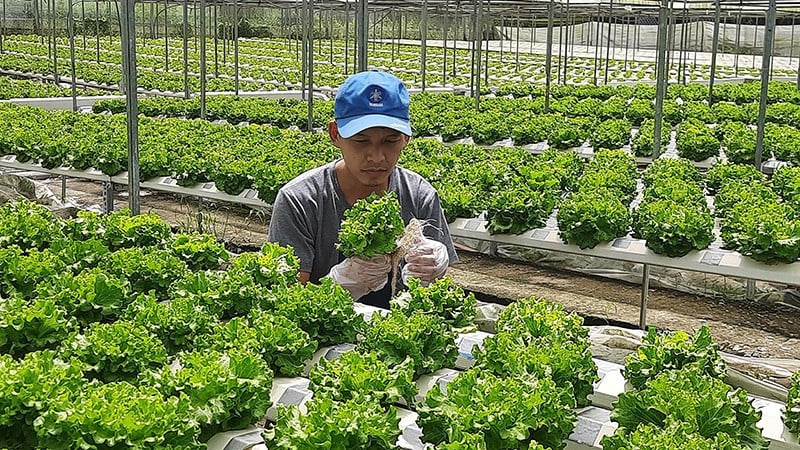
From precision irrigation and fertilization systems; smart greenhouses and polytunnels; recirculating aquaculture models; data-driven pest management processes… to deep processing lines, extended shelf life preservation technologies, and traceability, scientific and technological solutions have helped farmers and businesses reduce costs, increase productivity, and meet the increasingly high quality standards of the market.
As a result, Vietnamese agriculture, which was once self-sufficient in food, has risen to become one of the leading agricultural exporting countries, with its structure increasingly shifting from "selling raw materials" to processed products and products with high technological content and added value.
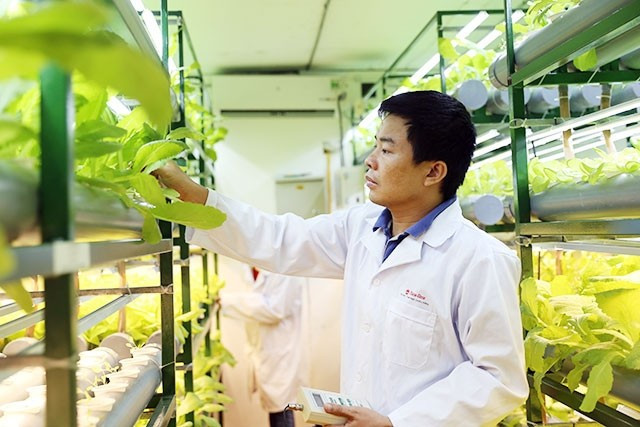
Within this overall picture, the Vietnam Academy of Agriculture is one of the outstanding research and training centers. With a large team of professors, associate professors, and doctors; a system of standard-compliant laboratories; numerous practical models and modern research and analysis equipment, the Academy plays a crucial role in creating new varieties, technical processes, biological products, and technological solutions for agriculture and the environment.
Through channels such as VNUA Tech-Mart, the AgroMart technology exchange platform, and a network of partner businesses, many research results have been successfully transferred, shortening the distance from the laboratory to production.
Innovation ecosystem for green growth
Entering a new phase, the requirement is not just to "have more topics and projects," but to build a synchronized innovation ecosystem in which the State creates policies, research institutions create knowledge and train human resources, and businesses play a central role in the application and commercialization of technology. The agricultural sector has been developing strong research groups in big data, artificial intelligence, digital agriculture, molecular biology, IoT, automation, etc., applying them to breeding, pest and disease forecasting, nutrient management, water-saving irrigation, environmental monitoring, traceability, and market analysis.
The concepts of precision agriculture, digital agriculture, low-carbon agriculture, circular agriculture, and industrial aquaculture are gradually becoming a reality through specific projects and models.
Furthermore, mechanisms and policies are being improved to remove barriers to research and technology transfer. Science and technology programs are being redesigned based on practical solutions; the ordering and assignment mechanisms are linked to the needs of businesses; and scientists' rights regarding research results are given greater importance, encouraging them to pursue their research to the final product.
Digital transformation is being accelerated in industry management: building databases on land, seeds, growing areas, and farming areas; digital maps of production areas; disaster and disease warning systems; and platforms for traceability and supply-demand connectivity, thereby effectively supporting farmers, cooperatives, and businesses.
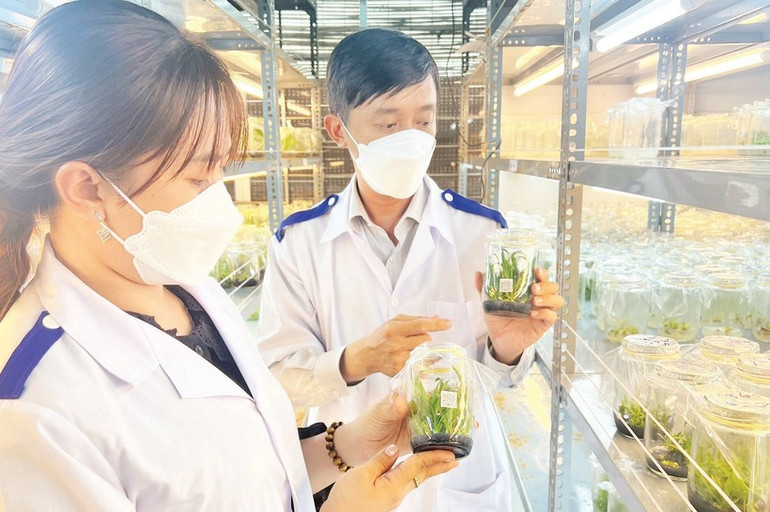
When science and technology are truly placed at the center, education and training are prioritized, and the innovation ecosystem is perfected, the path from the laboratory to the field, factory, and market will become increasingly shorter.
That is the key for Vietnamese agriculture to enter a new phase of development: modern, green, circular, high value-added, and making a worthy contribution to the goal of building a prosperous and happy country.
Source: https://nhandan.vn/khoa-hoc-nong-nghiep-tu-phong-thi-nghiem-den-ruong-dong-post930137.html












































































Comment (0)